
Delhi Government Announces Compensation for Construction Workers Amid Pollution Crisis
Compensation for Affected Workers
On Wednesday, December 17, 2025, Delhi's Labor Minister Kapil Mishra announced a compensation of ₹10,000 for construction workers who lost their jobs due to the implementation of GRAP III and GRAP IV measures aimed at combating pollution. The minister emphasized that all government and private institutions must enforce a work-from-home policy for 50% of their staff starting Thursday, December 18, or face penalties. During a press conference, Mishra noted that GRAP III had been in effect for 16 days, and workers impacted by restricted activities would receive the compensation.
Two Major Initiatives Announced
The first initiative involves direct financial assistance for all registered and verified construction workers whose livelihoods have been affected by the halt in construction activities. The ₹10,000 will be transferred directly to their bank accounts through a direct benefit transfer system.
Secondly, the government has mandated that all government and private offices in Delhi implement a work-from-home policy for 50% of their workforce. This measure aims to reduce pollution caused by vehicles and protect citizens from hazardous air quality. However, essential services such as healthcare and other critical sectors are exempt from this directive.
Flexible Working Hours Implemented
Offices have also been instructed to adopt flexible working hours. Essential services, including prisons, healthcare, public transport, electricity, and other critical departments, are not subject to these restrictions.
Measures to Combat Toxic Air Pollution
These decisions are part of the Delhi government's broader strategy to reduce pollution while ensuring that vulnerable segments of the workforce receive economic and social support. Construction activities were halted for 16 days under GRAP Stage 3 restrictions. Compensation related to GRAP Stage 4 will be assessed after the restrictions are lifted.
Officials have stated that the registration portal will remain open, allowing more construction workers to register and qualify for relief.
Delhi's Air Quality Remains Poor
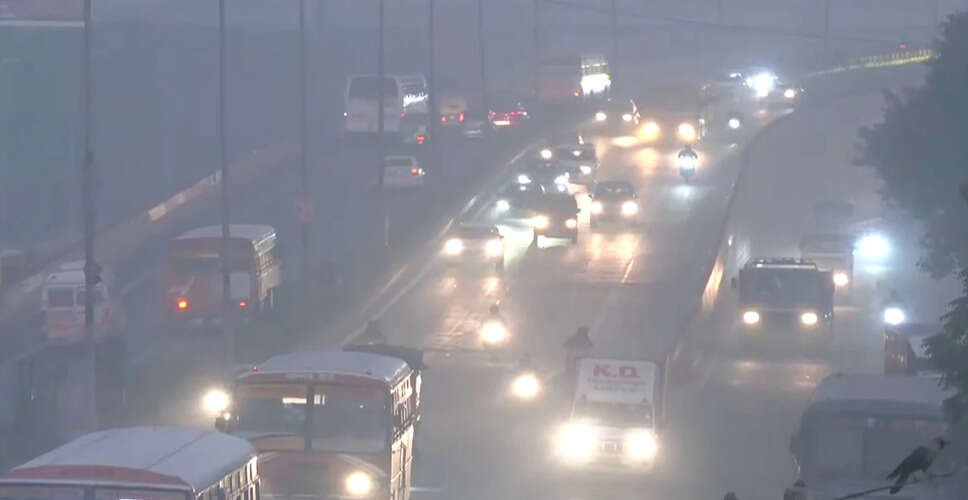
This announcement comes at a time when Delhi's air quality showed slight improvement on Wednesday morning, with an AQI of 328 recorded, still categorized as 'very poor.' Large parts of the city were shrouded in dense fog, reducing visibility during the early hours. AQI readings are classified as follows: 0 to 50 is 'good,' 51 to 100 is 'satisfactory,' 101 to 200 is 'moderate,' 201 to 300 is 'poor,' 301 to 400 is 'very poor,' and 401 to 500 is 'severe.'