
India Welcomes New Chief of Defence Staff and Naval Chief

Leadership Transition in Indian Armed Forces
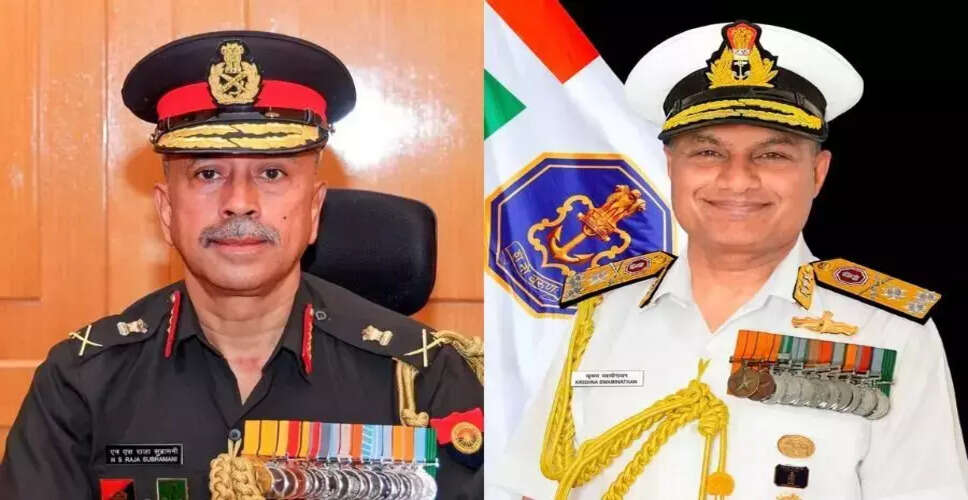
File image of India's new CDS Lt Gen NS Raja Subramani (left) and Navy chief Admiral Krishna Swaminathan (Photo: PTI)
New Delhi, May 31: General N.S. Raja Subramani has officially taken over as India’s new Chief of Defence Staff (CDS), while Admiral Krishna Swaminathan has assumed the role of the 27th Chief of the Naval Staff (CNS) on Sunday, marking a pivotal change in the nation's military leadership.
Upon taking office, Gen Subramani shared his vision, highlighting the need for military transformation, enhanced collaboration among the three branches of the armed forces, and the swift adoption of homegrown defence technologies.
“It is a privilege to take on the responsibilities of Chief of Defence Staff. We appreciate the trust placed in our Armed Forces by the nation. The Indian Army, Navy, Air Force, Ministry of Defence, strategic institutions, and all partners are united in a comprehensive approach to bolster India’s security,” he stated.
The CDS reaffirmed the armed forces' dedication to Prime Minister Narendra Modi’s vision encapsulated in “JAI,” which stands for Jointness, Atmanirbharta, and Innovation.
He further emphasized that his primary focus would be on organizational reforms aimed at improving synergy and integration among the three services.
Earlier in the day, Gen Subramani honored fallen soldiers by laying a wreath at the National War Memorial and received a Guard of Honour at the South Block lawns.
He succeeds Gen Anil Chauhan, who concluded his term as the country’s highest-ranking military officer on Saturday.
A graduate of both the National Defence Academy and the Indian Military Academy, Gen Subramani previously held the position of Vice Chief of the Army Staff and served as a Military Adviser at the National Security Council Secretariat.
His notable career includes commanding counter-insurgency operations in Assam during Operation Rhino and holding various significant operational, intelligence, and instructional roles.
On the naval side, Admiral Krishna Swaminathan has officially taken command of the Indian Navy from Admiral Dinesh K. Tripathi.
In a press briefing after his appointment, Admiral Swaminathan stated that the Indian Navy remains alert in the face of a complex and unpredictable regional security landscape.
“The Indian Navy is committed to protecting the nation’s interests and is actively engaged in a regional security environment that is increasingly challenging and uncertain,” he remarked.
He underscored the Navy’s ongoing modernization initiatives, stating that his top priority would be to ensure the highest levels of operational readiness and combat effectiveness.
“The Navy is on a path of capability enhancement and modernization. My primary focus will be to guarantee that the Navy remains operationally ready and effective in safeguarding India’s security and economic interests,” Admiral Swaminathan added.
Referring to Operation Sindoor and Operation Urja Suraksha, Admiral Tripathi noted that the Navy's professionalism and commitment have been evident amid evolving regional security challenges, including the current situation in West Asia.
Both appointments were announced by the government earlier this month. Gen Subramani was appointed as the next Chief of Defence Staff following Gen Chauhan’s retirement, while Admiral Swaminathan, who was serving as the Vice Chief of the Naval Staff, was named to succeed Admiral Dinesh K. Tripathi as the Chief of the Naval Staff.
As the senior-most military officer and principal military adviser to the government, the CDS is responsible for fostering joint operations among the Army, Navy, and Air Force, as well as implementing key reforms such as military theatre commands.
Meanwhile, the Chief of the Naval Staff oversees the Indian Navy, ensuring maritime security, operational readiness, and force modernization.