
Evolving Warfare: Insights from CDS General N.S. Raja Subramani

Modern Warfare and National Security Challenges
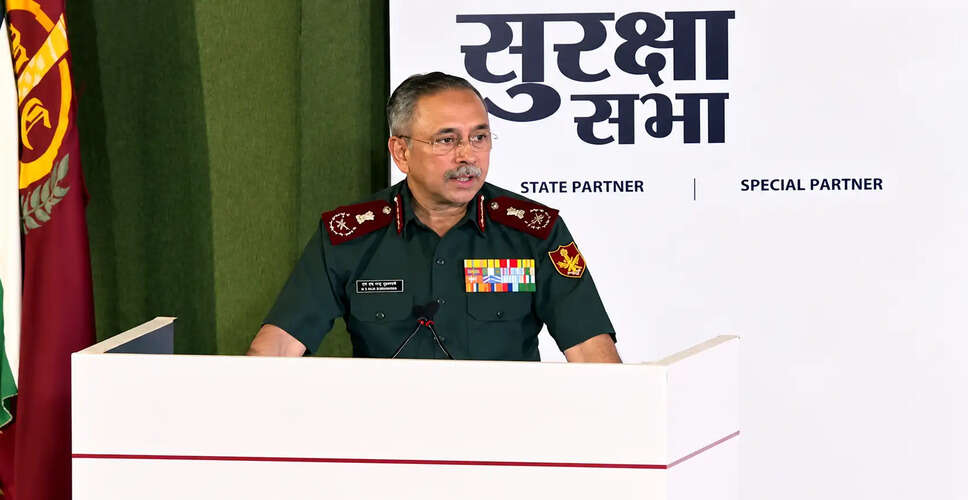
During a significant address at a security conference, Chief of Defence Staff (CDS) General N.S. Raja Subramani discussed the evolving landscape of warfare and the new challenges facing national security. He emphasized that contemporary conflicts are no longer confined to traditional battlefields, as domains such as cyber, space, electronic warfare, and information have become crucial for security.
Emphasis on Multi-Domain Operations
The CDS highlighted the necessity of integrating various military branches in future conflicts. He stated that mere coordination among the three armed forces is insufficient; there is a pressing need to advance towards multi-domain integration.
The Ministry of Defence has also been focusing on preparing for multi-domain conflicts, enhancing the integration of the three services, and strengthening technological capabilities in recent initiatives.
Changing Nature of Warfare
According to the CDS, the traditional line between peace and war is rapidly blurring in the modern era. Factors such as economic pressures, cyber activities, information campaigns, and technological competition can significantly impact national security.
This indicates that a nation's security cannot solely rely on troop presence at borders; safeguarding technological capabilities, networks, information, and critical infrastructure is equally vital.
The Growing Role of AI and Data
General Subramani also stressed the increasing importance of artificial intelligence and data-driven decision-making in modern battlefields. He pointed out that the challenge lies not in the lack of information but in the ability to identify and act on the right information promptly.
The Defence Ministry's Future Warfare Course has identified AI, cyber capabilities, autonomous systems, information warfare, space technology, and data-driven decision processes as essential components for future conflicts.
Reducing Time from Sensors to Decisions
The CDS noted the rising transparency in warfare, attributing it to surveillance technologies, sensors, and networks that rapidly disseminate information about events. In such an environment, the side with superior information, robust networks, and quick decision-making capabilities will gain a strategic advantage.
He emphasized that the significance of technology lies not just in long-range observation but in understanding and effectively utilizing the available information.
Need for Enhanced Coordination Among Armed Forces
The CDS identified jointness as a crucial aspect of future military preparedness. He asserted that land, sea, air, space, and cyber domains cannot be viewed in isolation.
In India, training and strategic discussions regarding multi-domain operations are already underway. The 'Ran Samvad' event in April 2026 also emphasized the need for better coordination among physical, synthetic, and cognitive domains, along with rapid decision-making in AI-driven battlefields.
Self-Reliance and Strong Logistics Are Essential
The CDS linked technological self-reliance and national resilience to security preparedness. He noted that a country's capacity during prolonged crises is influenced not only by weapons or military platforms but also by its supply chains, industrial capabilities, maintenance, and production capacities.
Promoting self-reliance in the defence sector aims to reduce external dependencies for critical equipment and supply chains.
National Security Is a Collective Responsibility
In his address, the CDS described national security as a broad responsibility, emphasizing the roles of government, industry, the tech sector, academic institutions, and society.
He stated that India needs preparations that integrate traditional military capabilities with new technologies and domains in the changing security environment.
Preparing for Future Conflicts
The core message of the CDS's address was that future conflicts are likely to be more complex and multi-faceted than before. Therefore, coordinated preparations across land, sea, air, cyber, space, electronic, and information domains are essential.
For India, the challenge lies not only in adopting new technologies but also in integrating the three armed forces, industries, technical institutions, and other national resources into a comprehensive security framework.