
Delhi Forest Department Advocates for Mechanical Elephants in Religious Events

Advisory for Religious Institutions
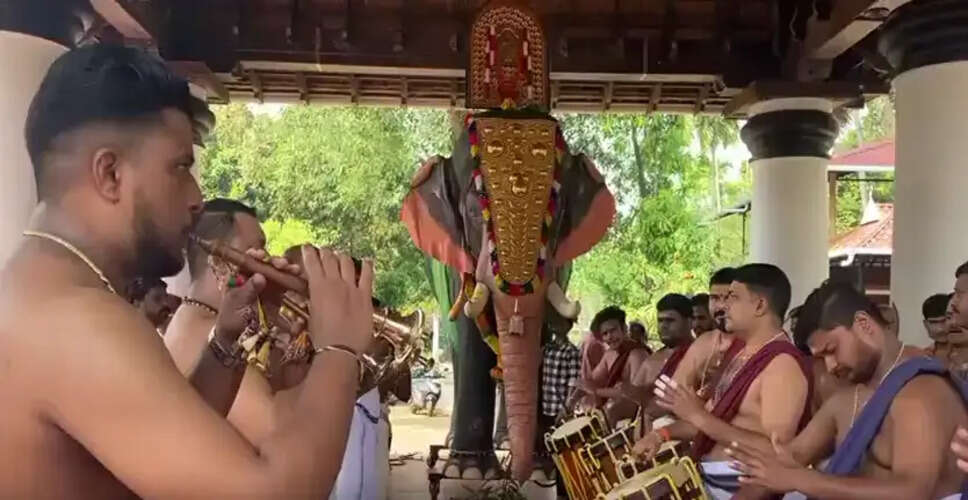
A religious ceremony held at Kombara Sreekrishna Swami Temple with a mechanical elephant in Kerala (Photo: 'X')
New Delhi, Sept 21: The Forest Department of Delhi has issued a recommendation urging religious organizations, temple committees, and event planners to opt for mechanical (robotic) elephants instead of live ones during festivals and religious ceremonies, emphasizing concerns for animal welfare and public safety.
This advisory comes in response to a request from PETA India, which pointed out the difficulties associated with transporting captive elephants from various regions to densely populated urban settings for such events, as stated by the organization.
The department has encouraged devotees and event organizers to consider mechanical elephants as a viable substitute for live animals during processions and cultural gatherings.
PETA India has expressed support for this advisory, viewing it as a significant move towards safeguarding both elephants and participants. Vikram Chandravanshi, a senior policy and legal advisor at PETA India, remarked, “The advisory from the Delhi Forest Department is a compassionate and progressive measure that benefits both elephants and devotees.”
The organization has also called upon the Union Ministry of Environment, Forest and Climate Change to promote the adoption of robotic elephants in temples and for various activities, including film shoots, weddings, and tourist attractions.
PETA India highlighted that captive elephants used in events often endure severe training practices, including physical punishment and confinement. Many elephants in temples reportedly suffer from foot ailments, leg injuries, insufficient veterinary care, and lack of natural habitats.
According to data from the Heritage Animal Task Force, captive elephants were responsible for 526 human fatalities in Kerala over a span of 15 years.
The organization has advocated for a nationwide prohibition on elephant rides, bathing experiences, selfies, and other close-contact tourist activities involving captive elephants, citing numerous incidents of danger to both humans and elephants.
Notable incidents include the death of a tourist and an elephant during a bathing session at Karnataka’s Dubare Elephant Camp, as well as a fatal attack on a mahout by a captive elephant at Dudhwa Tiger Reserve in Uttar Pradesh.
PETA India noted that mechanical elephants, which can imitate the movements of real elephants, present a suitable alternative for cultural and religious events. These robotic models feature moving eyes, ears, tails, and trunks, and are mounted on wheeled bases.
Such mechanical elephants are already in use at various temples across India. Kerala Tourism has launched a mechanical elephant safari at Thamboormozhi Butterfly Park, which received PETA India’s Golden Elephant Protection Award in April 2026.
Additionally, mechanical elephants have been utilized at weddings, political rallies, and in advertisements.
PETA India also mentioned other initiatives aimed at reducing dependence on captive elephants, such as the introduction of a robotic elephant by the Telangana Forest Department in June 2026 and Karnataka’s endorsement of mechanical elephants in government temples in September 2024.
There has been a noted decline in elephant rides at Amer Fort, alongside international efforts to limit activities involving captive elephants.
PETA India believes that the advisory from Delhi could play a crucial role in broader initiatives to protect elephants while still allowing for the continuation of religious and cultural traditions.