
Assam Government Updates on Scheduled Tribe Status for Six Communities

Update on Scheduled Tribe Status Proposal
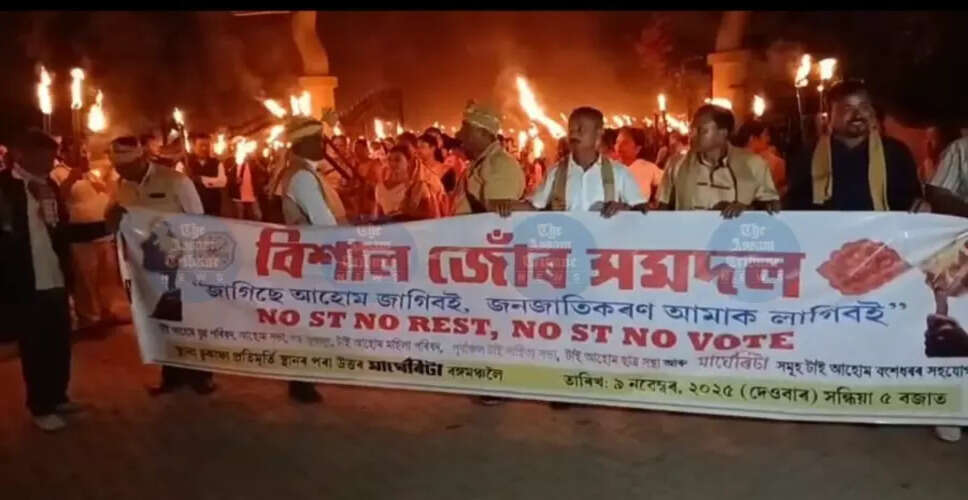
File image of a protest march taken out by Tai Ahom community in Margherita demanding ST status. (AT Image)
Guwahati, July 29: The Assam Legislative Assembly was informed on Wednesday that the proposal for granting Scheduled Tribe (ST) status to six communities is currently with the Central government, following the completion of all necessary formalities by the State.
This matter was brought up during the Budget Session's 14th day by Rupan Chandra Roy, an MLA from the Bodoland People's Front (BPF), who urged the government to expedite the long-standing demand for constitutional recognition.
Roy emphasized that the Koch Rajbongshi community, along with five others (Moran, Matak, Tea Tribes/Adivasis, Tai Ahom, and Chutia), has been advocating for ST status to enhance their socio-economic conditions and safeguard their identities.
He stated, "Their goal is to achieve better opportunities, maintain their identity, and uplift their socio-economic status. Any delay diminishes their hopes. The government must ensure the process is completed swiftly."
In response, Tribal Affairs Minister Ranoj Pegu explained that the responsibility now largely lies with the Central government, as the inclusion of communities in the Scheduled Tribe list is regulated by Article 342 of the Constitution.
"The State has fulfilled its duty by sending the proposals to the Centre. The Registrar General of India and the Union government are currently reviewing the matter. A Bill must be introduced and passed in Parliament for these communities to be added to the Scheduled Tribe list," Pegu clarified.
He noted that the Centre has requested further clarifications from the State regarding how ST status could be granted without negatively impacting existing communities.
"The Centre has asked us to outline the process of granting ST status without compromising the interests of current communities. They also want to understand the implications for reservations, as these six communities are presently categorized under Other Backward Classes, which receive a 27% reservation. The effects on the OBC quota must be assessed if these communities transition to the ST list," he added.
Pegu mentioned that the State government has submitted the necessary memorandum and is now waiting for a decision from the Centre.
He also highlighted that the evaluation includes looking into the status of similarly situated communities across various regions of the State.
"In certain areas of Barak Valley, some groups are recognized as communities but do not hold ST status. Similar situations exist in Karbi Anglong and other areas, which need careful consideration before a final decision is made," he stated.
Addressing the constitutional complexities, Pegu referenced the Mising community, noting, "While we are commonly referred to as Mising, constitutional documentation still requires the use of 'Miri' for obtaining ST certificates. Such legal and constitutional matters must be handled with care during this process."
The minister also informed the Assembly that a Cabinet Sub-Committee has been formed to explore various issues related to the proposed inclusion of the six communities in the Scheduled Tribe list while awaiting the Centre's decision.