
Debate Intensifies Over Taj Mahal's Historical Identity in Court
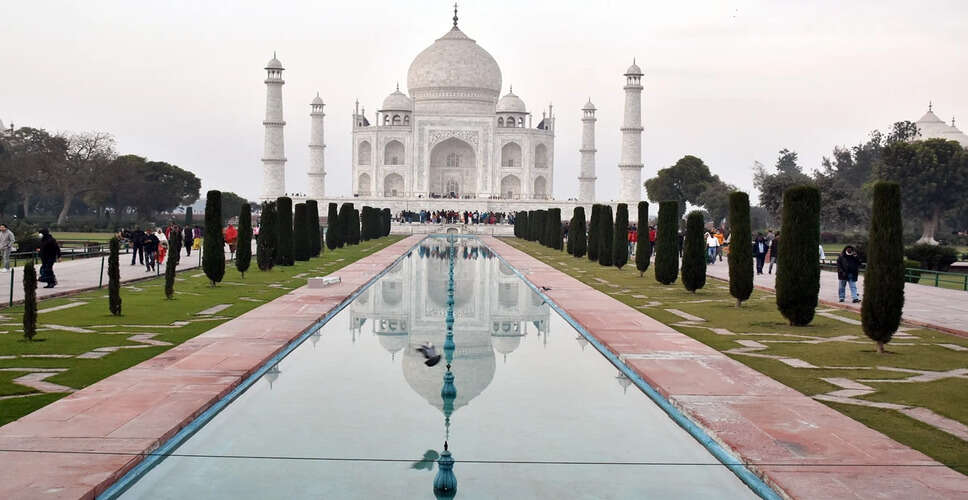

Renewed Legal Dispute Surrounding the Taj Mahal
The discussion regarding the Taj Mahal has reignited in court once again. A petition filed in the Allahabad High Court has brought back an old controversy, asserting that the Taj Mahal is actually an ancient Shiva temple known as 'Tejo Mahalay.' Amidst this ongoing dispute, a pressing question arises: why is there such resistance to a survey? If the claims are unfounded, what is the fear of scientific and historical scrutiny? Conversely, if the claims hold validity, the truth will inevitably surface in court. So, why the hesitation in conducting a survey?
Background of the Controversy
This issue traces back to a case filed in 2015 in Agra's civil court, which claimed that the Taj Mahal was originally a temple dedicated to Lord Shiva. The petitioners include individuals such as Advocate Harishankar Jain and Ranjana Agnihotri, who argue that this structure predates the Mughal era and was constructed by King Paramardi Dev in 1212. They assert that it was later under the control of Raja Man Singh and then Jai Singh, before Shah Jahan transformed it into a mausoleum for Mumtaz Mahal.
Request for a Survey
The petition also highlights that several sections of the Taj Mahal complex remain inaccessible to the public, and these areas require urgent examination. In 2019, a request was made to the court to appoint an advocate commissioner to conduct a survey of the Taj Mahal, capture photographs, and create video documentation to investigate the true nature of the structure.
Court's Response
However, the Agra civil court rejected this request, stating that the petitioners failed to provide sufficient documentation regarding the disputed property, and there were inconsistencies in the property details. Subsequently, a revision petition filed before the additional district judge was also dismissed on the grounds that it was not worthy of consideration. This matter has now escalated to the Allahabad High Court.
Current Developments
On Monday, Justice Rohit Ranjan Agarwal's court sought responses from the central government and the Archaeological Survey of India. The court has also instructed the respondents to file a counter-affidavit. The petitioners argue that not only was the request for an advocate commissioner improperly denied, but the demand for photographs of the complex was also unjustly obstructed.
The Core of the Debate
This is where the real debate begins. If all historical facts regarding the Taj Mahal are so clear, and if the Archaeological Survey of India firmly regards it as a Mughal-era mausoleum, then why is there reluctance towards an impartial survey? It raises the question of who is threatened by scientific investigation and historical examination. A survey conducted under judicial supervision will neither demolish a monument nor attack anyone's beliefs. So, why is there such intense opposition?
Arguments from Petitioners and Historians
The petitioners contend that the truth must be revealed. They argue that if architectural features indicating a temple exist within the structure, they should be investigated. Conversely, a segment of historians and the Archaeological Survey of India has consistently dismissed these claims, asserting that the Taj Mahal is a mausoleum built by Shah Jahan in memory of Mumtaz Mahal, supported by ample historical and archaeological evidence.
Historical Context of the Dispute
This controversy is not new. Author P.N. Oak made similar claims in his book, and in 2000, the Supreme Court dismissed his petition. Nevertheless, this issue periodically resurfaces in courts and public discourse, with demands for opening closed rooms or conducting new surveys.
Significance of the Taj Mahal
There is no doubt that the Taj Mahal is a UNESCO World Heritage Site and a symbol of national identity. However, questioning the history of a monument does not diminish its significance. Investigating history is not a crime; in a democracy, it is natural to ask questions and demand facts. Ultimately, courts base their decisions on evidence.
Conclusion
Importantly, the petitioners are not merely seeking a declaration; they are calling for an investigation. They request that a team of experts conduct a study under the court's supervision, take photographs, and analyze the structure to reveal the truth. Thus, this debate has transcended the Taj Mahal itself, evolving into a question of transparency versus fear. All eyes are now on the Allahabad High Court, as it faces not just a petition but a lingering question: why is there such difficulty surrounding a survey?