
Cultural Significance of Assam's Vrindabani Vastra Highlighted by Expert
Exploring the Depth of Vrindabani Vastra
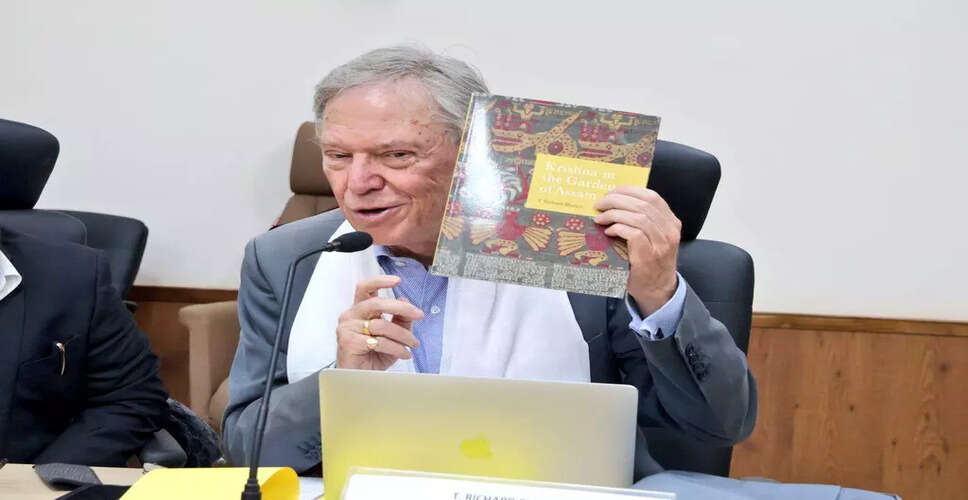
Guwahati, Feb 27: Renowned archaeologist T. Richard Blurton has emphasized that the Vrindabani Vastra of Assam should be appreciated not just as an artistic creation but as a significant cultural artifact influenced by faith, collective memory, and storytelling traditions.
His insights highlighted the necessity of situating this textile within a broader global and civilizational framework.
During an academic session in Guwahati, Blurton, who previously led the South and Southeast Asia Section at the British Museum, delved into the artistic, devotional, and narrative richness found in the Vrindabani Vastra.
He pointed out that the textile exemplifies the interconnectedness of religious devotion, craftsmanship, and community involvement.
Referring to the artefact as “more than just art,” Blurton articulated that the Vrindabani Vastra embodies a cultural imagination developed over centuries through shared beliefs and storytelling.
He noted that this textile, linked to the Vaishnavite tradition of Mahapurush Srimanta Sankaradeva, depicts scenes from sacred stories while also reflecting the social and spiritual values of its era.
Blurton further remarked that such heritage items offer vital insights into how societies convey their values, beliefs, and collective identities.
He asserted that the Vrindabani Vastra is a testament to Assam’s rich artistic legacy and its significance in the wider context of devotional art throughout South and Southeast Asia. He urged that global scholarship should engage more thoroughly with regional traditions to grasp their historical and philosophical importance.
Additionally, he stressed the need to preserve traditional knowledge systems and crafts that nurture such cultural expressions, emphasizing that heritage is dynamic and evolves through reinterpretation and ongoing community involvement.
In this context, he advocated for collaborative research, documentation, and conservation efforts to ensure that future generations remain connected to these living traditions.
The session also ignited discussions on material culture, sacred traditions, and artistic expression, with participants examining how textiles, performance, and ritual practices continue to influence Assam’s cultural identity.
Scholars highlighted that heritage like the Vrindabani Vastra serves as a bridge between past and present, transmitting values across generations.
Vice Chancellor Prof. Nani Gopal Mahanta reflected on the lasting impact of Srimanta Sankardeva and the pivotal role of devotion and craftsmanship in Assam’s spiritual landscape.
He pointed out that institutions such as the Naamghar and traditions like Ankiya Bhaona represent a fusion of faith, philosophy, and art that continues to shape society.
Blurton’s engagement reaffirmed the necessity of integrating Assam’s civilizational heritage into global academic discussions while acknowledging the region’s distinctive cultural contributions.
His comments also highlighted the increasing international interest in Assam’s artistic traditions, especially those that intertwine narrative, devotion, and community involvement. The event was attended by esteemed academics and dignitaries.
Earlier, on Feb 22, Chief Minister Himanta Biswa Sarma laid the foundation stone for the Cultural Museum Project, which will house the much-anticipated 500-year-old sacred Vrindavani Vastra.
“I believe we will complete the construction within 1.5 years,” Sarma stated following the bhoomi poojan at the site in Khanapara.