
Criticism of Prithviraj Chavan's Remarks on Operation Sindoor Sparks Controversy
The recent statements by former Maharashtra Chief Minister Prithviraj Chavan regarding Operation Sindoor have ignited significant controversy. His claims of India's defeat have been met with strong backlash, as military experts affirm the operation's success. This article delves into the implications of Chavan's remarks, the achievements of Operation Sindoor, and the broader context of India's military strategy against terrorism. With insights into the operation's planning and execution, it highlights the decisive leadership of Prime Minister Narendra Modi and the strategic outcomes that reshaped India's defense posture.
| Dec 17, 2025, 18:34 IST
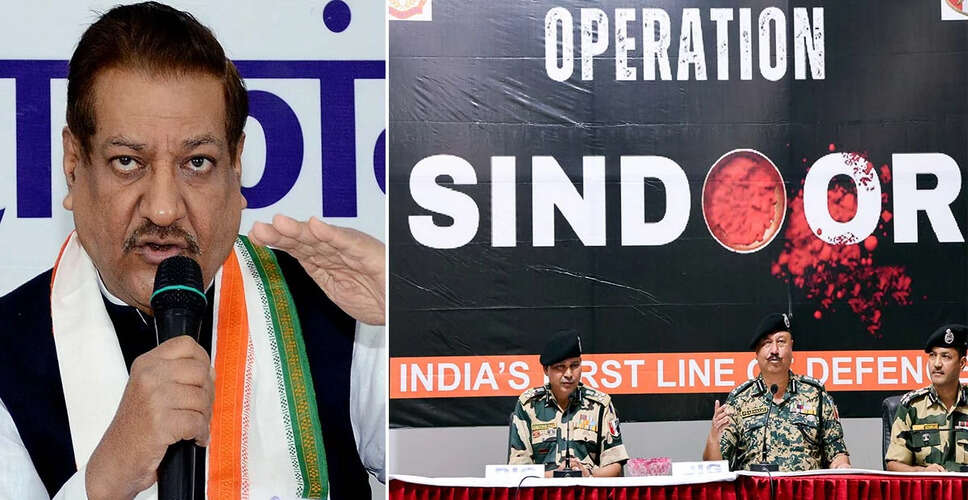
Controversial Statements on Operation Sindoor
The former Chief Minister of Maharashtra, Prithviraj Chavan, has made statements regarding Operation Sindoor that are not only unfounded but also represent a direct affront to the valor, sacrifice, and global reputation of the Indian Armed Forces. It appears that rather than posing questions, Chavan has insulted the Indian Army outright. When a leader invokes the Constitution to raise questions, it is crucial to assess whether those inquiries serve the national interest or aim to undermine the nation. While it is true that the Constitution grants Chavan the right to ask questions, the country also has the right to question whether such inquiries empower adversaries.
Reactions to Chavan's Claims
As global defense experts and military analysts regard Operation Sindoor as a successful and decisive military campaign, it is unfortunate that a senior leader within India would claim, “India lost completely on the first day.” Chavan's remarks either reflect a deliberate anti-national sentiment or a significant lack of military understanding. Before criticizing the Indian Air Force, Chavan should consider that some of the world's most respected military analysts have confirmed that the Indian Air Force effectively neutralized Pakistani systems equipped with Chinese technology during one of the largest aerial engagements in decades. If Chavan believes India “lost completely,” why did Pakistan have to call for a ceasefire? If the Indian Air Force was grounded, how were Pakistani airbases destroyed? If the Indian Army was defeated, why are military personnel from various countries being trained on the valor of the Indian Army under Operation Sindoor?
Chavan's Stance and Congress's Response
Chavan has stated that he will not apologize. In reality, he should not waste time seeking forgiveness, as the Indian populace will never forgive him for his deeply offensive remarks. The Congress party should take strict action against Chavan, but this seems unlikely, given that many Congress leaders have previously demanded evidence of surgical strikes and questioned the Balakot airstrike. Now, as Operation Sindoor is labeled a defeat for India, the party appears to be passively observing the situation. The patriotic public will undoubtedly respond to Congress in the upcoming elections.
Operation Sindoor: A Significant Victory
While Congress leaders may view Operation Sindoor as a failure, it was, in fact, a monumental victory for India against terrorism and a symbol of justice rather than mere retaliation. Following the Pahalgam attack, India initiated Operation Sindoor, which altered the strategic landscape of South Asia. Understanding Operation Sindoor requires recognizing that it was not an emotional reaction but a planned, multi-layered, intelligence-based operation. India meticulously scanned the entire ecosystem of terrorism, targeting enemy training camps, launch pads, weapon depots, and command centers, executing precise strikes within a limited timeframe and with limited weaponry. The goal of Operation Sindoor was not revenge but the establishment of justice, aimed at dismantling the hands that repeatedly threaten India, while also sending a strong message to terrorists and their supporting structures. Importantly, India's targets were not civilian areas but terrorist strongholds, highlighting the moral distinction that sets India apart from sponsors of terrorism.
The Execution of Operation Sindoor
The Indian Air Force executed the mission in just 23 minutes using advanced weapons like Rafale, SCALP, and Hammer. Pakistan's Chinese air defense systems were jammed, their radars blinded, and terrorist infrastructures destroyed. In desperation, Pakistan targeted residential buildings, temples, gurdwaras, and churches in border areas after Operation Sindoor. When this did not deter India, the radar systems in Lahore and Gujranwala were also destroyed. Furthermore, all drone attacks from Turkey and China were thwarted by the Indian defense system. On May 10, Pakistan's DGMO had to discuss a ceasefire with India's DGMO. Even after the ceasefire, Pakistan continued its provocations, sending drones and UAVs into Indian military and civilian areas, which were successfully intercepted by the Indian air defense system.
Strategic Decisions Following Operation Sindoor
Chavan should recognize that the most decisive blow of Operation Sindoor was not solely military. India also significantly weakened Pakistan on non-military fronts. Suspending the Indus Water Treaty was a historic decision, as a large portion of Pakistan's agriculture, economy, and population relies on this water system. This decision dealt a strategic blow to Pakistan, sending a clear message that blood and water cannot flow together. Additionally, the Attari-Wagah border was closed, bilateral trade was completely halted, visas for Pakistani citizens were revoked, and cultural exchanges were entirely suspended. Moreover, at the diplomatic level, military advisors at the Pakistani embassy were declared undesirable, leading to staff reductions.
Leadership and National Security
Throughout this entire episode, Prime Minister Narendra Modi's leadership proved decisive. He established a new national security doctrine stating that any future terrorist attack would be considered an act of war. In his address to the nation on May 12, the Prime Minister clearly articulated that Operation Sindoor was not just a name but a symbol of the emotions and resolve for justice of millions of Indians. He firmly stated that terrorism and dialogue cannot coexist, nor can terrorism and trade, and that blood and water cannot flow together.
The Achievements of Operation Sindoor
In summary, the achievements of Operation Sindoor were unprecedented. Nine major terrorist bases were destroyed, over a hundred terrorists were killed, and deep strikes were conducted within Pakistan, dismantling its air defense systems while showcasing remarkable coordination among Indian forces. This was not merely a military victory; it was a declaration of India's confidence and global stature.