
Controversy Surrounds Indian Hockey Team's Jersey Change Ahead of World Cup
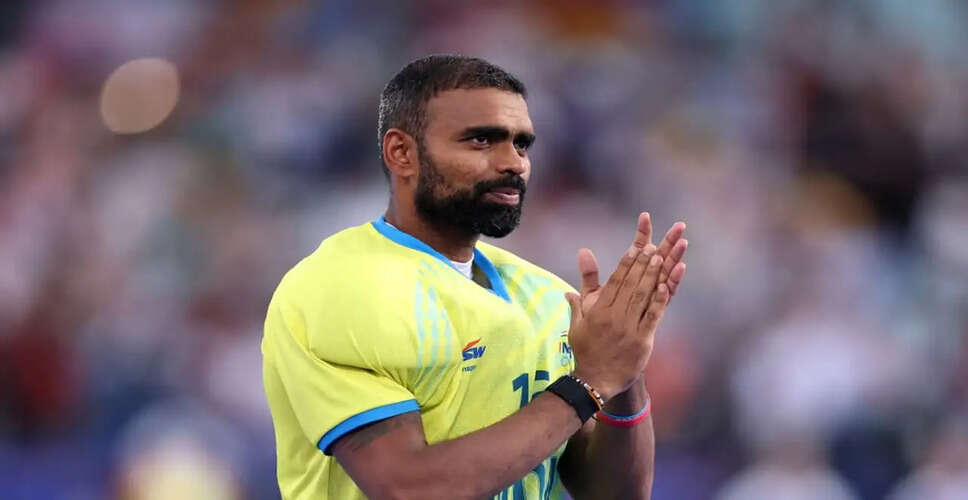

PR Sreejesh Weighs in on Jersey Debate
Former Indian hockey captain and goalkeeper PR Sreejesh has expressed his views on the ongoing debate regarding the national team's transition from the traditional blue jersey to a saffron kit, which has ignited both political and sporting discussions as the World Cup approaches.
As the World Cup 2026 is set to commence on August 15, Hockey India has attracted significant attention after replacing the iconic blue jersey with a complete orange outfit. This change has elicited varied responses from former players, political figures, and fans, raising questions about team identity and the departure from a long-standing tradition.
Dilip Tirkey, the president of Hockey India and a former player, voiced his concerns in an email to executive board members, criticizing the decision-making process that led to this change. He noted that the decision was made without proper consultation with the executive board, highlighting potential governance issues within the federation.
Sreejesh Questions the Focus on Jersey Color
With the jersey controversy dominating headlines, overshadowing India's preparations for the prestigious tournament in Belgium and the Netherlands, Sreejesh questioned the emphasis on the color change from blue to saffron.
"Honestly, I was puzzled by the uproar since the jersey color has changed for previous World Cups in 2014 and 2018. We even had an orange training kit," the two-time Olympic bronze medalist remarked.
"Why is there so much fuss this time? Is it merely because of the saffron color? If the issue is the color change, it should have been raised in 2014 and 2018 when we wore yellow and light blue jerseys," he added.
New Jersey Unveiled for Both Teams
The new saffron jersey will be worn by both the men's and women's teams as their primary uniform for the upcoming tournament. Hockey India officially announced the unveiling of the new kit on July 27, 2026, via social media.
Concerns Over Visibility Justification
Sreejesh also raised questions about the rationale behind the color change, particularly the claim regarding visibility on blue turfs. He stated that if visibility was indeed the concern, then the blue jersey should never be used again.
"I have no problem with changing the jersey color, but the reasoning provided is peculiar. If visibility is the issue, then we should not wear blue jerseys at all," he stated.
"While it's true that similar colors can make visibility challenging, the jersey color has only changed twice in the last 14 years since the introduction of the blue turf. We have played in blue at major tournaments, including the Tokyo and Paris Olympics," he added.
India's Historic Jersey Tradition
The Indian men's hockey team has been wearing blue jerseys in major international competitions since 1928, marking India's first Olympic participation. The women's team also donned the traditional blue kit during its inaugural international match against Scotland in September 1953.
Focus on World Cup Success
Despite the ongoing jersey debate, Sreejesh encouraged the team to concentrate on their performance and aim to break the 50-year drought for a World Cup medal. He emphasized that this is a significant opportunity to achieve a podium finish.
"We have waited for so long. This time, we have a golden chance. England is the only formidable team in our pool. If we top the group, we could face Argentina, a team we've previously defeated. The path to the semifinals appears more accessible," he noted.
"I urge the players to give their best, enjoy the game, and end this 50-year wait. Opportunities like this are rare. Ignore the pressure and off-field discussions, and focus on securing a podium finish. Fifty years is a long time to wait," he concluded.
Historical Context of India's World Cup Journey
India last claimed the Hockey World Cup title in 1975 in Kuala Lumpur, Malaysia. Since then, the team has only reached the knockout stage once, making it to the quarterfinals in 2018.
Despite hosting prestigious tournaments four times—1982 in Mumbai, 2010 in New Delhi, 2018 in Bhubaneswar, and 2023 in Rourkela—the team has struggled to replicate its past successes on the grand stage since its historic win under captain Ajit Pal Singh.