
Congress Questions Environmental Minister on Aravalli Hills Redefinition
Concerns Raised Over Aravalli Hills Redefinition
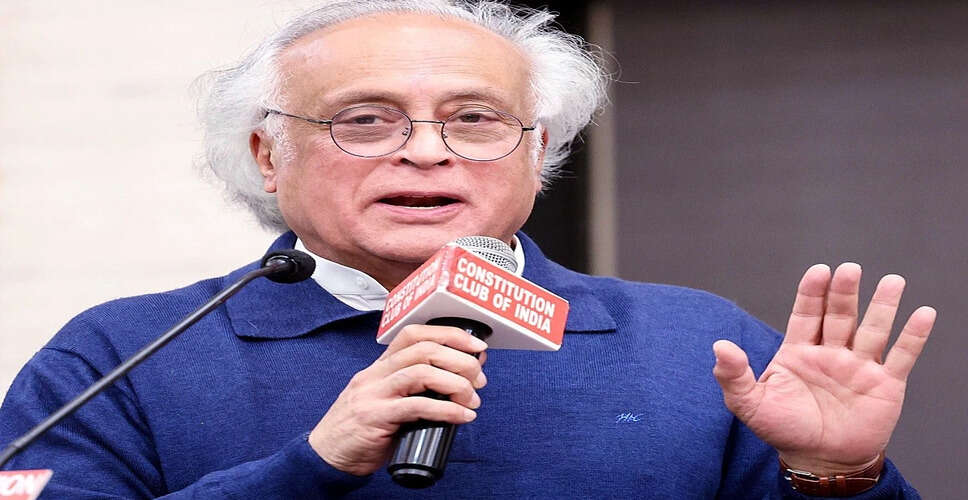
In light of the ongoing controversy regarding the redefinition of the Aravalli mountain range, Congress leader Jairam Ramesh has posed four critical questions to Environment Minister Bhupender Yadav. He asserts that this initiative could lead to the destruction of the Aravalli range and several smaller hills and landforms.
In a letter addressed to Yadav, Congress General Secretary Jairam Ramesh expressed that it is natural to have significant concerns about the redefinition of the Aravalli hills, as it restricts them to landforms that are 100 meters or taller.
He stated, 'In this context, I would like to ask you four specific questions for your consideration. The first question is: Is it not a fact that since 2012, the classification of the Aravalli hills and mountain ranges in Rajasthan has been based on the Indian Forest Survey report dated August 28, 2010, which stated that all areas with a slope of three degrees or more will be classified as hills?'
Ramesh further explained, 'Additionally, a uniform buffer of 100 meters will be added in the direction of the slope to account for potential expansion corresponding to a hill of 20 meters in height, which is equivalent to a 20-meter contour interval. Flat areas, pits, and valleys falling within these designated regions will also be considered part of the hills.'
He then posed a second question: 'Is it not true that the Indian Forest Survey, in a letter sent to the Ministry of Environment, Forest and Climate Change on September 20, 2025, stated that the smaller hill structures of the Aravalli act as natural barriers against desertification, as they prevent heavy sand particles from moving, thereby protecting Delhi and surrounding plains from sandstorms?'
Ramesh noted, 'Since the protective capacity of any barrier against airborne sand increases directly with its height, even small hills ranging from 10 to 30 meters can serve as effective natural windbreaks.'
He continued with a third question: 'Is it not a fact that the Central Empowered Committee (CEC), constituted by the Supreme Court, concluded in its report dated November 7, 2025, that 164 mining leases in Rajasthan were located within the Aravalli hills and mountain ranges according to the prevailing Indian Forest Survey?'
Finally, he asked, 'Is it not true that this new classification will lead to the destruction of many smaller hills and other landforms, ultimately compromising the geographical and ecological integrity of the entire Aravalli range spanning four states?'
The opposition Congress party claims that under the new classification of the Aravalli mountain range, over 90 percent of the area will not remain protected and will be opened up for mining and other activities. Following the controversy surrounding this issue, the central government has instructed states to impose a complete ban on granting new mining leases within the mountain range.