
Congress Criticizes Modi Government Over Malnutrition and Anaemia Issues

Congress Raises Concerns on Health Issues
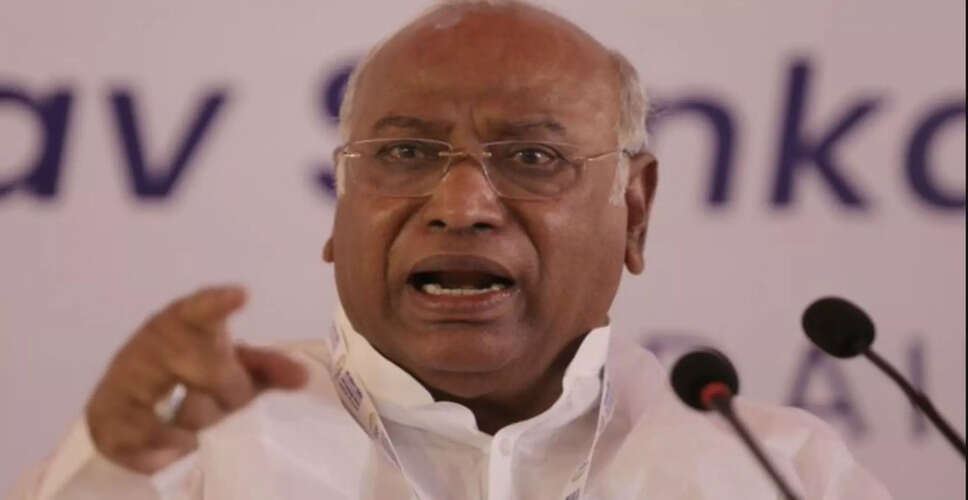
File image of Congress president Mallikarjun Kharge(Photo: @ians_india/X)
New Delhi, Nov 25: The Congress party has launched a strong critique against the central government regarding a recent report highlighting malnutrition and anaemia in India, questioning the accountability after 12 years under Modi's leadership.
Congress president Mallikarjun Kharge emphasized the contradiction of India aiming for a demographic dividend while millions of women and children face malnutrition challenges.
According to the Modi government's own ICMR-SAMPADA report, 55.9% of women of reproductive age are reported to be anaemic. Additionally, nearly two-thirds of adolescent boys and girls are lacking Vitamin B12, and 42% of children aged 1-4 years are also anaemic. In Gujarat, the figures are alarming, with 66% of women of reproductive age and 57% of young children affected by anaemia, Kharge noted on X.
Kharge pointed out that the government's focus on 'mild' anaemia does not change the reality that almost 30% of women of reproductive age suffer from moderate to severe forms of the condition.
The latest findings from NFHS-6 indicate that about one-third of children are underweight, and one in five is experiencing acute malnutrition, he added.
He further highlighted the government's financial records, revealing that over Rs 1.13 lakh crore has been allocated under various schemes like Saksham Anganwadi and POSHAN 2.0 over six financial years. However, there is a significant gap of over Rs 2,500 crore between the funds released and those utilized under POSHAN 2.0 in just four years, with nearly 44% of the original POSHAN Abhiyaan funds remaining unspent.
Kharge also noted that the allocation for Women and Child Development in the Union Budget has nearly halved, dropping from 0.96% in 2015-16 to 0.50% in 2025-26.
After 12 years of the Modi administration, with numerous nutrition initiatives and iron supplementation programs in place, he questioned the lack of accountability.
On Tuesday, Congress referenced an official report indicating Gujarat's poor performance regarding anaemia rates from 2023-25, questioning whether Union Health Minister J P Nadda could withstand the implications of this 'damning report.'
Congress general secretary Jairam Ramesh pointed out that the Union Ministry of Health and Family Welfare recently released a report titled 'Anaemia and Micronutrient Deficiencies Across the Life Course in India.'
In Gujarat, the anaemia rates for adolescent girls (10-19 years) stood at 61.4%, for adult women (20-59 years) at 63.8%, and for women of reproductive age (15-49 years) at 66.2% during 2023-25, Ramesh stated on X.
He noted that only Chhattisgarh had worse figures, while Kerala, often highlighted as a model state, had significantly lower rates of 21.4%, 28%, and 29.1% respectively.
For children aged 12-59 months, Gujarat recorded the highest anaemia prevalence at 56.5%, compared to Kerala's lowest at 14.5%, he added.
Ramesh questioned whether the Union Health Minister could endure the fallout from this report.
Interestingly, the prevalence of anaemia in India appears lower than in previous national surveys, with severe cases constituting less than 2% across most age groups, according to the findings from the Indian Council of Medical Research's SAMPADA survey released on Monday.
SAMPADA, which stands for the Survey for Assessment of Markers of Population Health, Activity, Diet and Anthropometry, was conducted between 2023-25, involving over 2 lakh individuals from more than 81,000 households across 183 districts in 35 states and Union Territories.
More than 1.7 lakh blood samples were analyzed for haemoglobin levels across various demographics, with the results indicating that most anaemia cases were mild, suggesting a potential for early intervention, as stated by the Department of Health Research.