
Confusion Surrounds US-Iran Peace Negotiations Amid Contradictory Statements
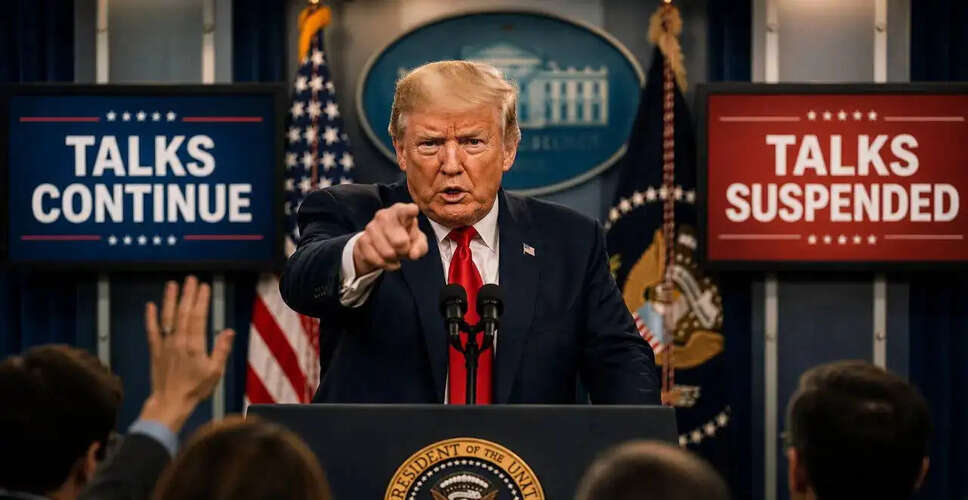

Contradictory Statements from Trump and Iran
Recent developments in the peace negotiations between the United States and Iran have led to significant confusion, as both parties have issued conflicting statements regarding the status of talks. On Monday, President Trump expressed indifference towards the negotiations, stating he was unconcerned about their potential conclusion. However, he later claimed that discussions were ongoing and progressing swiftly. In contrast, Iran has maintained its position since halting talks in response to Israel's military actions in Lebanon.
Trump's Mixed Messages
During an interview with CNBC, Trump remarked, "I really don't care. I couldn't care less," when asked about Iran's suspension of negotiations, labeling the discussions as "very boring." Shortly thereafter, he took to social media to assert that talks were indeed continuing at a rapid pace, contradicting his earlier comments. Trump also mentioned that Iran had not communicated any decision to suspend negotiations.
Iran's Suspension of Talks
On the same day, Iranian media reported that Tehran had decided to pause high-stakes negotiations with the US due to Israel's military offensive in Lebanon. The semi-official Tasnim news agency indicated that the Iranian negotiating team would halt discussions and the exchange of texts through intermediaries. Iran's foreign ministry stated that the US was directly responsible for the ceasefire violations against Iran and the actions of the Israeli regime in Lebanon.
Potential Retaliation from Iran
Mohammad Bagher Ghalibaf, the Speaker of Iran's Parliament, warned that Iran might retaliate if Israeli attacks persisted. He emphasized that Iran had been actively working to stop these assaults and indicated that if they continued, Iran would not only suspend negotiations but also take a stand against Israel. Ghalibaf mentioned that any agreement to end hostilities between Iran and the US would necessitate a cessation of attacks on all fronts, particularly in Lebanon.
Uncertainty Surrounding Ceasefire Efforts
Similar uncertainties were evident in the discussions between Israel and Hezbollah, as recent hostilities have resulted in casualties on both sides. Israeli Prime Minister Benjamin Netanyahu announced military strikes against Hezbollah targets in Beirut, accusing the group of breaching ceasefire terms. He stated, "There will not be a situation in which Hezbollah attacks our cities and our citizens." Following this, evacuation warnings were issued for residents in Beirut's Dahiya district.
Conflicting Reports on Ceasefire Agreement
Later, Trump claimed to have communicated with both Netanyahu and Hezbollah representatives, suggesting that a ceasefire had been tentatively agreed upon. The Lebanese Embassy in Washington confirmed that Hezbollah had accepted a US proposal for a mutual cessation of hostilities. However, Netanyahu's subsequent statement did not acknowledge any new ceasefire agreement, reiterating that Israel would continue its military operations in southern Lebanon if Hezbollah did not cease its attacks.
Conclusion
The conflicting narratives from Washington, Jerusalem, Beirut, and Tehran have left the status of both the US-Iran negotiations and the broader ceasefire efforts in a state of ambiguity.