
Concerns Rise Over Safety of Assamese Migrant Workers Amid Recent Incidents


Increasing Risks for Assamese Migrant Workers
A file image of labours during construction of a bridge. (Picture used for representational purpose)
Recent events involving Assamese migrant workers across India have sparked renewed concerns regarding the dangers associated with labor migration from the state, even as local employment initiatives are being promoted by the government.
On June 21, an ammonia gas leak at a seafood processing facility in Tamil Nadu's Tiruvallur district tragically claimed the lives of two women workers from Assam, among a total of nine fatalities.
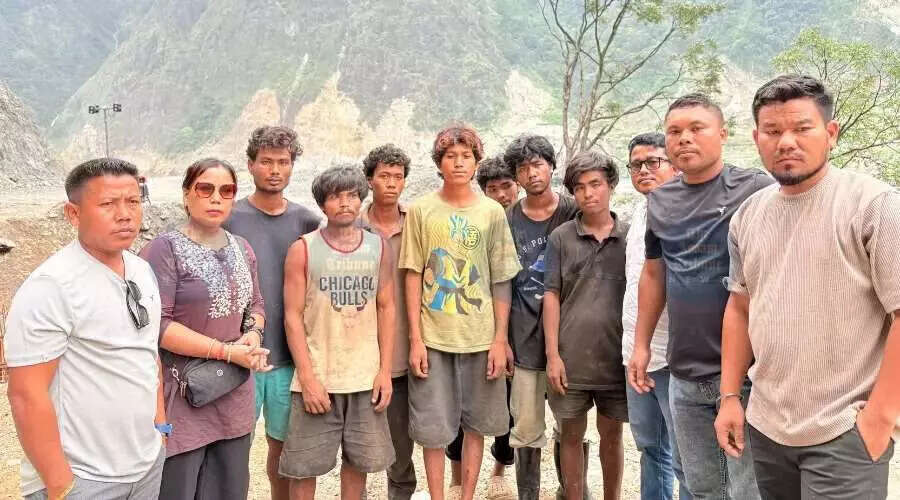
Just days prior, on June 9, seven Mising youths were rescued from a construction site in Arunachal Pradesh, where they reportedly endured physical abuse, starvation, and deplorable working conditions.
These two incidents, while different in nature, highlight the hazardous situations many Assamese workers face when they leave their homes in search of employment.
Every year, countless individuals leave Assam for jobs, ranging from construction work in Karnataka and Kerala to factory positions in Gujarat and roles in the hospitality sector in major cities like Delhi, Mumbai, and Bengaluru. This migration occurs despite the state government's ongoing efforts to encourage youth to explore emerging job opportunities within Assam.
For numerous families, however, migration is a necessity rather than a choice.
"Many households in the state rely on agriculture, but farming income is often insufficient to sustain a family. Consequently, many individuals, particularly from Upper Assam, seek work in places like Roing and Tezu. During this process, some exploitative individuals target vulnerable workers, enticing them with promises of better pay. This is how many of our youths end up leaving the state," explained Binod Dao, president of the Takam Mising Porin Kebang (TMPK) in Sadiya district, who played a pivotal role in rescuing the seven youths from Arunachal Pradesh.
In response to the increasing number of such incidents, TMPK has decided to implement a documentation and monitoring system for workers traveling to Arunachal Pradesh.
Starting in July, Assamese laborers seeking employment in the neighboring state will be required to register with the organization and submit their documents prior to departure.
"They will need to present their documents at our office. The contractor or individual responsible for their employment will also have to provide their details and sign an agreement with the workers. This agreement will clearly outline their work location, job responsibilities, and wages," Dao stated, adding that an office will be established on the Assam side of the border, with copies of the agreements shared with authorities in both states to ensure accountability.
Dao emphasized that Arunachal Pradesh is just one of many destinations for these workers. "Since the lockdown, numerous laborers have migrated to cities like Chennai and Bengaluru due to unemployment. But does the Assam government have accurate data on them? A proper database is essential. The government should monitor how many workers have left the state for jobs," he remarked, highlighting a significant gap—the lack of comprehensive data on migrant workers, which complicates the authorities' ability to respond when workers go missing, face exploitation, or are involved in workplace accidents.
The Labour Department was approached for a comment on this issue before publication, but repeated attempts to reach them via calls and emails went unanswered. Updates will be provided once a response is received.
Following a tragic incident where nine migrant workers from Assam died in an accident at a construction site in the Ennore Special Economic Zone thermal power station near Chennai on October 2, 2025, the state government initiated the Shraddhanjali scheme that October. This program aims to ensure the dignified transportation of the remains of Assamese residents who pass away outside the state.
For grieving families, this scheme has provided vital assistance. "My brother passed away in Bengaluru. I still don't know what happened because he was perfectly healthy. His death devastated our family. Thanks to the TMPK Bengaluru unit and the Shraddhanjali scheme, we managed to bring his body back home," shared Rahul Chirang, whose brother Jiten Chirang from Majuli died in Bengaluru earlier this month.
However, community organizations argue that support after death addresses only a fraction of the issue.
They assert that improved tracking of migrant workers, stricter regulation of recruitment agencies, enhanced interstate coordination, and increased awareness among workers are equally crucial to prevent such tragedies from occurring in the first place.
The scale of migration is significant, even if the exact figures remain unclear. According to rough industry estimates reported by a news outlet in May, approximately 13 million migrant laborers from northern and eastern India are employed across Kerala, Tamil Nadu, and Karnataka, while data from the Centre for Migration and Inclusive Development (CMID) indicates that Kerala alone employs around 4 million migrant laborers, with nearly 70% originating from West Bengal and Assam.
The issue also extends to Assam's plantation sector. The Assam Chah Mazdoor Sangha (ACMS), the largest trade union in the sector, raised concerns in July 2025 about a growing migration crisis quietly unfolding across the state's tea estates.
"These youths are not merely leaving Assam for jobs; many are falling into traps set by unscrupulous brokers who offer false promises. The majority are unprotected, untrained, and unfamiliar with the very systems designed to safeguard them," stated Raju Sahu, a former MLA of Chabua and a veteran trade union leader associated with the ACMS.
Most of those who migrate enter unorganized sectors, making it challenging to quantify their numbers. During the Covid-19 pandemic, an estimated 426,000 workers returned to Assam from other states, a figure that reflects the scale of outward migration, although no dedicated study has been conducted to assess the conditions these workers face.
Sources from the Labour Department noted that workers typically leave the state without notifying the department or any other authority, seeking government assistance only after encountering difficulties, which contributes to the lack of precise data on their numbers.
In summary, the fatalities in Tiruvallur, the rescue operation in Arunachal Pradesh, and the warnings from trade unions and community organizations all point to a common underlying issue—protection that is primarily reactive rather than proactive. Until the state establishes a functional system to monitor who is leaving, where they are going, and under what circumstances, initiatives like Shraddhanjali will continue to address the aftermath of the risks associated with migration, while those working closely with affected families argue that preventive measures are urgently needed.