
Concerns Rise Over Highway Safety Following Wall Collapse in Mandi
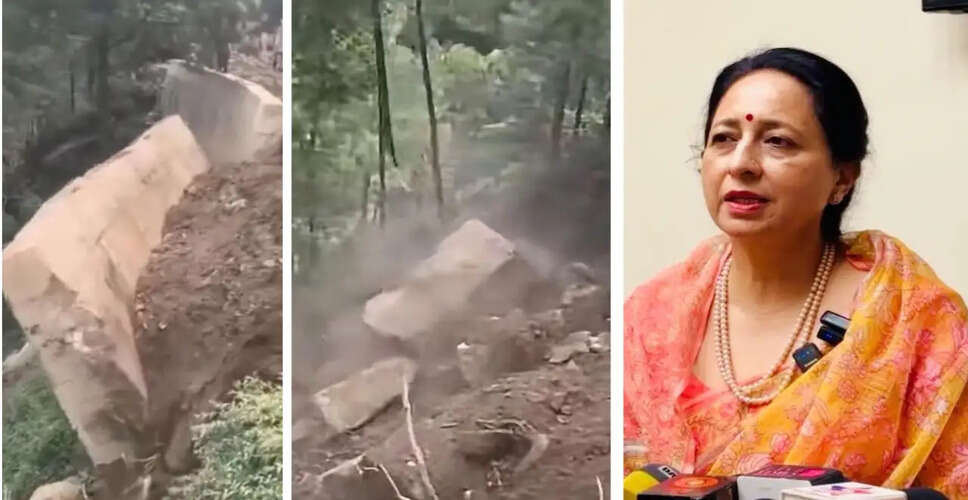

Wall Collapse Sparks Safety Concerns
Munish Sood
Mandi
The recent failure of a large retaining wall along the Mandi–Kotli National Highway has reignited discussions about the safety and quality of ongoing highway construction projects. Social activist and academic Prof. Anupama Singh has called for an independent technical audit and the public release of inspection reports.
The collapsed wall, which stood between 30 and 52.5 feet tall, fell during construction, raising alarms among local residents regarding the integrity of highway structures and the implications of extensive hill cutting.
Prof. Singh, who has been vocal about highway construction issues in the region, emphasized that this incident should not be dismissed as merely a structural failure. She questioned whether the construction adheres to the approved Detailed Project Report (DPR), design specifications, safety standards, and technical guidelines.
She has requested information on quality audits, structural inspections, and technical evaluations conducted on the existing road and safety structures, insisting that these reports should be accessible to the public.
Prof. Singh stated, “This incident raises critical questions about whether proper technical safeguards are being implemented during construction and if the quality of work is subject to independent oversight.”
She also highlighted concerns regarding the methods used for hill slope cutting during highway expansion, alleging that adequate slope stabilization, drainage systems, and retaining structures are often lacking at construction sites. The safety of nearby homes, farmland, and natural water sources affected by construction should also be prioritized.
Prof. Singh has posed several inquiries to the National Highways Authority of India (NHAI) and other involved agencies.
She seeks clarification on which agency is responsible for quality and structural audits, whether the construction aligns with the approved designs and specifications, and what technical evaluations have been conducted to ascertain the cause of the wall's collapse.
Additionally, she has requested information regarding accountability for damage to private properties, agricultural land, and water sources allegedly impacted by construction activities, as well as the processes available for affected residents to seek compensation and resolution.
Concerns about muck disposal have also been a significant part of her complaints. Prof. Singh noted that issues regarding improper disposal of construction debris and its potential environmental effects have been raised previously. She referred to records and proceedings related to environmental issues and muck dumping associated with highway construction, advocating for increased transparency in managing excavated materials.
Prof. Singh mentioned that these concerns are not new. She had previously discussed the matter with Union Minister for Road Transport and Highways Nitin Gadkari during a meeting on September 28, as well as with NHAI and other officials.
She emphasized that mere assurances are insufficient and called for a transparent system where quality inspection reports for major structures are publicly available, independent technical and structural audits are performed, and safety assessments are documented both before and after construction.
Furthermore, she sought clarity on the contractual and technical qualifications of agencies responsible for executing major projects, especially in cases where prior allegations or regulatory actions have been raised against them.
Prof. Singh asserted, “Our demand is not against infrastructure development but for construction that is scientifically planned, technically sound, and accountable.”
She stressed that public funds should lead to infrastructure that is safe, durable, and capable of serving the community effectively over time.
The exact cause of the wall's collapse remains to be determined through an independent technical evaluation. While local observations suggest that soil and water pressure may have contributed to the failure, such claims require formal engineering investigation.
This incident has reignited the broader discussion about highway construction in the delicate Himalayan region, where extensive hill cutting, slope stability, drainage, and retaining structures are vital for road safety.
For Prof. Singh, the key issue is accountability: if a structure funded by public money fails, there must be a clear process to identify the cause, assign responsibility, and implement corrective actions to prevent future occurrences.
“Roads must be constructed, but not at the expense of public safety. Development should be accompanied by quality, transparency, and accountability,” she concluded.