
Concerns Arise Over Fire Safety Regulations After Guwahati Blaze
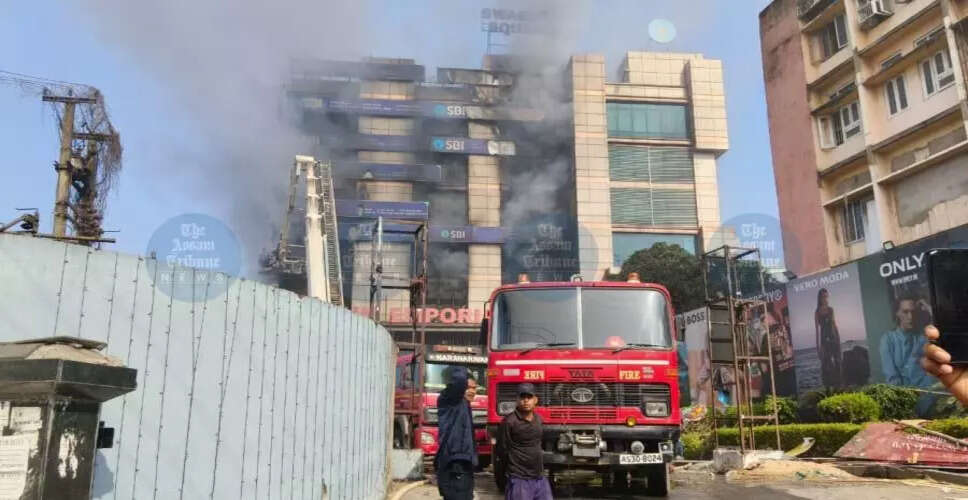
Fire Incident at Swagota Square
A recent fire at the seven-storey 'Swagota Square' on GS Road in Guwahati, although not catastrophic, took nearly two days for firefighters to control, despite the involvement of around 50 fire engines.
The extended duration of the firefighting efforts can largely be attributed to the lack of sufficient open space surrounding the building.
Firefighters faced challenges accessing the rear area where the fire started, following the explosion of two gas cylinders on an upper level.
This incident raises critical questions regarding the oversight of the Guwahati Metropolitan Development Authority (GMDA), which seemingly ignored significant flaws in the building's design when granting construction approval.
Current regulations mandate that high-rise structures maintain adequate open space on all sides for emergency access, yet many recent constructions in Guwahati have failed to comply, with minimal enforcement from the GMDA. The issues with 'Swagota Square' were only revealed due to this fire.
Additionally, the building, especially being a commercial space, lacked sufficient internal fire safety systems that could have mitigated the damage.
While it may seem unrealistic to expect regular fire safety inspections from municipal authorities, the absence of such measures can lead to dire consequences.
Fortunately, 'Swagota Square' primarily houses offices, including several floors occupied by the State Bank of India and a large fashion store. Had it been a residential building, the prolonged fire could have resulted in a far more tragic outcome.
Questions also arise regarding whether the hydraulic fire tenders used were equipped with snorkels long enough to reach the building's height, or if technical limitations hindered the fire brigade's efforts. Furthermore, did water shortages impede firefighting operations?
It is worth noting that GS Road lacks fire hydrants capable of providing a continuous water supply from underground sources, which is crucial for extinguishing fires in high-rise buildings.
All evidence points to the 'Swagota Square' fire being a man-made disaster, resulting from negligence on the part of both the builder and regulatory authorities.
Building codes were blatantly disregarded, highlighting a troubling and unchecked relationship between developers and regulatory bodies. With rapid construction ongoing throughout the city, this issue has been overlooked for far too long.
Multi-storey residential buildings are being allowed on narrow streets where even two vehicles struggle to pass, raising concerns about emergency access.
The government seems largely indifferent to the safety of residents and tenants. Despite the expansion of Guwahati's municipal boundaries over the years, essential civic services remain severely lacking.
Moreover, the city's safety is questionable, especially given its susceptibility to flooding after moderate rains and frequent seismic activity. Instead, what is evident is a reckless approach to 'development' that prioritizes speed over long-term planning, allowing unscrupulous individuals to take advantage of the system.
This troubling relationship between builders, brokers, and authorities is not confined to Guwahati; it is a widespread issue affecting cities nationwide.
The recent tragedy at a nightclub in Goa, which resulted in 25 fatalities, serves as a grim reminder. The venue, operating in clear violation of safety regulations with official complicity, was only ordered to be demolished after the disaster occurred. Such incidents highlight the pervasive nature of this issue across the country.
Jivraj Burman