
Clarification from Assam Sahitya Sabha President on Controversial Remarks
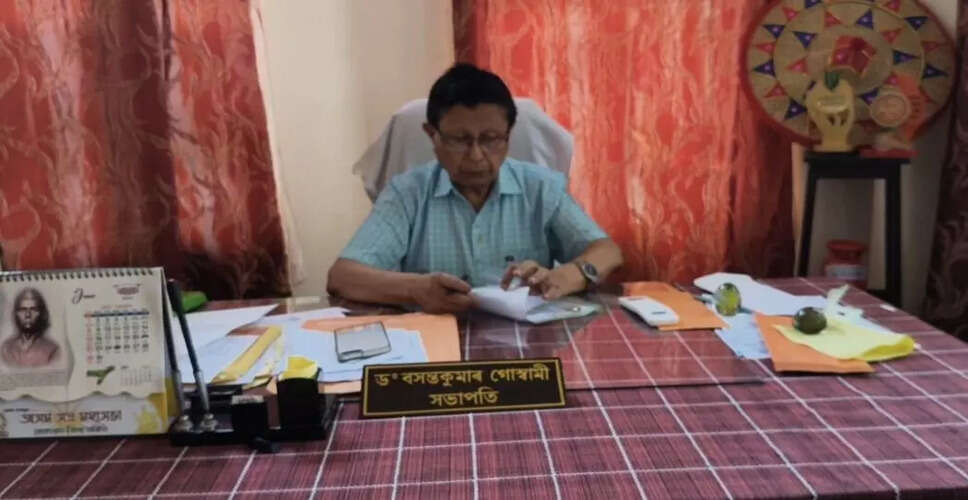

Goswami Addresses Misunderstanding Over Community Identity
Basanta Kumar Goswami
Jorhat, May 22: Basanta Kumar Goswami, the president of Assam Sahitya Sabha, has provided a comprehensive clarification in response to the uproar surrounding his recent comments about the Mising and Bodo communities. He emphasized that his statements were “entirely misrepresented” and asserted that it is inaccurate to claim that these communities do not identify as Assamese.
In a statement issued on Thursday, Goswami explained that his remarks, made during an academic and cultural event organized by the Asam Sahitya Sabha in Kokrajhar on May 17, were selectively edited and misinterpreted by certain media outlets, resulting in public confusion.
The controversy began when reports and social media discussions suggested that Goswami implied that the Mising and Bodo people were not part of the Assamese identity.
This led to criticism from various groups and individuals who questioned the Asam Sahitya Sabha's stance on indigenous identity and inclusivity.
In light of the backlash, Goswami clarified that his comments had been taken out of context.
“While attending the academic and cultural gathering in Kokrajhar, I was asked a question by journalists, and my answer has been completely misrepresented. To prevent any further misunderstanding, I want to clarify what I actually said,” he stated.
He elaborated that his intention was to emphasize the linguistic and cultural identities of the indigenous communities that have resided in Assam for generations.
“In Assam, communities that have lived here for years, whose languages are officially recognized and used as mediums of instruction in schools, are commonly referred to by their mother tongues, such as Bodo or Mising,” Goswami explained.
He further clarified that he used the Bodo and Mising communities merely as examples and never intended to exclude them from the larger Assamese identity.
“It is incorrect to assert that the Mising and Bodo communities are not Assamese. We do not possess such audacity,” he stated firmly.
Goswami also expressed regret over the incident and apologized to anyone who felt offended by the misinterpretation of his comments.
“If my distorted statement caused hurt to people's sentiments, I sincerely apologize,” he remarked.
In his clarification, Goswami reaffirmed his lifelong dedication to language, literature, and social harmony, highlighting his efforts to promote unity among Assam's diverse ethnic groups.
“I have dedicated my life to serving society through language and literary endeavors,” he noted.
He also emphasized that since taking on the leadership of the Asam Sahitya Sabha, he has been actively working to foster stronger relationships with literary and cultural organizations representing various indigenous communities throughout the state.
Goswami mentioned several organizations with which the Sabha plans to collaborate, including the Karbi Sahitya Sabha, Deuri Sahitya Sabha, Dimasa Sahitya Sabha, Mising Sahitya Sabha, Bodo Writers’ Association, Bodo Sahitya Sabha, Sarania Kachari Sahitya Sabha, Bishnupriya Manipuri Sahitya Sabha, and various tribal development committees.
Additionally, he stated that the Sabha aims to partner with organizations like the Srimanta Sankardev Sangha and the All Assam Students’ Union (AASU) to strengthen the concept of a greater Assamese society that includes all ethnic groups residing in the state.
“In a time when efforts are being made to unify all communities in Assam into a greater Assamese nation, such misinterpretations are regrettable,” he concluded.