
CJI Surya Kant Criticizes NCERT's Textbook on Judicial Corruption
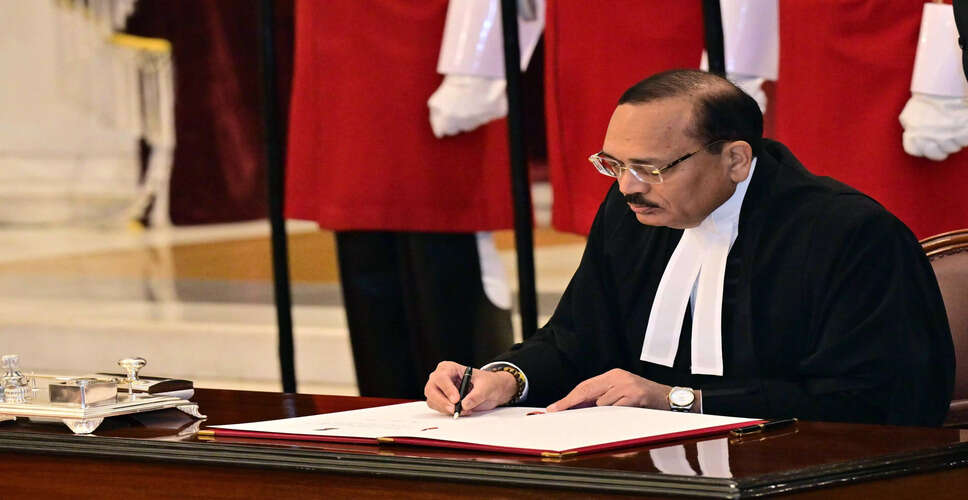
CJI's Strong Opposition to Textbook Content
New Delhi, Feb 25: Chief Justice of India Surya Kant expressed his firm disapproval regarding a chapter on judicial corruption included in the NCERT's Class 8 syllabus. He emphasized that no one should be permitted to tarnish the reputation of the judiciary.
A three-judge bench, which included the CJI along with justices Joymalya Bagchi and Vipul M Pancholi, took notice of the "objectionable" remarks concerning the judiciary found in NCERT textbooks. This action was prompted after senior advocate Kapil Sibal, accompanied by Abhishek Singhvi, brought the issue to the court's attention for immediate review.
The NCERT Social Science textbooks for Class 8 highlight issues such as corruption, a significant backlog of cases, and an insufficient number of judges as challenges confronting the judicial system.
Within the section titled "Corruption in the Judiciary," the textbooks assert that judges must adhere to a code of conduct that regulates their behavior both in and out of the courtroom.
"We are deeply troubled as members of this institution to learn that Class 8 students are being instructed about corruption within the judiciary. This is part of the NCERT curriculum. We have a significant interest in this institution... this chapter is utterly scandalous. We possess copies of the book," Sibal remarked.
The CJI responded, stating, "I am fully aware of this matter," noting that he had received numerous calls and messages, with many high court judges expressing their concern.
When Sibal anticipated that the bench would take suo motu cognizance, the CJI replied, "Please wait for a day. This is indeed a matter of concern for the entire institution. Both the bar and the bench are unsettled. Every stakeholder in the system is genuinely worried. I am receiving numerous calls and messages. High court judges are also disturbed by this."
The CJI assured Sibal that he had already initiated suo motu cognizance regarding the issue.
"I will not allow anyone to undermine the integrity of this institution or defame it. At any cost, I will not permit this. Regardless of who it may be, the law will take its course. I know how to handle this situation," a visibly upset CJI stated.
Singhvi pointed out that the NCERT seemed to adopt a selective perspective, suggesting that it implied "there was no corruption in other areas. There was no mention of corruption in the bureaucracy, politics, public life, or other institutions."
"This appears to be a calculated and deeply rooted strategy... we prefer not to elaborate further... I am aware and have fulfilled my responsibility," the CJI concluded, expressing gratitude to the lawyers for highlighting the issue.
Justice Bagchi mentioned the basic structure doctrine, stating that "the constitutional integrity related to the basic structure is absent in the contents of the textbook."