
China's Advancements in 6th Generation Fighter Jets Challenge India's AMCA Program
China's Surprising Leap in Air Power
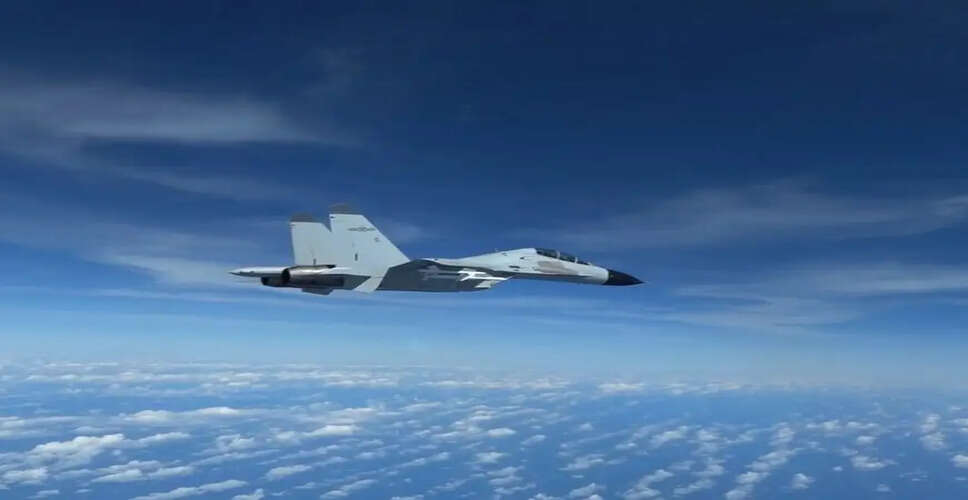
In the global race for air superiority, China has once again made headlines. Recent reports from the U.S. Department of Defense and leaked satellite images reveal that two of China's sixth-generation fighter prototypes, the Chengdu J-36 and the Shenyang J-50, are already undergoing flight testing. Following their inaugural flight in December 2024, multiple prototypes have been spotted in the air during 2025-2026, showcasing features such as a tailless design, ultra-long range, advanced stealth capabilities, AI-integrated systems, and drone teaming.
This rapid development poses a significant challenge to India's Advanced Medium Combat Aircraft (AMCA) program, which is still classified as fifth-generation. According to the Defence Research and Development Organisation (DRDO) and the Aeronautical Development Agency (ADA), the first AMCA prototype is expected to roll out between 2026 and 2027, with its first flight slated for 2028 and induction anticipated by 2034-2035. This timeline suggests that while India enters the fifth generation, China will have already advanced to the sixth.
Key Factors Behind China's Rapid Progress
- J-36: A large, triple-engine, long-range air superiority fighter expected to fly for the first time in 2024, with upgraded prototypes undergoing testing in 2025-2026, featuring refinements like 2D thrust vectoring and new DSI intakes.
- J-50: A smaller, twin-engine, tailless design with a lambda wing, set to take flight in 2024 and showcased in high-resolution images in 2025, focusing on all-aspect stealth.
- Both programs are running in parallel, allowing China to achieve operational capability by the early 2030s, potentially outpacing the U.S. NGAD/F-47, which is scheduled for its first flight in 2028.
The Pentagon's report indicates that China is adopting a 'system of systems' approach, incorporating manned-unmanned teaming, exponential stealth reduction, and enhanced sensing capabilities. This development presents a formidable challenge for India, as the AMCA currently relies on the GE F-414 engine, with the Mk2 version (high-thrust engine) not expected until 2040.
Pakistan's Potential Advantage? Meanwhile, the Pakistan Air Force (PAF) is preparing to receive deliveries of the J-35 (fifth-generation stealth fighter) from China between 2026 and 2027. Reports suggest that the first batch of 4 to 12 J-35E (export version) will soon arrive, replacing the F-16. Some sources indicate that Pakistan may acquire 30-40 J-35A units, along with KJ-500 AEW&C and HQ-19 BMD systems.
If Pakistan successfully inducts the J-35 ahead of India, it could achieve fifth-generation capability before India, which is still in the prototype stage with the AMCA. Experts warn that China's swift technology transfer (with the J-35 being exported to Pakistan first) could disrupt the air balance in South Asia. Pakistan already relies on platforms like the J-10C and JF-17 Block III, and the J-35 could challenge India's Rafale and S-400 systems.
India's Position and Concerns The Indian Air Force (IAF) and DRDO are focused on accelerating the AMCA program, with private sector involvement, but delays remain a concern. The Air Chief Marshal recently confirmed that the AMCA is on track for its 2028 flight and 2035 induction. However, the advancements in China's sixth-generation capabilities and Pakistan's J-35 deal raise alarms about potential gaps in regional air superiority.
Conclusion China's ambitions have materialized, with sixth-generation fighters already in the air, while India prepares to enter the fifth generation. The pressing question remains: will Pakistan leverage Chinese technology to surpass India? This will be a crucial factor in the air power balance in the coming years. India must expedite the DRDO-HAL project to keep pace with its neighbor's rapid advancements.