
China Urges Iran to Reopen Strait of Hormuz Amid Nuclear Talks
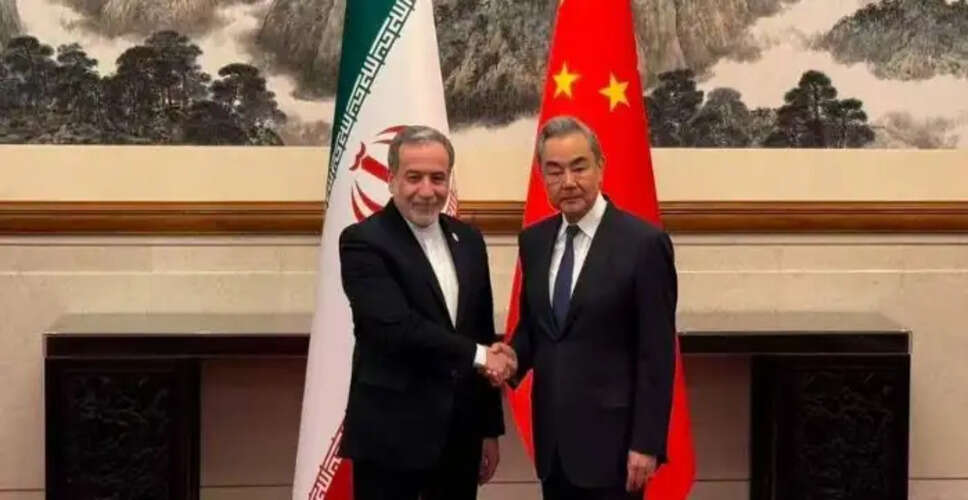

China's Call for Action on the Strait of Hormuz
Beijing: On Wednesday, China urged Iran to promptly reopen the Strait of Hormuz, expressing appreciation for Tehran's commitment to refrain from developing nuclear weapons, a key demand from US President Donald Trump aimed at resolving the ongoing conflict with the Islamic Republic.
During discussions with Iranian Foreign Minister Abbas Araghchi, Chinese Foreign Minister Wang Yi emphasized the international community's shared concern for restoring safe navigation through the Strait, hoping that all parties would heed this urgent call.
Wang acknowledged Iran's pledge not to pursue nuclear weapons, reiterating that China supports Iran's right to utilize nuclear energy for peaceful purposes.
Araghchi, visiting Beijing for the first time since the US-Iran conflict escalated in late February, updated Wang on the negotiations with Washington aimed at ending hostilities.
Wang highlighted the necessity of achieving a comprehensive ceasefire, stating that reigniting conflict would be highly undesirable.
The Iranian minister indicated that addressing the reopening of the Strait of Hormuz should be a priority.
He affirmed Iran's commitment to protecting its sovereignty and dignity while seeking a peaceful resolution through dialogue.
Iran anticipates China's continued positive involvement in fostering peace and establishing a new regional framework that balances development and security.
Wang suggested that Gulf and Middle Eastern nations should take charge of their own futures, signaling Beijing's intent to lessen reliance on the US for regional security.
He encouraged Iran and other Gulf states to engage in constructive dialogue and build amicable relations, advocating for a regionally-led peace and security framework.
In a separate development, Iranian and Saudi foreign ministers held a phone conversation, emphasizing the importance of ongoing diplomatic efforts to prevent renewed tensions.
Araghchi's visit comes just ahead of President Trump's scheduled trip to Beijing from May 14 to 15, where he will meet with Chinese President Xi Jinping to discuss various issues, including a potential trade agreement.
Reports from Beijing indicated that Wang and Araghchi met to address the situation stemming from the US blockade of Iranian ports, which aims to compel Tehran to lift its blockade of the Strait of Hormuz.
China maintains a close partnership with Iran and is the largest buyer of its crude oil.
Araghchi's visit follows US Secretary of State Marco Rubio's announcement that major military operations against Iran have concluded.
Rubio stated that 'Operation Epic Fury,' the US and Israel's attack on Iran on February 28, has achieved its objectives.
He previously urged China to convey to Araghchi that Iran's actions are leading to its global isolation.
During Araghchi's visit, Rubio reiterated the necessity for Iran to lift its blockade of the vital Strait of Hormuz, which is crucial for over 20% of the world's oil and gas supplies.
He expressed hope that China would communicate the need for Iran to cease its actions in the Strait, which are detrimental to its own interests.
Rubio remarked that Iran's actions are isolating it globally, and that China, more than the US, is affected due to its economy's reliance on shipments through Hormuz.
Both China and the US are keen to see an end to the conflict in West Asia before Trump's visit.
Reports suggest that Beijing is assisting Pakistan, which is mediating between the US and Iran to resolve the conflict.
China, which has strong ties with other Gulf nations, is reportedly advising Tehran to negotiate with Washington.
The US blockade of Iranian ports, which China has criticized, is increasing pressure on Beijing to secure its energy supplies.