
Challenges of Human-Elephant Conflict in Assam: A Call for Sustainable Solutions
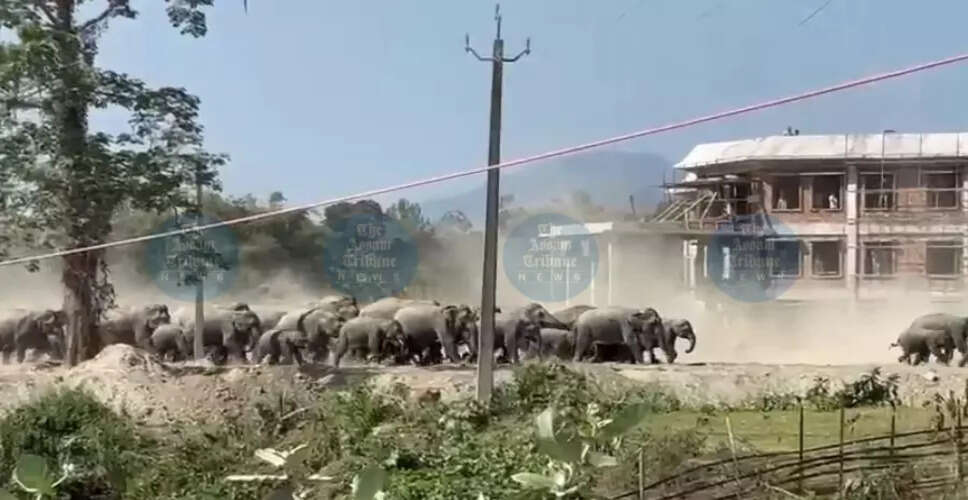

Efforts to Manage Elephant Herds in Assam
A herd of elephants, estimated to be over 150, traversed through villages in the Kumarikata forest range (Image)
Over the course of five days, local volunteers, forest officials, and villagers worked diligently to track a large herd of elephants along the India-Bhutan border in Assam, aiming to keep them away from populated areas.
The elephants moved through various locations, including the Pagladiya river area and the Nagrijuli tea garden, causing damage to homes and crops, and instilling fear among local residents.
After extensive collaboration involving the Baksa Forest Division and community members, the herd was successfully redirected towards Bornadi on November 19.
However, those involved in the operation recognize that merely relocating the elephants is not a comprehensive solution. The pressing concern remains whether the forest can provide adequate food, water, and space for the elephants to thrive.
Five Days of Concern
In recent months, the frequency of human-elephant conflicts in the Tamulpur, Baksa, and Nalbari districts has escalated, as large herds have been descending from the hills in search of food.
At times, the herd size has exceeded 150 elephants, frequently passing through villages in the Kumarikata forest range, including Dorangapar, Sesapani, and Khairani.
Managing such large groups poses significant challenges for forest officials. Madhav Chetri, secretary of the Gaibari Saipatri Foundation, which has been aiding in monitoring the elephants, emphasized the complexities highlighted by the five-day operation.
"While we successfully guided the herd from Nagrijuli tea garden to Bornadi, simply pushing them away is not a viable long-term solution. We are dealing with a herd of 100 to 200 elephants, including young calves. What will happen to them?" Chetri questioned.
Some of the calves are only one or two months old, complicating the herd's movement. Chetri noted that the lack of food in forest areas exacerbates the situation.
"Upon inspecting the forest, we found minimal food resources. Some herds we monitor near Kampur and Ghumurighat also have very young calves. How far can they travel in search of food? If their hunger is not addressed, they will inevitably return to human settlements. We need to consider solutions beyond just driving them away," he stated.
Food Scarcity in the Forest
Kumarikata forest ranger Prabhat Barman mentioned that elephant movements have been tracked since June and July when their numbers were lower.
The situation worsened in August and September, with numbers peaking in October, leading to an estimated herd size of over 150.
"Elephants typically enter human settlements when paddy crops are ripe, as agricultural fields provide easy access to food. They also seek water, which is scarce in higher regions," Barman explained.
The resulting destruction of homes and crops has led to both human and elephant casualties.
To address the issue, the Forest Department is collaborating with local communities, NGOs, and law enforcement.
Barman highlighted the crucial role of villagers, many of whom have cooperated despite crop losses.
"We have been making public announcements and conducting meetings to educate people on avoiding confrontations with the herd. Following the Forest Minister's appeal, several villagers have voluntarily removed parts of their fences to allow elephants to access paddy from their fields, even at a financial cost. Their cooperation is commendable," Barman added.

Forest personnel actively engaging in guiding the herd of elephants towards Bornadi (Image)
Forest officials have also been coordinating with local residents to monitor elephant movements and alert at-risk communities.
Support from police and district officials in Nagrijuli, Kumarikata, Dorangapar, and Tamulpur has been instrumental in these operations.
However, the challenge extends beyond managing individual herds. The elephants' traditional habitats along the India-Bhutan border are increasingly under threat.
Declining forest cover, food, and water availability have been noted in several regions. Additionally, activities such as stone and sand extraction in riverbeds, along with noise from machinery, have disrupted elephant movements.
For officials, each operation requires balancing the need to protect human lives while ensuring the elephants are moved without undue stress or harm.
From Management to Restoration
Recognizing the escalating conflict, the state government has announced new initiatives.
On November 7, Forest Minister Jayanta Malla Baruah revealed the deployment of 140 Gaj Mitras in 14 teams across the Kumarikata, Batabari, and Tamulpur forest ranges.
These teams are tasked with enhancing coordination with villagers, monitoring elephant movements, and preventing unexpected encounters between humans and herds.
Another focus is on restoring food sources within forest areas. The government plans to engage the Kokrajhar Ecological Task Force, comprising former military personnel, in plantation efforts across 50 hectares.
The proposed plantations will include trees that serve as food for elephants, aiming to encourage them to remain in their natural habitats.
The government is also contemplating increasing compensation for families affected by elephant attacks from Rs 6 lakh to Rs 8 lakh.
The herd of elephants observed in Tamulpur district (Video)
Previously, on November 4, the timeframe for disbursing compensation to the next of kin was shortened from 72 hours to 48 hours.
These measures underscore the urgency of the situation. However, those on the ground believe that compensation and repeated drives cannot resolve the fundamental issues.
"We urge Forest Minister Jayanta Malla Baruah to address the food shortages faced by the elephants. The villagers have shown remarkable understanding and cooperation, but the government must engage with the community to discuss how to secure food for the herds. Elephants are a valuable resource, just as humans are. We need to protect both and find a way for them to coexist," Chetri concluded.
While the five-day operation successfully redirected the herd towards Bornadi, it has revealed the limitations of repeatedly pushing elephants back into forests that may no longer support them. For Tamulpur, the challenge now lies not just in driving elephants away from villages but in restoring the conditions that will keep them at bay.