
Challenges Ahead for NDA in Passing Women's Reservation Bills

NDA's Struggle for Support in Parliament
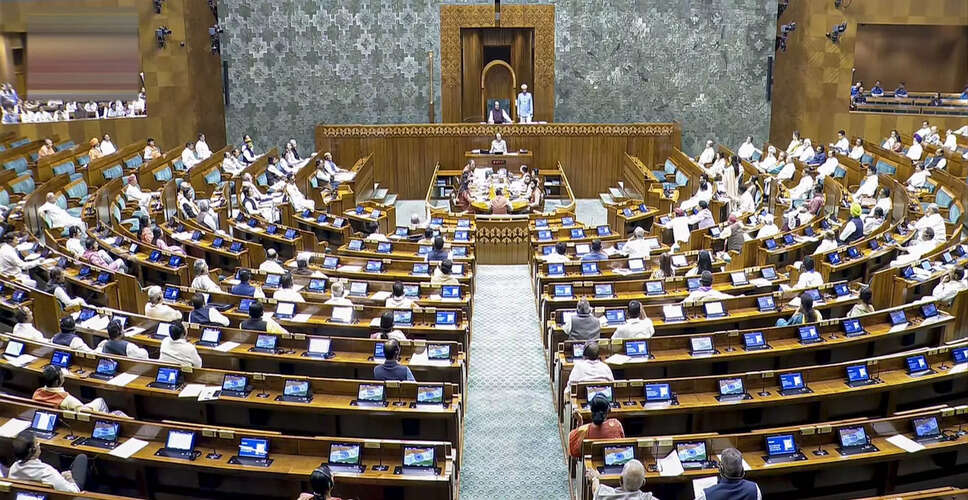
A file image of Lok Sabha session (Photo:PTI)
New Delhi, Apr 16: The ruling National Democratic Alliance (NDA) faces significant hurdles in securing the necessary two-thirds majority in Parliament to pass the women's reservation bills, unless they can garner support from other political parties or persuade some to abstain from voting.
Currently, the NDA holds the backing of 293 members in the Lok Sabha, accounting for 54 percent of the total seats, while the opposition commands 233 MPs.
Additionally, there are 7 independent MPs and another 7 from parties such as YSRCP, AIMIM, and Shiromani Akali Dal, who have not yet declared their support for the proposed legislation.
To pass the bills, including the constitutional amendment, a total of 360 MPs must vote in favor, which represents two-thirds of those present and voting.
For the Lok Sabha to approve the bills, at least two major opposition parties, such as the Samajwadi Party (37 MPs), Trinamool Congress (28 MPs), or DMK (22 MPs), would need to abstain. The Congress party holds 98 seats in the Lok Sabha.
On the NDA side, the BJP has 240 MPs, while TDP and JDU contribute 16 and 12 MPs, respectively.
If the Lok Sabha does not approve the bills, they will not be considered in the Rajya Sabha.
In the Rajya Sabha, the NDA has 141 members, which is 58 percent of the upper house, compared to 83 MPs from the opposition.
Parties like BRS, YSRCP, BJD, and BSP, along with independents, hold 20 seats in the upper house, which could influence the outcome.
To pass the constitutional amendment bill in the Rajya Sabha, the ruling coalition needs the support of 163 MPs present and voting, which constitutes a two-thirds majority.
While the BJP has 107 MPs in the Rajya Sabha, the Congress has 28, TMC 13, AAP 10, and DMK 8.
Sources indicate that several BJP MPs have privately acknowledged the party's lack of sufficient numbers to pass these crucial bills.
Amending the Constitution necessitates a special majority in both houses: a majority of the total membership (over 50 percent) and a two-thirds majority of those present and voting.
With all 540 members currently in the house, the two-thirds majority threshold would be 360 votes.
In a bid to rally support for the bills, Prime Minister Narendra Modi made a passionate appeal in the Lok Sabha, stating that he would take full credit if the opposition opposes the bills but is willing to offer a "blank cheque" to all if they support the legislation.
The Constitution (131st Amendment) Bill, aimed at modifying the women's quota law, was introduced in the Lok Sabha on Thursday following a vote division.
Additionally, two ordinary bills—the Delimitation Bill and the Union Territories Laws (Amendment) Bill—were introduced to facilitate the implementation of the amended women's quota law in the Union territories of Delhi, Puducherry, and Jammu and Kashmir.
Voting on the three bills concerning the women’s quota law and the establishment of a delimitation commission is scheduled for 4 PM on Friday.