
Centre Justifies Temporary Suspension of Telegram Ahead of NEET UG Re-Examination

Government's Defense of Telegram Suspension
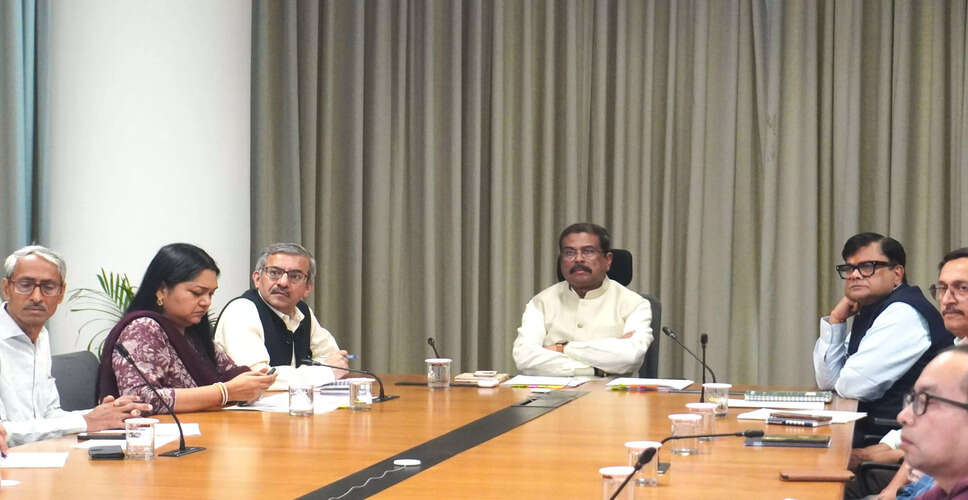
Dharmendra Pradhan chaired a high-level review meeting to assess preparedness for NEET UG re-examination, on Thursday. (Photo:@PIB_India)
New Delhi, June 18: The Indian government has defended its choice to temporarily halt Telegram's services nationwide in light of the upcoming NEET (UG) 2026 re-examination. This decision was presented to the Delhi High Court, where officials stated that the Union government had "no alternative" but to utilize emergency blocking powers as outlined in the Information Technology Act.
In an affidavit submitted to the Delhi High Court, responding to Telegram's petition against the suspension, the Ministry of Electronics and Information Technology (MeitY) explained that the action was taken only after all other options were considered and deemed insufficient.
“I affirm that the decision was made after exploring less restrictive alternatives, which included targeted removal of illegal content, but these measures would have been grossly inadequate,” stated Mayank, a Scientist-E at MeitY, in the affidavit.
The government emphasized that Telegram had emerged as a significant platform for the distribution of alleged NEET paper leaks, fraudulent examination materials, cyber scams, and other illegal activities, which posed a serious risk to public order and the integrity of the national examination system.
“This matter is both sensitive and alarming for the entire student body, and any further compromise to the integrity of an examination involving nearly 22 lakh students across India could lead to unrest and public order issues,” the affidavit noted.
According to the government's response, MeitY received a complaint from the National Testing Agency (NTA) on May 21, detailing an alleged organized fraud network operating on Telegram under names like "Re-NEET 2026" and "Paper Leaked NEET".
The NTA reported that the identified channels, groups, and bots had a collective reach of approximately 1.46 lakh accounts, openly promoting access to examination papers for a fee.
The affidavit mentioned a meeting with Telegram officials on June 3, during which the platform reportedly acknowledged challenges in proactively identifying channels involved in selling leaked papers and admitted that malicious actors were taking advantage of its anonymity features.
The government asserted that Telegram had not implemented sufficient proactive measures despite ongoing concerns raised over the years.
In defending the use of emergency powers under Rule 9 of the Information Technology (Procedure and Safeguards for Blocking for Access of Information by Public) Rules, 2009, the Centre stated that authorities had no feasible alternative due to the rapid emergence of mirror channels, anonymous accounts, and automated bots.
The affidavit referenced a Telegram channel named "NEET Mafia", which had around 18,617 subscribers, alleging it was used to share content related to examination paper leaks, payment arrangements, and advance booking schemes.
“Each subscriber may represent a potential recipient, participant, facilitator, beneficiary, or witness concerning the unlawful activity being investigated,” the Centre argued.
The Union government also cited reports from the Indian Cyber Crime Coordination Centre (I4C), asserting that Telegram's technical features, including anonymity-enhancing tools, large channels, automated bots, forwarding mechanisms, and cloud-based architecture, posed significant challenges for law enforcement.
The Centre contended that content-specific takedowns were ineffective since channels and bots could be recreated almost instantly.
“Thus, interim blocking under Section 69A is the only effective measure to disrupt the cycle of immediate respawning that Telegram itself acknowledges,” the affidavit concluded.
With the NEET re-examination scheduled for June 21, the Union government stated that its primary concern was to uphold the sanctity and integrity of the examination process and avert any further controversies. Telegram's services will remain temporarily restricted in India until June 22.