
Centre Extends Ban on NSCN (K) for Five More Years
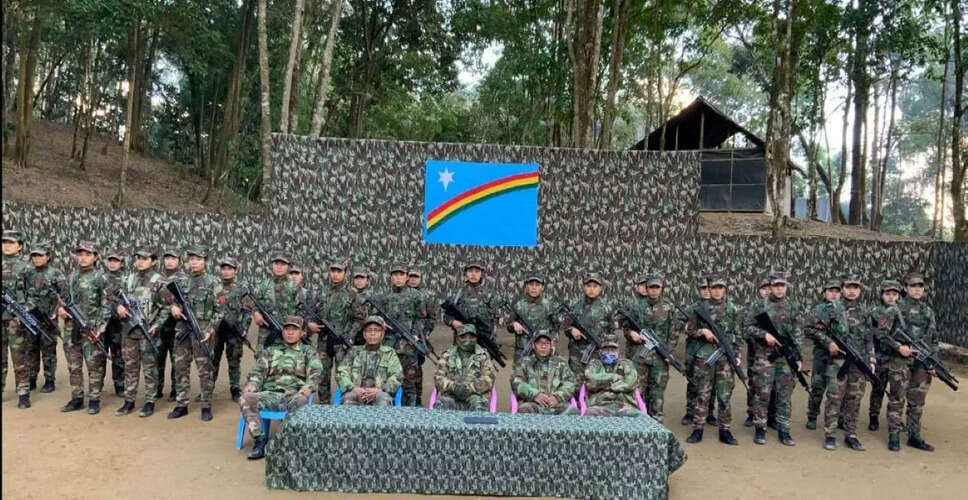

Government's Decision on NSCN (K)
New Delhi, Mar 31: The Unlawful Activities (Prevention) Tribunal has upheld the five-year ban imposed by the government on the National Socialist Council of Nagaland (Khaplang), commonly known as NSCN (K), along with all its associated factions and fronts, as stated in an order released on Tuesday.
In a ruling dated March 19, which was published in the gazette late Tuesday, Presiding Officer Justice Nelson Sailo determined that the actions of NSCN (K) pose a threat to the sovereignty and integrity of India, with the group's ultimate goal being to secede from the nation.
The tribunal's findings indicated that the activities conducted by the NSCN (K) and its members clearly demonstrate that the organization is engaged in warfare against the Government of India.
The ban will take effect from September 28, 2025, lasting for a duration of five years.
According to the Unlawful Activities (Prevention) Act of 1967, any association deemed unlawful must be referred to the Tribunal within 30 days of the notification for adjudication on the validity of the declaration.
The tribunal concluded that there was substantial evidence indicating that the group's activities posed a significant threat to the nation's sovereignty, aiming to establish a 'sovereign Nagaland' that would include Naga-inhabited regions of the Indo-Myanmar area through secession from India.
"The actions of NSCN (K) represent a direct challenge to India's sovereignty and integrity, necessitating a ban on their unlawful activities to prevent further disruption and anti-national conduct," the tribunal stated.
Upon reviewing the evidence presented by the central government and the state governments of Arunachal Pradesh, Manipur, and Nagaland, the tribunal noted that the organization had engaged in unlawful activities that jeopardize national unity and the safety of citizens.
It warned that without immediate intervention, the group could regroup, rearm, and escalate its anti-national activities, potentially leading to civilian and security force casualties.
The tribunal also revealed that NSCN (K) has been collaborating with other unlawful groups, including the United Liberation Front of Asom (Independent) [ULFA (I)], People's Revolutionary Party of Kangleipak (PREPAK), and People's Liberation Army (PLA).
"Given the aforementioned points, there is adequate justification to classify NSCN (K) and all its factions, wings, and front organizations as an 'unlawful association' for a period of five years starting from September 28, 2025. This decision is confirmed by the Tribunal under the UA(P) Act, 1967," it concluded.
The state governments of Nagaland, Manipur, and Arunachal Pradesh have also supported the classification of NSCN (K) as an unlawful association under the Unlawful Activities (Prevention) Act (UAPA).
NSCN (K) has faced bans for decades, with extensions occurring every five years.
Following the death of its leader, S S Khaplang, a Myanmarese Naga, in 2017, the group is now managed by two of his deputies.
In contrast, the rival faction, NSCN-IM, is currently engaged in peace talks with the central government to seek a lasting resolution to the longstanding insurgency in Nagaland.