
Central Government Assures Fuel Availability Amid Global Tensions
Government Reassures Public on Fuel Supplies
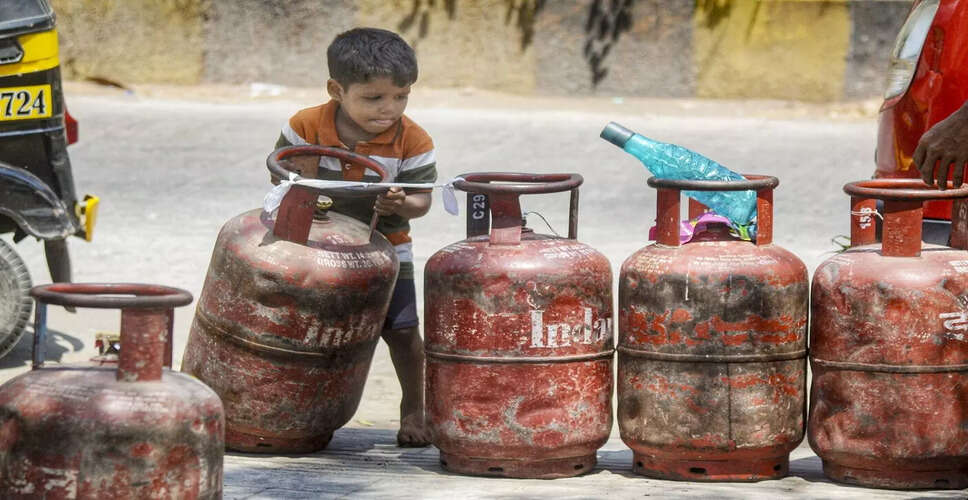
A child attempts to carry an LPG cylinder amid disruptions in supplies, in Navi Mumbai. (Photo:PTI)
Guwahati, April 4: On Saturday, the Central government addressed public worries regarding fuel availability, urging citizens to refrain from panic buying of petrol, diesel, and LPG. They assured that supplies are sufficient despite recent disruptions caused by rising tensions in West Asia and the temporary closure of the Strait of Hormuz.
The Ministry of Petroleum and Natural Gas issued a comprehensive statement, highlighting the government's proactive measures to ensure a steady supply of essential fuels and cooking gas throughout the nation.
Citizens are encouraged to rely solely on official communications and practice responsible consumption.
“There is no shortage of petrol, diesel, or LPG in the country. Supplies remain stable, and people should avoid panic buying,” the ministry reiterated.
To prioritize domestic needs, the government has ensured that LPG and piped natural gas (PNG) supplies are directed towards households, hospitals, and other critical services.
Indian refineries are operating at full capacity with ample crude inventories, and petrol stations are well-stocked.
Authorities have stepped up enforcement against hoarding and black marketing, conducting over 3,700 raids nationwide, which led to nearly 1,000 show-cause notices issued to LPG distributors and the suspension of 27 dealerships.
Despite global pressures, officials confirmed that there are no shortages at distribution points. On Friday alone, approximately 51 lakh LPG cylinders were delivered, with online bookings making up 95% of the demand.
To manage supply effectively, commercial LPG distribution has been limited to 70% of pre-crisis levels, while alternative fuels like kerosene and coal are being utilized to alleviate demand in specific sectors.
Even with geopolitical tensions affecting one of the world's key energy corridors, India has successfully maintained fuel inflows.
An Indian-flagged LPG tanker, Green Sanvi, carrying 46,650 tonnes of LPG, successfully navigated the Strait of Hormuz on Saturday, marking the seventh vessel to transit this sensitive route since the conflict escalated.
“The vessel has safely crossed the Strait with all 25 crew members secure,” the government confirmed.
In another development, an LPG shipment from Iran, carried by Sea Bird with approximately 44,000 tonnes of cargo, has docked at Mangalore and is currently being unloaded. This is significant as it represents one of India's first imports of Iranian LPG in several years, following a temporary easing of US sanctions amid rising global prices.
Earlier this week, additional LPG carriers, including BW TYR and BW ELM, safely reached Indian ports, while other vessels such as Pine Gas, Jag Vasant, MT Shivalik, and MT Nanda Devi have also completed successful transits recently.
The Strait of Hormuz, crucial for global oil and gas transport, has been severely impacted by military escalations involving Iran, the United States, and Israel. This narrow passage is vital for energy exports from Gulf nations, which account for nearly 90% of India's LPG imports.
India, which consumed over 33 million tonnes of LPG last year, relies on imports for about 60% of its needs, making the stability of maritime routes essential.
Currently, 17 Indian-flagged vessels with around 460 seafarers are in the western Persian Gulf region. Authorities, including the Directorate General of Shipping, are closely monitoring their movements in coordination with ship owners and Indian missions abroad.
The government has confirmed that all Indian seafarers are safe, and no incidents involving Indian vessels have been reported in the last 24 hours.
To protect consumers from fluctuating global oil prices, the Centre has reduced excise duty on petrol and diesel by Rs 10 per litre and imposed export levies on diesel and aviation turbine fuel to enhance domestic availability.
Moreover, natural gas supplies to households and transport sectors are being maintained at full levels, while allocations to industries and fertilizer plants are gradually increasing, supported by incoming LNG shipments.
The government has instructed state authorities to enhance monitoring, combat misinformation, and ensure smooth last-mile fuel distribution.
Reiterating its position, the ministry stated that India's overall energy ecosystem remains secure despite external disruptions.
“We are closely monitoring the situation and taking all necessary steps to maintain a seamless supply of essential fuels. There is no cause for alarm,” the statement concluded.