
Celebrating Environmental Awareness: Maganbhai Patel's Birthday Tree Plantation Initiative
Maganbhai Patel, a prominent industrialist, celebrated his birthday by planting trees at a pharmacy college in Ahmedabad, emphasizing the urgent need for environmental conservation. He addressed students about the interconnectedness of human life and nature, highlighting the detrimental effects of pollution. Patel's efforts coincide with World Environment Day, a global initiative aimed at raising awareness about environmental issues. He discussed the alarming rise in air, soil, and water pollution, urging collective action to combat these challenges. The event serves as a reminder of the importance of sustainable practices and the role of individuals in preserving the environment for future generations.
| Jun 16, 2026, 18:34 IST

A Meaningful Celebration
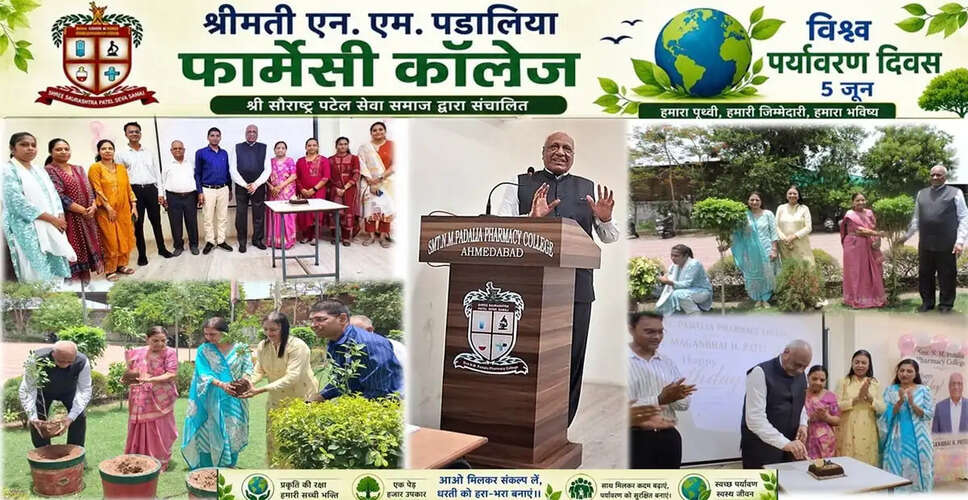
Recently, renowned industrialist and philanthropist Maganbhai Patel, who also serves as the president of the All India MSME Federation, celebrated his birthday by planting trees at the Shri N.M. Padalia Pharmacy College in the Changodar area of Ahmedabad, accompanied by family members and college students. His wife, Shantaben Maganbhai Patel, daughter Dipti Patel, and daughter Jyotsnaben Patel were notably present for the occasion. As the chairman and managing trustee of the college, Maganbhai Patel also took the opportunity to send a letter to Union Environment Minister Bhupendra Yadav, offering significant suggestions regarding the current state of land, air, and water pollution on the occasion of World Environment Day.
Connecting Humanity and Nature
During his address to the students, Maganbhai Patel emphasized the deep connection between human life and nature. He pointed out that clean air, pure water, fertile land, forests, and wildlife are the pillars of human existence. However, the severe impacts of increasing industrialization and urbanization are disrupting the environmental balance. He explained that 'environment' refers to the surrounding atmosphere, which nature has generously provided with rivers, mountains, forests, and clean air. Yet, due to modernization and population growth, the global environment is now at risk. If we fail to protect the environment today, future generations will struggle to survive. Environmental conservation is not merely a responsibility; it is a fight for the existence of our future generations.
World Environment Day: A Global Awareness Initiative
World Environment Day is celebrated annually on June 5 to raise awareness about this critical issue. The first global conference on the human environment was held by the United Nations in Stockholm, Sweden, in 1972, where significant discussions on environmental protection took place. Following this, the UN decided to observe June 5 as World Environment Day. Official celebrations began in 1974, and today, over 150 countries participate in various programs, campaigns, and awareness activities to mark this day. The world is now increasingly vigilant about moving towards a green era and future, with India also making significant strides in green growth, particularly in Gujarat.
Addressing Pollution Challenges
Maganbhai Patel further highlighted the various pollutants damaging the environment, including vehicle emissions, toxic gases from factories, and the burning of waste, which have severely polluted the atmosphere. Additionally, the discharge of chemical-laden water from industries into rivers and the accumulation of plastic waste have contaminated water bodies, while the excessive use of chemical fertilizers, pesticides, and plastics in agriculture has led to soil pollution.
Air Pollution: A Growing Concern
1. Climate Change, Global Warming, and Air Pollution:
Air pollution is one of the most pressing issues today. There is a stark difference in air quality compared to previous decades. Estimates indicate that between 1950 and 1980, India's Air Quality Index (AQI) ranged from 20 to 50, considered extremely clean and healthy. During that time, thousands of stars were visible at night, and the moon was so bright that one could thread a needle by its light. This was due to limited vehicles and industries, resulting in negligible particulate matter in the air. In contrast, today, the AQI in most Indian cities has surged to between 300 and 500, raising serious health concerns. In metropolitan areas like Delhi, it often exceeds 500, significantly impacting citizens' health and leading to an increase in respiratory diseases. Reports indicate that air pollution in India has risen by over 67% from 1998 to 2021, with rising levels of carbon dioxide (CO2), methane (CH4), and nitrous oxide contributing to global warming, causing polar ice to melt and sea levels to rise.
Mitigating Air Pollution
Measures to Combat Air Pollution:
To combat air pollution, citizens should utilize public transport, bicycles, or electric vehicles whenever possible. Wearing masks (N95) during high pollution days and using sunglasses for eye protection is advisable. Planting more trees around homes can serve as natural air purifiers. Engaging in collective initiatives like Mission LiFE at both community and government levels can promote environmentally friendly lifestyles. Avoiding open burning of waste and adopting clean energy sources like solar or wind energy is essential.
Soil Pollution: A Serious Threat
2. Soil Pollution:
Soil pollution is a critical issue affecting the fertility of the earth and human health. Over time, the quality of soil has deteriorated alarmingly. Before the 1960s and 70s, more than 90% of farming was organic, utilizing natural fertilizers. Today, India uses over 5 million tons of chemical fertilizers annually. Previously, plastic use was minimal, but now approximately 3.4 million tons of plastic waste is generated each year, much of which ends up buried in the ground. Natural vegetation once controlled soil erosion, but now about 147 million hectares of land in India are affected by various forms of erosion and pollution. Daily, cities in India generate 150,000 tons of solid waste, which degrades land at landfill sites. Excessive use of hazardous chemical fertilizers and pesticides has made soil either 'acidic' or 'alkaline,' destroying beneficial organisms like earthworms. Solid waste from chemical, textile, and pharmaceutical companies contaminates the soil with toxic elements like lead, mercury, and arsenic, while e-waste from smartphones and batteries significantly contributes to soil pollution.
Preventing Soil Pollution
Measures to Prevent Soil Pollution:
Instead of chemical fertilizers, adopting 'cow-based farming' or organic farming should be prioritized, along with increasing the use of agro-waste. Agro-waste refers to the byproducts generated during farming and animal husbandry. Composting urban waste should be initiated at all levels, with wet and dry waste separated for composting and recycling. Industries should neutralize their waste before disposal to prevent toxic elements from contaminating the soil.
Water Pollution: A Growing Crisis
3. Water Pollution:
Human activities have led to the contamination of water sources on Earth, posing severe risks to aquatic life and human health. Over time, the quality of water in India has deteriorated alarmingly. In the 1950s and 60s, the annual per capita water availability was about 5,177 cubic meters, with river water considered pure and drinkable. Today, by 2021, per capita water availability has dropped to approximately 1,486 cubic meters, marking a 71% decline. About 70% of India's surface water is unsafe for use. According to a report by the Central Pollution Control Board (CPCB) for 2022-23, around 296 to 311 river stretches in India are polluted. Cities generate approximately 72,368 million liters of wastewater daily, of which only 44% is treated.
Combating Water Pollution
Measures to Combat Water Pollution:
Establishing sewage treatment plants (STPs) in every city is essential for purifying wastewater before it is released into rivers. Plastics, oils, and other chemicals should not be disposed of directly into drains or water bodies. Rainwater harvesting should be implemented to enhance groundwater levels, and pollution from industries should be strictly monitored by agencies like the Pollution Control Board.
A Vision for a Greener Future
During a recent event in Gujarat, Prime Minister Narendra Modi stated that Gujarat was the first state to establish a separate department for climate change at the beginning of this century. The state also built India's first solar park in Charanka village, which became a pilgrimage site for many. The initiatives taken in Gujarat have inspired the entire nation. Today, India is progressing with the mantra of 'Economy and Ecology' in harmony with nature.
The Path Ahead
Maganbhai Patel concluded by stating that in our country, treated wastewater is now being provided to industries, and those managing this wastewater are also earning from it. Over the past 12 years, significant activities have been undertaken in the direction of 'Waste to Wealth,' contributing to the cleanliness and greenery of our cities. The expansion of green growth initiatives in the country is also accelerating. Some industrial sectors are expected to produce green steel, utilizing green energy in steel production.
Facing Global Challenges
Today, the world is facing unprecedented challenges, with this decade proving to be a time of disasters. The COVID-19 pandemic was followed by an energy crisis due to conflicts in Gulf countries, leading to fluctuating fuel prices and disrupted gas supply chains.
Strengthening Renewable Energy
India must strengthen its capabilities in refining, solar, and wind energy, which can be immensely beneficial for the country. Currently, India's renewable capacity stands at 250 gigawatts, a significant leap from previous megawatt discussions. As India works in areas like green hydrogen and green ammonia, public participation is crucial. The renewable capacity developed in the energy sector over the past 12 years is vital. Previously, solar energy production was negligible in India, but today, the country ranks among the top five globally, with significant advancements in ethanol blending, railway electrification, and nuclear energy.
A Call to Action
India has moved beyond negativity and is filled with boundless optimism and extraordinary aspirations. Citizens must commit to turning their resolutions into achievements. When the people of India and the world are resolute, the country can achieve every goal.
A Collective Effort for the Environment
In conclusion, Maganbhai Patel expressed that the All India MSME Federation welcomes the efforts of Prime Minister Narendra Modi and his team in building a developed India. He urged every citizen to participate in the 'One Tree for Mother' campaign on World Environment Day, emphasizing that collective efforts can lead to a cleaner environment and desired outcomes.