
Calcutta High Court Orders Compensation for Manual Scavenging Tragedy
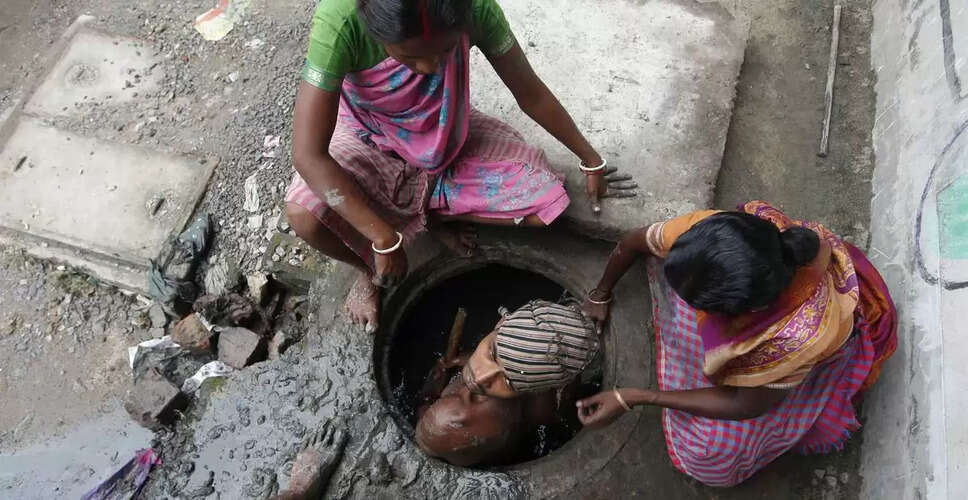
Court Ruling on Manual Scavenging Incident
The Calcutta High Court has determined that the Kolkata Municipal Corporation and state officials are accountable for significant failures that resulted in the deaths of four workers and injuries to three others during sewer line cleaning in February 2021.
A division bench, comprising Acting Chief Justice Sujoy Paul and Justice Chaitali Chatterjee Das, mandated that each family of the deceased workers receive Rs 30 lakh, adhering to a Supreme Court directive regarding compensation for fatalities linked to manual scavenging. The previously disbursed Rs 10 lakh will be deducted from this total.
The court instructed that the compensation be paid within three months.
Additionally, it ordered Rs 5 lakh to be provided to the injured workers within two months.
The court emphasized that manual scavenging is a severe human rights issue and its ongoing existence is a stain on the nation's conscience.
It noted the absence of necessary monitoring systems as required by the 2013 Prohibition of Employment as Manual Scavengers Act.
The court criticized a police affidavit that only mentioned a first information report against unknown individuals as insufficient.
It directed the deputy police commissioner to submit a report regarding the incident and requested the West Bengal government to establish a monitoring committee within a month.
The State Legal Services Authority was tasked with reaching out to the affected families to ensure the compensation is properly distributed.
The four deceased workers, hailing from Malda district, were engaged in sewer desilting under the Kolkata Environment Infrastructure Improvement Project, a contractor working for the municipal corporation, when the tragedy occurred.
They succumbed or sustained injuries due to inhaling hazardous fumes within the sewer.
The victims were identified as 19-year-old Sabir Hossain, 35-year-old Mohammad Alamgir, 22-year-old Jahangir Alam, and 20-year-old Liyakat Ali.
In the wake of these tragic deaths and injuries to others involved in similar sewer work, a public interest litigation was filed by the NGO Association for Protection of Democratic Rights and a civil rights activist, leading to the current case.
Manual scavenging, defined as the manual removal of human waste from sewer systems or septic tanks, is prohibited under the 2013 Prohibition of Employment as Manual Scavengers and their Rehabilitation Act, yet the practice continues in various regions across the country.