
C. Joseph Vijay's Political Journey: Transforming Tamil Nadu Governance

A New Era in Tamil Nadu Politics
On February 2, 2024, the renowned South Indian actor 'Thalapathi' C. Joseph Vijay announced the formation of his political party, 'Tamilga Vetri Kazhagam' (TVK). Initially, many traditional Dravidian political figures dismissed his ambitions, believing he would only serve as a 'kingmaker' rather than a 'king'. However, the results of the Tamil Nadu assembly elections on May 4, 2026, proved them wrong, as the electorate ousted established Dravidian parties and entrusted Vijay with the state's leadership. After taking the oath of office on May 10, critics continued to question his ability to govern without prior administrative experience.
Vijay's Modern Approach to Governance
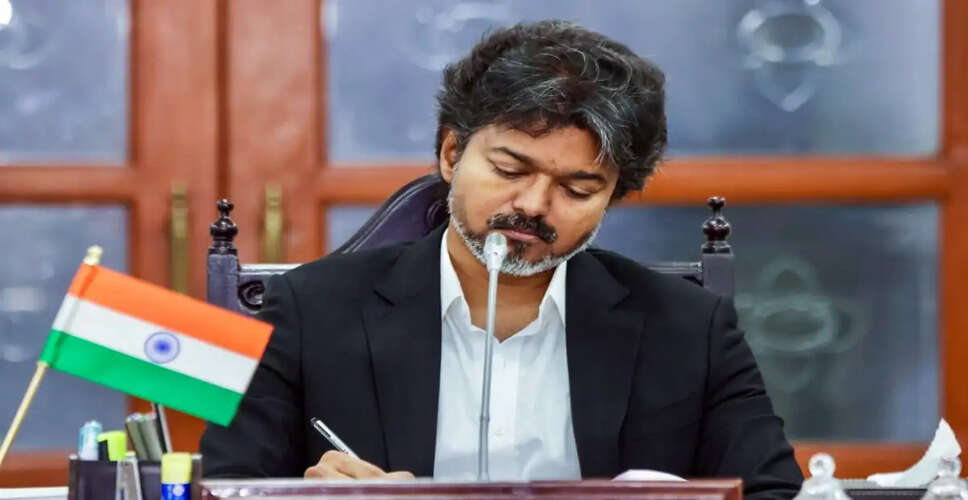
Now, over a month into his tenure, Chief Minister Vijay has silenced his critics with his decisive actions, discipline, and a corporate-style approach to governance. One of the most talked-about aspects is his shift from the traditional white 'veshti' to a modern black suit, symbolizing his identity as a contemporary administrator rather than a conventional politician.
Vijay's commitment to discipline is evident as he spends approximately seven hours daily at his desk from Monday to Friday. He has mandated punctuality and biometric attendance across the administrative system, revitalizing a previously sluggish bureaucracy.
Prioritizing Governance Over Politics
His directives to district collectors and police chiefs reinforce the perception that CM Vijay prioritizes governance over political maneuvering. He has instructed them to act decisively against criminals without political interference, ensuring swift and fair justice for even the most influential offenders. Additionally, he has proposed air-conditioning for all public transport buses in Tamil Nadu.
From his first day in office, Vijay has consistently communicated a message of effective governance. During the election campaign, he made several promises to the people of Tamil Nadu, assuring them that he would not deceive voters with false commitments. On voting day, the citizens upheld their end of the bargain, and now it is Vijay's turn to fulfill his promises.
Immediate Initiatives and Social Welfare
Within hours of assuming office, Vijay announced a scheme to provide 200 units of free electricity, benefiting approximately 24 million domestic electricity consumers in the state. He also established an anti-drug task force in every district to combat drug trafficking and ensure strict penalties for offenders, with Vijay personally overseeing its operations.
Furthermore, he launched a special task force for women, named 'Singappen' (Lioness), aimed at preventing crimes against women and children, ensuring prompt action on complaints.
Addressing Alcohol Accessibility Near Religious Sites
In a decisive move within 48 hours of taking office, Vijay ordered the closure of 717 retail outlets of the Tamil Nadu State Marketing Corporation (Tasmac) located near places of worship, educational institutions, and bus stands. Officials were instructed to shut down all state-run liquor shops within a 500-meter radius of temples, mosques, churches, schools, and colleges within two weeks.
This decision led to the closure of 276 shops near religious sites, 186 near educational institutions, and 255 near bus terminals, fulfilling Vijay's promise to create alcohol-free public spaces. While several electoral promises remain unfulfilled, the government assures that they will be implemented soon.
Vijay's Unique Leadership Style
Vijay's approach to governance, characterized by punctuality, modern attire, and a CEO-like work ethic, sets him apart. Each morning, he arrives at the secretariat dressed in a well-fitted black suit and white shirt, a deliberate departure from the traditional white 'veshti' that has long symbolized Tamil Nadu's political leaders. This choice reflects his intention to present himself as a modern administrator rather than a traditional Dravidian politician.
Inside the secretariat, he emphasizes discipline, reportedly spending around seven hours daily at his desk. He has urged senior officials to maintain punctuality and made timely attendance a mandatory requirement across the administrative system.
Building a Culture of Accountability
While these measures may seem superficial, they contribute to shaping the culture of governance. They send a clear message that efficiency, discipline, and accountability should be valued as much as political rhetoric. The Vice Chairman of the NITI Aayog praised Vijay's efforts, highlighting his commitment to Tamil Nadu's interests while maintaining a practical working relationship with the central government.
After taking office, Vijay met with Prime Minister Narendra Modi to address several long-standing issues in Tamil Nadu politics, including legal action against the proposed Mekedatu dam project in Karnataka and the release of Tamil Nadu fishermen detained by Sri Lanka.
Economic Vision and Anti-Corruption Initiatives
Vijay's economic vision has garnered attention in political circles. The Vice Chairman of the NITI Aayog publicly commended his long-term roadmap aimed at elevating Tamil Nadu's economy to $1.5 trillion by 2035, describing it as ambitious yet clearly articulated. This recognition signals that the new Chief Minister is striving to position Tamil Nadu not only as India's manufacturing hub but also as a global investment and technology destination in the coming decade.
Vijay's government has prioritized the effective implementation of welfare schemes and the improvement of public services. Within weeks of taking office, significant changes were ordered for the 620 'Amma Unavagam' canteens in Tamil Nadu, focusing on modernizing kitchens, upgrading utensils, enhancing cleanliness, and addressing long-standing complaints about food quality.
Commitment to Transparency and Governance
The administration has announced the first phase of cooperative bank loan waivers for poor and economically disadvantaged borrowers, alongside the resumption of several drinking water projects under the 'Jal Jeevan Mission' to enhance access to safe drinking water. To support the agricultural sector, the government unveiled a ₹134.83 crore package to promote paddy cultivation.
Other early initiatives include deploying 40 new vehicles to strengthen rural healthcare and emergency medical services, as well as implementing strict monitoring at scan centers to improve maternal healthcare. Alongside welfare measures, the government aims to present itself as one focused on administrative reforms and clean governance.
A Vision for the Future
Vijay's 'Vettri Tamilzhagam Vision Document' outlines a 436-point governance framework across 35 departments, inspired by the principles of 'Thirukkural', a classic Tamil text on ethics and virtuous living. This document sets measurable goals in areas such as education, healthcare, infrastructure, economic development, and transparent governance.
He also released a 'White Paper' on Tamil Nadu's economic situation, highlighting the state's existing debt burden and promising greater financial transparency. Additionally, Vijay directed officials to eliminate 'parallel power centers' within the bureaucracy, warned against corruption in public works contracts, and expanded the single-window clearance system for investors.
Conclusion: Vijay's Leadership in Action
C. Joseph Vijay, who ruled the silver screen for over two decades, now appears ready to govern Tamil Nadu with the same flair. Despite facing several controversies, he has consistently portrayed himself as a decisive leader actively involved in governance, aiming to silence critics who question whether an actor can be an effective administrator.