
BJP's Political Consolidation in Barak Valley: Insights from the 2026 Assam Assembly Elections

BJP's Stronghold in Barak Valley
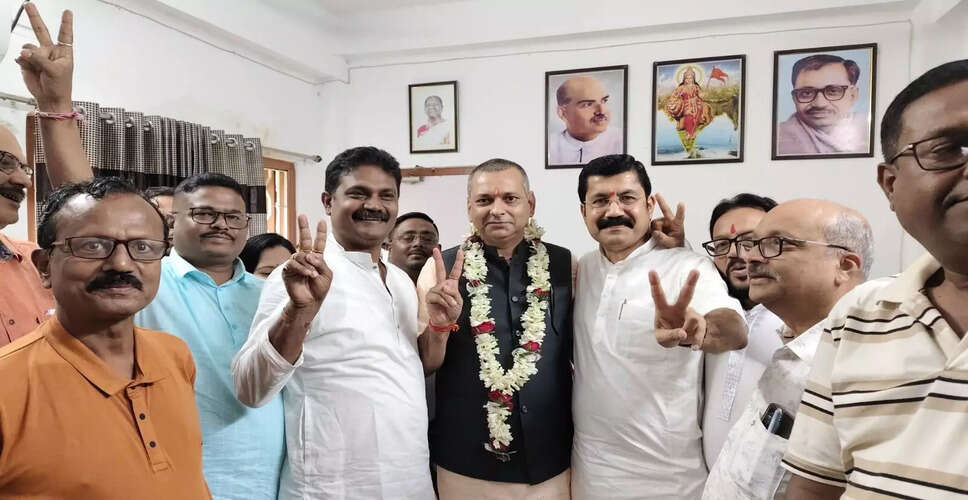
Early celebrations at the residence of Lakhipur MLA Kaushik Rai on Monday after huge mandate in 2026 polls (AT Photo)
Silchar, May 5: The results of the 2026 Assam assembly elections in Barak Valley signify more than just a typical electoral victory; they indicate a phase of political strengthening for the BJP. However, notable resistance from Congress highlights a complex mandate throughout the region.
Reflecting on the historical context, Lakhipur MLA and candidate Kaushik Rai compared the current results to the party's earlier growth. He noted, “In 1991, the BJP secured 9 out of 15 seats. This time, we achieved 9 out of 13, showcasing an even better performance,” suggesting that this outcome is a sign of the party's organizational growth rather than a fleeting success.
This comparison is particularly relevant given the recent delimitation, which has reduced the number of Assembly segments in Barak Valley from 15 to 13.
Within this new structure, the BJP's nine-seat victory indicates a significant territorial influence across Cachar and parts of Karimganj and Hailakandi.
While Congress managed to win four seats, its presence is increasingly limited to specific areas.
Lakhipur emerged as a testament to the BJP's strength, with Rai winning decisively, garnering over 1.25 lakh votes and defeating his Congress opponent by more than 99,000 votes.
He credited the overwhelming support to governance-focused politics, stating, “Voters have chosen visible development and effective governance. There is strong confidence in the leadership of Chief Minister Himanta Biswa Sarma and Prime Minister Narendra Modi.”
The BJP's success across the valley reflects both its organizational depth and its expanding social influence.
In Silchar, Dr. Rajdeep Roy's victory by nearly 54,000 votes demonstrated robust urban support.
In Udharbond, Rajdeep Goala defeated veteran Congress leader Ajit Singh by over 55,000 votes, indicating a shift towards younger leadership.
Seats like Dholai, previously seen as competitive, became one-sided, while Borkhola and Katigorah provided comfortable margins, further solidifying the party's dominance.
Additional wins in Patharkandi, Ramkrishna Nagar, and Hailakandi expanded the BJP's reach, with the latter showing a late surge in favor of the party during the counting process.
Nevertheless, the Congress narrative is still present.
In Sonai, Aminul Haque Laskar won against an AGP candidate, marking the only seat in Cachar to withstand the NDA wave.
Notably, in Algapur-Katlicherra, Youth Congress leader Jubair Anam Mazumder achieved a remarkable victory with a margin exceeding 1 lakh votes, one of the most significant wins in the area.
Congress also retained seats in North and South Karimganj, demonstrating its capacity to maintain support in certain demographic and political areas.
Overall, the Barak election results reveal a dual-layered political landscape.
The BJP's nine-seat dominance signifies widespread consolidation driven by leadership-focused campaigning and effective grassroots organization.
Conversely, Congress has shown it can still mobilize strong localized support capable of achieving significant victories.
Thus, the results indicate a structurally stronger BJP presence in Barak Valley, but not one without contestation, leaving room for selective, issue-based opposition that may influence the region's political future.