
BJP Leader K. Annamalai Challenges Tamil Nadu Government and Central Policies
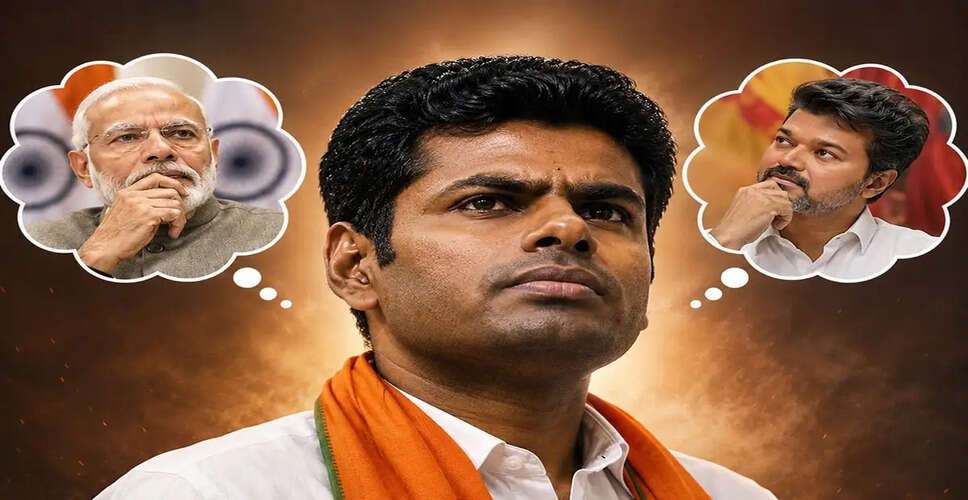

Annamalai's Bold Stance on Education and Food Policies
BJP leader K. Annamalai has been vocal in criticizing the government for public welfare, even targeting his own party's central administration. Recently, he has taken a stand against both the Tamil Nadu government and the central authorities, indicating his desire to address issues beyond party lines and establish a distinct identity by focusing on public concerns. His recent comments on language policy and the midday meal scheme for schoolchildren highlight this intent.
The Central Board of Secondary Education (CBSE) has sparked a new debate in Tamil Nadu politics by mandating a three-language system for ninth-grade students. This decision, announced on May 15, requires students to learn a third language starting this academic year, a shift from the previous notification that planned to implement it in the 2029-30 academic year. Annamalai has openly opposed this sudden change and has urged the Ministry of Education to retract the notification.
Concerns Over New Language Policy
Annamalai expressed that this decision is particularly shocking for parents in Tamil Nadu. He argued that imposing a new language on students at such short notice would add unnecessary pressure and adversely affect their education. He reminded the authorities that the central government had previously assured the implementation of this policy would not occur until 2029-30, emphasizing the need for the government to honor its commitments.
Shift in Political Dynamics
This shift in Annamalai's stance is noteworthy, as he has previously been a strong supporter of the new education policy and the three-language system. Whenever the Dravida Munnetra Kazhagam (DMK) and former Chief Minister M.K. Stalin accused the central government of imposing Hindi, Annamalai defended the center vigorously. His current public dissent is seen as a significant political move.
Language issues have always been sensitive in Tamil Nadu, with anti-Hindi movements in the 1960s reshaping the state's political landscape. Dravidian parties have maintained their dominance on this basis for decades. Any action perceived as an attack on Tamil identity can quickly escalate into political and emotional disputes.
Annamalai's Political Strategy
Since entering Tamil Nadu politics, Annamalai has aimed to localize the BJP's image, showcasing the party as a representative of Tamil aspirations rather than merely an external ideology. However, balancing this image with issues like the new education policy and language system is challenging. If the party openly promotes the three-language policy, opposition parties intensify their accusations of imposing Hindi. Consequently, Annamalai has opted to question the implementation methods rather than oppose the policy itself, stating that the issue lies not in multilingual education but in the haste and administrative pressure involved.
The controversy has also taken a judicial turn, with the Supreme Court issuing notices to the CBSE and the central government regarding petitions challenging the new three-language system. The Chief Justice's bench has requested responses from both parties within four weeks, with the next hearing scheduled for July 15 and 16, indicating that the language dispute has evolved into a constitutional debate.
Political Implications of Annamalai's Statements
The timing of Annamalai's statements is particularly significant, given the BJP's disappointing performance in the recent Tamil Nadu assembly elections, where the party secured only one seat compared to its ally, the Anna Dravida Munnetra Kazhagam (ADMK), which won 47 seats. Allegedly, ADMK leadership had previously sought to sideline Annamalai to facilitate a smoother alliance between the two parties. Subsequently, the BJP removed him from the state president position and did not field him in the assembly elections, stating that his capabilities would be utilized at the national level.
Sources indicate that Annamalai was uncomfortable with the BJP's apparent over-reliance on ADMK. He believes the party should evolve into an independent political force in Tamil Nadu. Following the electoral defeat, discussions regarding the state unit's organization and leadership have commenced, with ongoing talks in Delhi about the party's future and new leadership. In this context, Annamalai's statements are perceived as a political message.
Critique of Midday Meal Scheme
In addition to the language controversy, Annamalai has raised serious concerns regarding the Tamil Nadu government's midday meal scheme. He accused contractors of stockpiling around 20 crore eggs in cold storage after their prices dropped in March, intending to supply them to schools throughout the year. At that time, the price of eggs had fallen to ₹3.70 each, while the government provided ₹5.63 per egg under the scheme.
Annamalai warned that the quality, nutrition, and safety of eggs stored for extended periods could be compromised. He emphasized that this issue transcends procurement processes, impacting the health of millions of children and the trust of parents. Complaints about rotten eggs in the midday meal program have surfaced in Tamil Nadu before, where over 40 lakh students benefit from the nutrition program daily. Any negligence regarding food quality could have widespread repercussions.
Annamalai's Commitment to Public Issues
Annamalai firmly stated that any negligence in the quality of food provided to children is unacceptable. His statements indicate that he is not merely engaging in opposition politics but is striving to establish himself as a vocal leader on public welfare issues in Tamil Nadu. This is evident as he challenges both the state government and questions his own party's central government.