
Bihar's Industrial Struggles: A 20-Year Journey Under Nitish Kumar
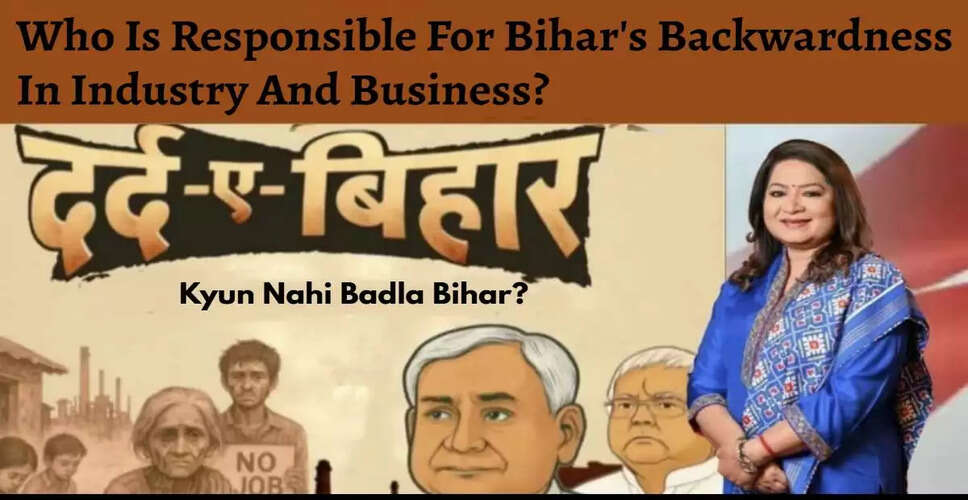
Bihar's Election Countdown
Bharat Ek Soch: Bihar is gearing up for another election cycle, with Chief Minister Nitish Kumar, who has been in office for two decades, at the forefront. The state government has recently pledged to create nearly 1 crore jobs over the next five years. Furthermore, a new industrial policy is on the horizon, aimed at revitalizing the state's economy. This month, an 'Idea Festival' is set to take place, targeting the collection of 10,000 startup concepts. A specialized team will later link the selected ideas with potential markets and investors, with the government offering Rs 10 lakh for innovative proposals.
The Timing of Promises
However, a pressing question arises: Why are these initiatives being announced now? Despite being labeled a 'Vikas Purush' and 'Sushasan Babu', Bihar continues to lag in industrial development and entrepreneurship.
Bihar's Slow Progress
Two decades is ample time for significant change, yet Bihar's growth remains sluggish compared to other states. Why are there fewer factories in Bihar? What prevents local industrialists from establishing businesses? The state's per capita income is less than half the national average. Are policy shortcomings to blame for this stagnation? Who is accountable for the lack of industrial advancement?
Exploring Bihar's Historical Significance
Bihar is historically significant, being the birthplace of Emperor Ashoka and the land of Buddha's teachings. It has a rich legacy in science, with figures like Aryabhatta, and was the cradle of democracy with institutions like Vikramshila and Nalanda. Yet, the state's current economic status raises concerns. With a national per capita income of Rs 1,84,205, Bihar's stands at a mere Rs 66,828, highlighting a stark disparity.
Industrial Development Challenges
Prime Minister Modi's remarks in Motihari prompted many to question why Bihar remains underdeveloped industrially. Nitish Kumar has been Chief Minister since 2005, with a brief interruption. Why is there a sudden focus on job creation as elections approach?
Factory Numbers Tell a Story
2013-14: Bihar had 3,132 operational factories, while the national total was 1,85,690.
In the subsequent year, the number of factories in Bihar fell to 2,942, while nationwide figures rose to 1,89,466.
2015-16: The state had 2,918 factories, compared to 1,91,062 across the country.
2021-22: The total number of operational factories in Bihar dropped to 2,729, while the national figure reached 2,00,576.
Employment Prospects in Bihar
Bihar's Industries Minister, Nitish Mishra, claims rapid changes are underway. However, residents wonder if job opportunities akin to those in Gurugram will emerge in Gaya. Can Motihari rival Mumbai in economic growth? Will industrial parks be established?
The Decline of Bihar's Sugar Industry
Once known as the 'sugar bowl' of India, Bihar had 33 sugar mills producing 40% of the nation's sugar. However, the Bihar Economic Survey indicates that only 9 mills currently operate, producing a fraction of the previous output. The decline of rice mills mirrors this trend, as many factories shut down during the liberalization wave.
Policy Changes Without Impact
In September 2020, during the election campaign, Nitish Kumar acknowledged that most industries are located in coastal states. Shahnawaz Hussain, a former Industry Minister, noted that despite efforts, the industrial landscape remained stagnant. Why did Bihar remain industrially backward until 2021?
The Reluctance of Entrepreneurs
Initially, there was interest from entrepreneurs to invest in Bihar, but the state's conditions deterred them. The Bihar Industrial Incentive Policy of 2006 failed to achieve its goals due to inadequate infrastructure and law enforcement issues. Subsequent policies in 2011 and 2016 also failed to stimulate significant industrial growth.
Proposals vs. Reality
Statistics reveal a stark contrast between proposals and actual industrial establishments. In 2019-20, 248 proposals led to 89 industries; in 2020-21, 284 proposals resulted in only 53 industries. The trend continues, with 393 proposals in 2023-24 yielding just 88 new industries.
Migration for Opportunities
Despite claims of an industrial boom, many Biharis migrate for work. Approximately 2.9 crore people from Bihar seek employment in other states, with Delhi being the most popular destination. The migration rate from Bihar is significantly higher than the national average.
Education and Brain Drain
The decline in educational standards has led to a brain drain, with around 5 lakh youths leaving Bihar annually for better educational opportunities. The absence of private institutions in Bihar raises questions about the state's ability to retain talent.
The Need for a Collaborative Effort
While Bihar is touted as a leader in the ethanol industry, the reality remains that many residents still seek employment outside the state. The government must create a conducive environment for industries to thrive, ensuring safety and stability for investors.
Historical Context of Industrial Decline
Bihar's industrial decline can be traced back to several factors, including historical policies and socio-economic conditions. The focus on social justice overshadowed industrial growth, leading to a perception that investing in Bihar was unwise.
Conclusion: A Call for Action
To realize the vision of 'Bihar First' and 'Make in Bihar', a collective effort is essential. Leaders and citizens must work together beyond election promises to foster genuine industrial growth.