
Bihar Chief Minister Nitish Kumar Resigns from Legislative Council Ahead of Rajya Sabha Oath
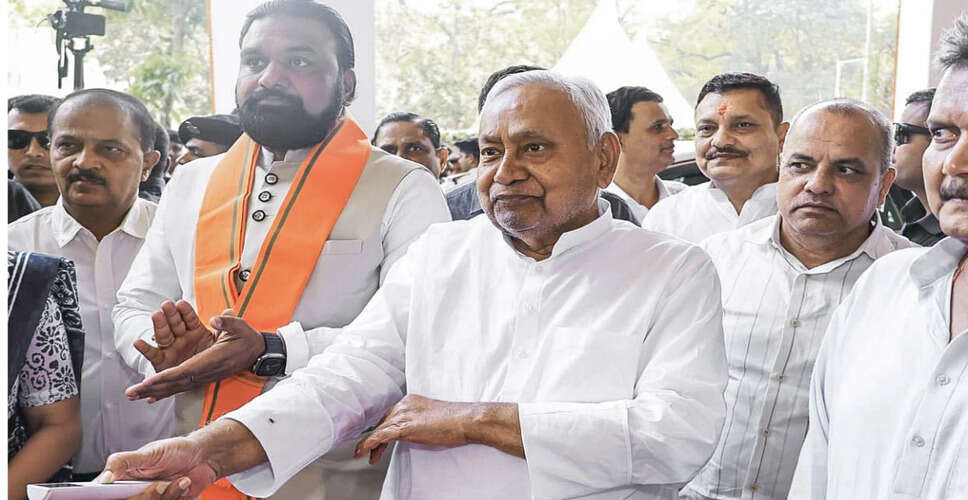
Nitish Kumar's Resignation from Bihar Legislative Council
According to the Chairman of the Legislative Council, Avadhesh Narayan Singh, Bihar's Chief Minister Nitish Kumar submitted his resignation from the state legislative council on Monday, March 30, 2026. Sanjay Gandhi, a member of the JDU, presented Kumar's resignation to the council. Kumar is expected to take an oath as a member of the Rajya Sabha on April 10. However, he continues to hold the position of Chief Minister, and it remains uncertain who will succeed him and when this transition will occur. There has yet to be a consensus among major ally BJP regarding the selection of a new Chief Minister.
It is widely believed that there will be no political upheaval in Bihar. Prior to stepping down, Nitish Kumar has taken several steps, the most recent being his resignation from the legislative council, which fulfills a constitutional requirement following his election to the Rajya Sabha earlier this month. Indian constitutional law currently allows Kumar to remain in office as Chief Minister for the time being.
This resignation was constitutionally mandated. Kumar was elected to the Rajya Sabha on March 16, and according to Article 101(2) of the Constitution, a person must resign from their seat in the state legislature within 14 days of the announcement of Rajya Sabha elections. March 30 was the deadline for this requirement. The question now arises whether resigning from the state assembly means that Nitish Kumar is no longer the Chief Minister. Constitutionally, the answer is no; not yet.
Article 164(4) of the Constitution permits an individual to serve as Chief Minister or Minister for up to six months without being a member of the state assembly. This means that theoretically, Nitish Kumar can continue as Chief Minister in Patna while preparing to take his oath as a Rajya Sabha member on April 10. One cannot be a member of both houses for more than two weeks; however, one can serve as Chief Minister for six months without being a member of either house.
Considering the technical formalities, Kumar's entry into the upper house of Parliament is historic, as he is the first sitting Chief Minister to announce his decision to join the Rajya Sabha. Previously, Chief Ministers have transitioned from state to central roles, but typically after some time. For Nitish Kumar, whose health has been a concern, this signifies that he will now be a member of both the upper and lower houses at both the state and central levels, a rare achievement. Since first becoming Chief Minister in 2005, he has remained a central figure in Bihar's politics, maintaining his political relevance despite numerous coalition changes. Reports suggest that he may resign from the Chief Minister position immediately after taking the Rajya Sabha oath, paving the way for new leadership in Bihar.