
Australia's Growing Engagement with Northeast India: Opportunities for Collaboration

Strengthening Ties Between Australia and Northeast India
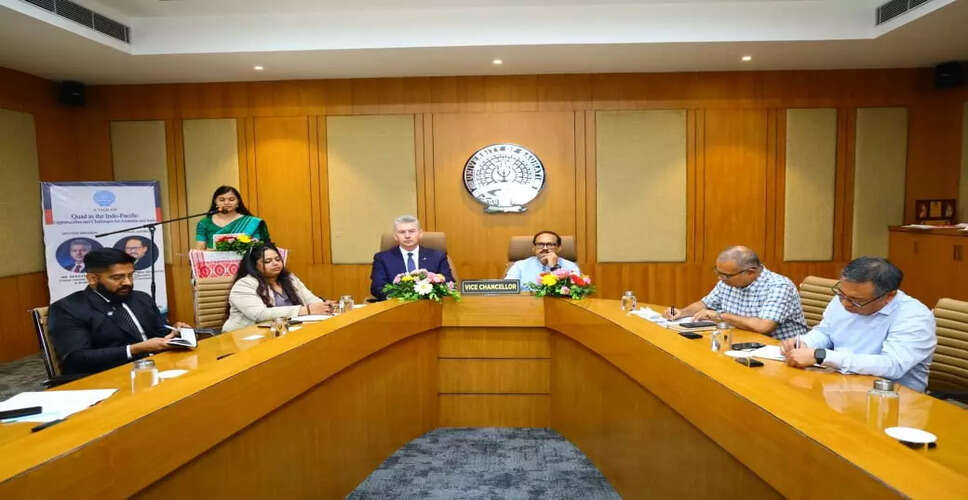
Australian Consul General Bernard Lynch and GU Vice-Chancellor Prof. Nani Gopal Mahanta with other dignitaries at the event. (AT Photo)
Guwahati, June 15: The Australian Consul General, Bernard Lynch, emphasized the significant potential of Northeast India as a connectivity hub linking India with Southeast Asia. He noted that Australia's involvement in the region extends beyond mere diplomatic relations, encompassing grassroots development initiatives across five northeastern states.
During a keynote speech at Gauhati University, titled "Quad in the Indo-Pacific: Opportunities and Challenges for Australia and India," Lynch, who oversees consular duties for the entire Northeast, highlighted the deep connections between the two nations, stating they are united not only by geography but also by shared interests.
Lynch elaborated on Australia's Direct Aid Programme, which funds projects in Assam, Nagaland, Tripura, Manipur, and Arunachal Pradesh, focusing on areas such as water management, education, community resilience, and the empowerment of women and girls.
On the topic of education, he expressed a strong desire to establish partnerships with Gauhati University, viewing it as a natural ally for Australian institutions in the region. He pointed out that collaborations between Australian and Indian universities have surged fivefold from 2007 to 2021, with several Australian universities either opening or seeking permission to establish branch campuses in India.
Prof. Nani Gopal Mahanta, Vice Chancellor of Gauhati University, who opened the event, supported Lynch's vision, stressing that universities like Gauhati University possess untapped potential and advocating for a broader diversification of educational ties between Australia and India, particularly towards the Northeast.
Lynch also discussed the expanding India-Australia relationship, noting that while India's global trade increased by 40% in the past four years, its trade with Australia skyrocketed by 200%. He attributed this growth to the Economic Cooperation and Trade Agreement (ECTA) signed in 2022, marking India's first trade agreement with an OECD country. Ongoing negotiations for a Comprehensive Economic Cooperation Agreement aim to further strengthen these ties, with Prime Minister Narendra Modi's upcoming visit to Australia expected to play a pivotal role.
In the context of the Indo-Pacific, Lynch remarked on the increasingly competitive global landscape and the pressures facing the rules-based order. He underscored the significance of the Quad—comprising India, Australia, the United States, and Japan—as a vital diplomatic platform, clarifying that it is not a military alliance but rather a commitment to peace, stability, and prosperity in the region. Key areas of cooperation include maritime awareness, critical minerals, energy security, and diversified supply chains.
The event successfully bridged academia and diplomacy, with participants highlighting the Northeast's strategic role as India's gateway to Southeast Asia and the necessity for enhanced collaboration between Australian and Indian institutions in the area.