
Assam's Turbulent 2025: A Year of Triumphs and Trials

Reflecting on a Defining Year for Assam
As 2025 draws to a close, Assam has navigated a year filled with significant challenges and milestones. The state experienced a whirlwind of political upheaval, administrative challenges, cultural pride, and shared sorrow, where aspirations often clashed with the need for accountability.
The year was marked by a tragic mining disaster that highlighted regulatory failures, alongside high-stakes elections, eviction initiatives, security concerns, and intense discussions on governance.
Amidst these challenges, Assam also showcased moments of ambition, including global investment opportunities, technological advancements, and cultural celebrations, all juxtaposed against issues like healthcare failures, land disputes, and instances of violence.
In this year-end review, we present a month-by-month account of the most impactful events and figures of 2025, illustrating how they shaped the political, social, and cultural fabric of the region.
Join us as we revisit a year that tested, transformed, and defined Assam and the Northeast.
January: The Umrangso Mining Disaster
January: Umrangso coal mine crisis
The year began with a tragic mining incident in Umrangso, located in Assam’s Dima Hasao district, where flooding in an illegally operated rat-hole coal mine resulted in the deaths of nine workers.
Initial rescue attempts were unsuccessful, prompting the state to enlist specialized agencies. From January 7, teams from the SDRF and NDRF were deployed, followed by divers from the Indian Navy and experts from ONGC, utilizing high-capacity pumps to discharge over 1,000 liters per minute. Between January 18 and February 22, five bodies were recovered after nearly six weeks of efforts. Authorities arrested mine managers and facilitators involved.
Chief Minister Himanta Biswa Sarma announced a compensation of Rs 10 lakh for each victim and ordered statewide inspections, revealing significant regulatory failures and illegal mining operations.
February: Economic Ambitions and Cultural Heritage
February: Advantage Assam 2.0 & Jhumur showcase
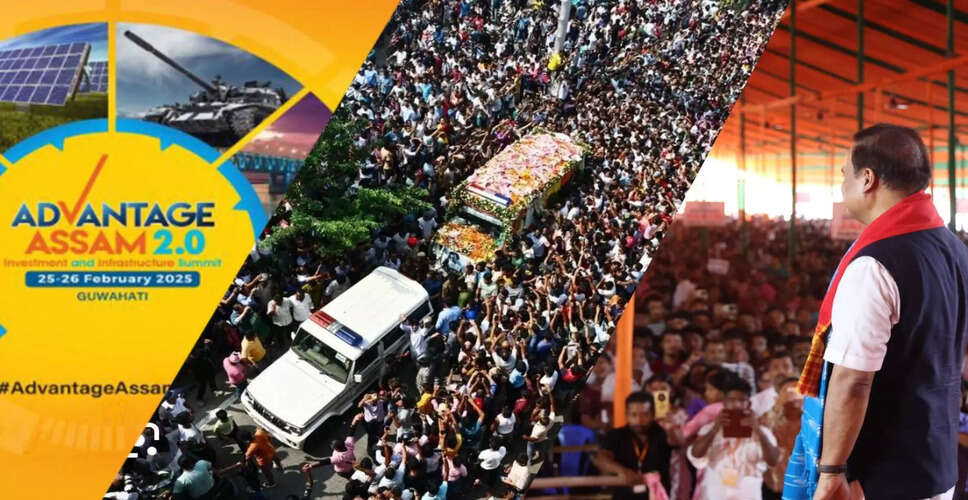
February highlighted both economic aspirations and cultural heritage as Assam hosted Advantage Assam 2.0 from February 25 to 26 in Guwahati. This global investment summit attracted domestic and international investors, Union ministers, and industry leaders.
On the first day, MoUs worth Rs 1.89 lakh crore were signed, with total investment proposals exceeding Rs 5.18 lakh crore by the end of the event, covering sectors like renewable energy, semiconductors, green hydrogen, AI, and infrastructure.
Chief Minister Sarma emphasized that enhanced connectivity had positioned Assam as the economic gateway of the Northeast. Earlier, on February 23, over 8,000 tea garden workers performed a grand Jhumur dance in Guwahati, showcasing the rich heritage of the tea tribe.
March: Technology and Security Concerns
March: Studio Ghibli & Amritpal Singh in Dibrugarh jail
March was characterized by discussions surrounding technology and security. Assam, like the rest of India, witnessed a surge in AI-generated images inspired by Studio Ghibli, which were widely shared on social media, raising questions about copyright and ethical use of AI.
On March 14, Chief Minister Sarma joined the trend by sharing AI-generated visuals from public events. On the security front, pro-Khalistani leader Amritpal Singh remained in Dibrugarh Central Jail under the National Security Act. On March 28, seven of his associates were transferred to Punjab after their detention period ended, while Assam retained Amritpal due to security concerns.
April: National Security Challenges
April: Pahalgam terror attack fallout
April was overshadowed by national security issues following a terror attack in Pahalgam, Jammu and Kashmir, on April 22, which claimed the lives of 26 individuals, including an Indian Air Force Corporal from Arunachal Pradesh.
Political tensions escalated on April 24 when AIUDF MLA Aminul Islam was arrested for allegedly making anti-India remarks related to the attack, igniting debates on free speech and misinformation.
May: Political Consolidation and Security Preparedness
May: Assam panchayat polls & Operation Sindoor drills
May witnessed political consolidation and increased security measures in Assam following Operation Sindoor. Panchayat elections held from May 2 to 10 resulted in a significant victory for the BJP-led NDA alliance, which secured a dominant position across various local bodies.
The results, announced on May 15, underscored the ruling coalition's strengthened rural base ahead of future elections. Concurrently, large-scale preparedness exercises were conducted in response to Operation Sindoor, with mock drills taking place at 27 locations involving multiple emergency services.
June: Security and Governance Issues
June: Bokakhat blast and Garukhuti Project row
June was marked by security and governance challenges. On June 24, a blast near Bokakhat raised concerns about a resurgence of insurgent activity, but Chief Minister Sarma clarified that it was linked to poaching activities rather than ULFA-I.
The month also saw political tensions surrounding the Garukhuti agricultural project, with allegations of corruption exceeding Rs 25 crore in the procurement of Gir cows, prompting calls for a CBI investigation.
July: Eviction Drives and Security Developments
July: Uriamghat eviction drive
July commenced with Assam's largest forest eviction drive in Uriamghat, targeting nearly 15 lakh bighas of encroached forest land. The operation, which began on July 8, involved over 150 excavators and 700 police personnel to dismantle illegal settlements.
While displaced settlers protested, Rengma Naga organizations supported the initiative, viewing it as a means to protect indigenous land rights. Additionally, security developments escalated following a drone strike that reportedly targeted ULFA-I camps along the Indo-Myanmar border.
August: Healthcare Crisis and Accountability
August: GMCH infant deaths & hospital inquiry
August was marred by a healthcare crisis at Gauhati Medical College and Hospital after an infant's tragic death due to a fall from a NICU bed, leading to public outrage and government action.
Chief Minister Sarma ordered an inquiry that revealed lapses in monitoring and staffing, resulting in the booking of 11 individuals for alleged extortion. The incident sparked a broader discussion on systemic weaknesses in Assam's healthcare infrastructure.
September: Mourning a Cultural Icon
September: Demise of beloved Zubeen Garg
September brought collective mourning to Assam with the passing of cultural icon Zubeen Garg on September 19 in Singapore. Reports indicated he drowned while swimming, shocking the Assamese community.
The state government facilitated the repatriation of his remains and observed state mourning. Thousands gathered to pay their respects, and questions arose regarding the circumstances of his death, leading to a Special Investigation Team being formed to probe the incident.
October: Film Release and Ongoing Investigations
October: ‘Roi Roi Binale’ release and Zubeen Garg death probe
October saw the release of Zubeen Garg’s final film, Roi Roi Binale, on October 31, fulfilling his wish to see his work on the big screen. The film resonated deeply with audiences and became a topic of discussion.
In parallel, the investigation into Garg’s death continued, resulting in the arrest of several individuals, including his manager and festival organizers, with the courts placing them in judicial custody.
November: Electoral Revisions and Protests
November: Special revision of electoral rolls & BTC violence
November was marked by administrative tensions as the Election Commission initiated a special revision of electoral rolls in Assam, aiming to update voter information ahead of upcoming elections.
Simultaneously, unrest erupted in Kokrajhar over alleged dilution of ST status for Bodo communities, leading to clashes with security forces and heightened security measures.
December: Concerts and Civil Unrest
December: Post Malone concert & West Karbi Anglong violence
The month began on a celebratory note with international artist Post Malone performing in Guwahati on December 5, marking a significant moment for Assam's concert scene.
However, this festive atmosphere was disrupted by violent protests in West Karbi Anglong related to eviction drives, resulting in casualties and injuries among security personnel. Chief Minister Sarma described the situation as critical, leading to emergency meetings and decisions to address the unrest.