
Assam's Chief Minister Urges for Development-Friendly Environment to Attract Investment

Chief Minister's Call for Competitive Development
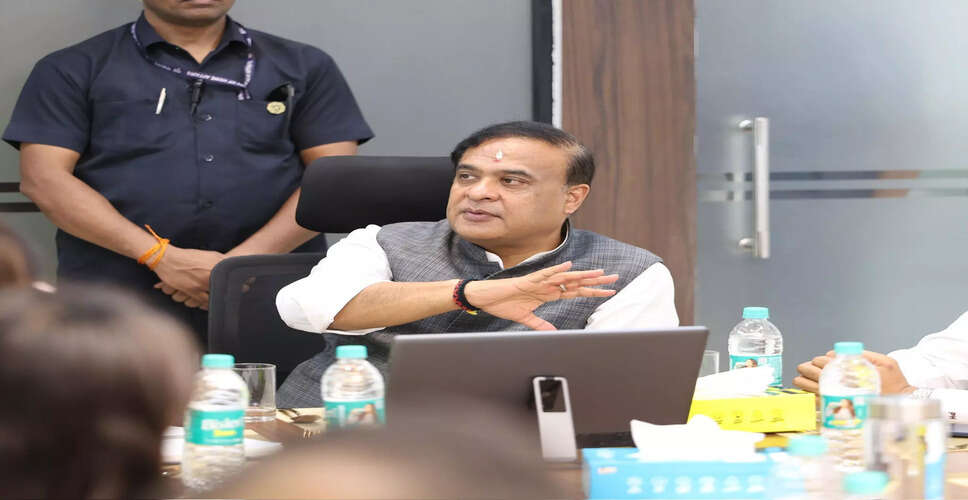
File image of CM Sarma. (Photo:@himantabiswa/X)
Guwahati, July 15: Chief Minister Himanta Biswa Sarma has expressed concerns that Assam risks losing its competitive advantage if significant infrastructure and industrial initiatives continue to encounter extended opposition. He emphasized the necessity for the state to foster a more development-oriented environment to draw in investments, create job opportunities, and maintain economic progress.
During a discussion regarding the Assam Budget for 2026-27 in the Assembly, Sarma highlighted the importance of adopting a mindset of "competitive federalism" by fast-tracking projects in key areas such as power generation, industry, semiconductors, artificial intelligence, and higher education.
"Engaging in the race for development will propel Assam forward. We are in an age of competitive federalism," the Chief Minister remarked.
He contrasted Assam's situation with that of Arunachal Pradesh, which has successfully garnered public support for large hydropower initiatives and is on track to become a significant energy producer.
"Thanks to public backing, Arunachal Pradesh is advancing towards generating 30,000 MW of power, with nearly 10,000 MW already in progress. There are no protests or unrest; the community has willingly provided land and accepted rehabilitation for their state's advancement," he stated.
Sarma warned that if Arunachal Pradesh completes its projects in the next decade, it could economically outpace Assam.
"If these developments are finalized within ten years, Arunachal Pradesh's GDP may surpass that of Assam, positioning it as the most developed state in the Northeast," he noted.
The Chief Minister pointed out that development initiatives in Assam frequently become entangled in prolonged protests, which delay their execution and inflate costs.
"In Assam, we spend two years debating tree removal for a flyover. Currently, we are struggling to establish a 6,000 MW pumped storage project," he remarked.
While not naming any specific organizations or political groups, Sarma accused factions influenced by "leftist ideology" of opposing nearly every significant development project initiated by the government.
"If we do not attract industries, enhance power generation, embrace the semiconductor revolution, advance artificial intelligence, and establish world-class universities, our future is bleak," he asserted.
Linking this issue to the state's efforts to improve the business environment, the Chief Minister stated that ongoing resistance to land acquisition deters potential investors.
"It takes years to attract investors. When land is required for development, accusations arise that it is intended for Adani or Ambani. Such narratives foster unrest and deter investment," he explained.
Highlighting the government's accomplishments in education, Sarma mentioned that over 81,000 appointments have been made in the sector in the last five years.
"Growth will only materialize when the state has a robust industrial base, agricultural reforms, effective flood management, and modernized education," he concluded.
Sarma also acknowledged the central government's support for several key infrastructure projects in Assam, including the proposed elevated corridor through Kaziranga National Park and the planned Numaligarh-Gohpur tunnel, stating that executing such large-scale projects would have been challenging for the state alone.