
Assam's Chief Minister Unveils Comprehensive Plan for Rural Economic Growth
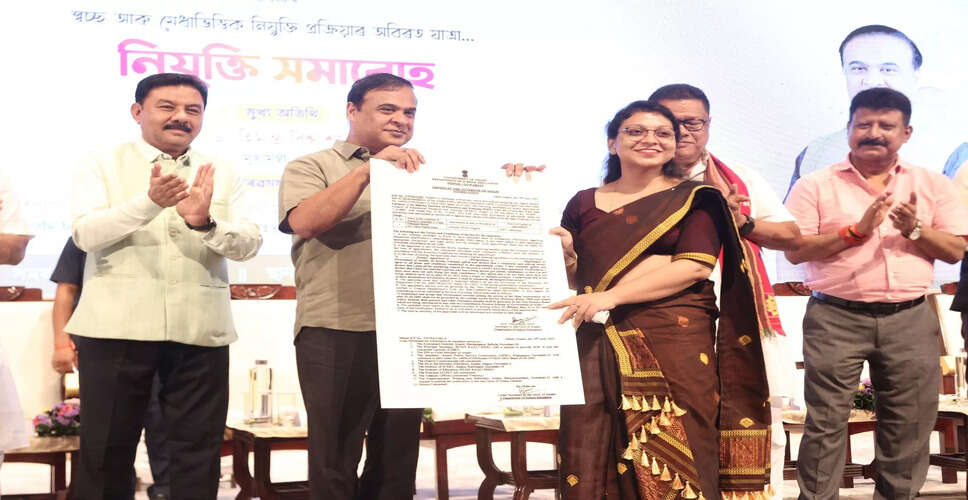
Transforming Assam's Rural Economy
Guwahati, June 19: On Thursday, Chief Minister Himanta Biswa Sarma introduced an extensive strategy aimed at enhancing Assam's rural economy through self-sufficiency in dairy, poultry, and pork production. He also announced a significant increase in government job opportunities and initiatives to boost tourism.
During a public gathering at the Srimanta Sankaradev International Auditorium in Panjabari, the Chief Minister distributed appointment letters to 481 individuals across three sectors: 443 in veterinary services, 12 in tourism, and 26 in education.
To date, the state government has issued 1,20,840 job appointments, with plans to add another 40,000 by October 10.
Discussing the potential of Assam's dairy industry, Sarma emphasized the need to leverage traditional livestock practices, drawing comparisons with successful models in Gujarat and Karnataka.
“In Gujarat, Amul processes 2 crore litres of milk daily beyond household consumption, while Karnataka's Nandini brand manages 80 lakh litres. Historically, Assam has not kept pace,” he remarked.
He noted that Purabi Dairy, which previously processed only 20,000 litres, has recently ramped up to over 2 lakh litres daily, thanks to collaborations with Amul, Kanyaka, and Sitajkhala.
To enhance dairy production, the state has launched North East Dairy and Foods Limited, which aims to procure 1 lakh litres from regions including Dibrugarh, Dhemaji, Cachar, and Jorhat, with Purabi Dairy in Guwahati set to manage up to 3 lakh litres. The long-term objective is to achieve a daily output of 10 lakh litres, supported by multi-brand milk parlours across Assam.
“Dairy farmers will soon receive an additional Rs 5 per litre as government support on top of the market price,” Sarma announced.
The Chief Minister also highlighted innovative breeding initiatives, including the development of a hybrid cow breed by crossing Assam's 'Lakhimi' cows with Gujarat's 'Gir' cows, aimed at increasing milk yield and adaptability to local conditions.
Additionally, the introduction of sex-sorted semen technology has achieved over 90% success in producing female calves, which is crucial for sustaining milk production.
On the topic of poultry, the CM pointed out that 90% of eggs consumed in Assam are imported. He revealed that daily procurement has risen to 5–6 lakh eggs, with a target of reaching 1 crore eggs per day in the future.
“With the establishment of layer farms and support from financial institutions and the state, we aim to cultivate 1,000 egg entrepreneurs and achieve industrial-scale production,” he stated.
Addressing the high pork consumption in the Northeast, Sarma noted the irony of Assam importing pork from Rajasthan, a predominantly vegetarian state. Efforts to reduce imports have led to price increases and complaints from neighboring states like Meghalaya and Nagaland.
“We are striving for self-sufficiency in pork. A pork processing unit has been set up in Nazira, and our goal over the next three years is to achieve self-reliance in pork, eggs, and milk,” he said.
The Chief Minister also emphasized the importance of biogas in Assam's "Atmanirbhar Bharat" initiative. By utilizing cow dung and Nepiar grass, the government aims to promote biogas as a sustainable energy source for rural areas, thereby strengthening the local economy. He underscored the vital role of veterinary field assistants in this ecosystem.
Tourism was another key focus of Sarma's address. He noted that Kaziranga ranked third in the nation for tourist visits last year, while Assam was recognized as the fifth most preferred destination in India by a prominent international publication.
“Kaziranga is seasonal, but we can develop Manas as a year-round destination. By effectively promoting our natural and religious sites, tourism can flourish,” Sarma stated.
He proposed a homestay model similar to that of Uttarakhand and emphasized the need to develop Dima Hasao into a premium tourist destination.
“We are investing Rs 4,000 crore in improving roads and connectivity in Dima Hasao to elevate it as a top-tier tourist spot, surpassing Meghalaya,” he concluded.