
Assamese Classic 'Mirijiyori' Translated into Spanish, Expanding Literary Horizons

A New Chapter for Assamese Literature
The book was released globally, adding another significant chapter to the growing international footprint of Assamese literature.
DOOMDOOMA, July 13: Significant literary achievements often occur away from the spotlight. A young scholar from Upper Assam has successfully introduced Assamese literature to the Spanish-speaking audience, ensuring that one of its cherished classics is now available to a broader readership.
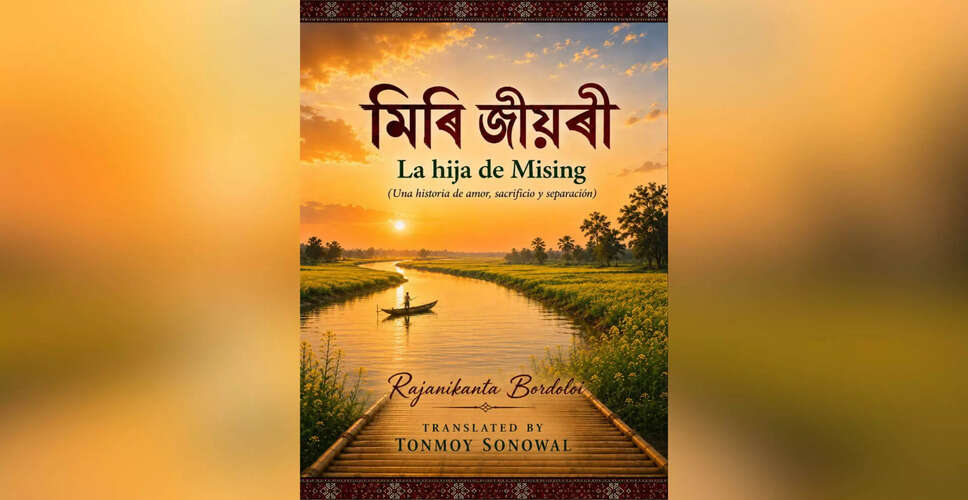
Rajanikanta Bordoloi’s renowned novel, Mirijiyori, which has enchanted Assamese readers for years with its touching narrative of Jonki and Panei, has been translated into Spanish. The new edition, titled La hija de Mising (The Daughter of the Mising), was launched globally on Friday, marking a notable milestone in the international recognition of Assamese literature.
This impressive feat is attributed to Tonmoy Sonowal, hailing from Bishnu Nagar in the Rupai Siding area of Doomdooma, Tinsukia district. Known for his modesty, Sonowal has dedicated several years to promoting Assamese literary works beyond Indian borders.
As the youngest son of retired state tax department employee Bhola Sonowal and Banti Sonowal, he currently teaches Spanish at the University of Delhi. His proficiency in the language has empowered him to embark on a significant literary mission: bridging Assamese and Spanish literature through translation.
Sonowal's journey commenced with the translation of Lakshminath Bezbaroa’s classic folktale collection, Burhi Aair Sadhu, into Spanish as Cuentos De La Abuela, which was published in 2022 and remains accessible to readers worldwide.
However, his latest translation posed a greater challenge. Mirijiyori is celebrated as a cornerstone of Assamese fiction, with its beauty rooted in the intricate portrayal of Mising culture and society. Capturing these cultural subtleties in Spanish while maintaining their authenticity required extensive research and careful attention.
“Rajanikanta Bordoloi’s Mirijiyori is a priceless piece of Assamese literature. I had to exercise extreme caution during the translation to preserve the original's essence,” Sonowal remarked. “Although I am not fluent in the Mising language, I sought help from those who are to ensure that every Mising expression and cultural reference was accurately translated.”
Published by the esteemed Notion Press, this nearly 100-page book has been released simultaneously in India, the UK, Spain, the US, Singapore, and Malaysia. Like Cuentos De La Abuela, La hija de Mising is also available online, making this Assamese classic accessible to a global audience.
The publication signifies more than just another translated work; it highlights the increasing acknowledgment that regional Indian literatures contain universally appealing narratives. Through the enduring love story of Jonki and Panei, readers unfamiliar with Assam will not only experience a poignant tale of love and sacrifice but also gain insight into the culture, traditions, and social life of the Mising community.
As Mirijiyori embarks on its journey into the Spanish-speaking realm, Sonowal is already engaged in another ambitious project. He is translating the late Jogesh Das’s celebrated novel Dawar Aru Nai, set during the Second World War. Upon completion, this translation is expected to introduce Spanish readers to another significant work of Assamese literature while shedding light on Assam’s experiences during a pivotal moment in history.
In a time when regional languages often struggle for recognition beyond their own borders, Tonmoy Sonowal’s quiet efforts serve as a powerful reminder that literature knows no boundaries. From a small town in Upper Assam to readers across six countries, his work continues to amplify the voice of Assamese literature globally, one classic at a time.