
Assam Students Transform Plastic Waste into Eco-Friendly Bricks
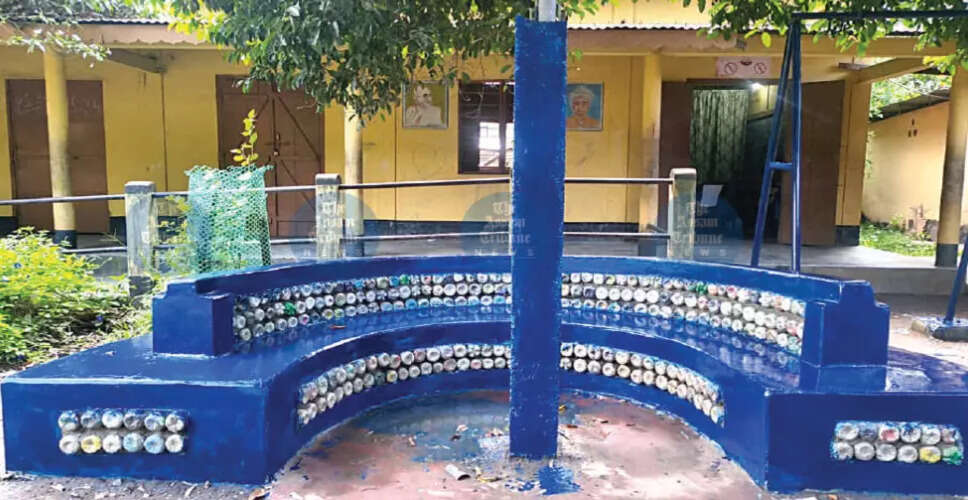

Innovative Eco-Brick Initiative in Assam Schools
This initiative not only mitigates plastic waste but also instills environmental stewardship in students through practical learning experiences.
Amingaon, Sept 25: In Assam, school students are creatively repurposing discarded plastic waste into eco-bricks, which are then utilized to construct various structures within their schools. This initiative not only addresses the issue of plastic pollution but also educates children about environmental responsibility through engaging, hands-on activities.
Kalpana Boruah, the Headmistress of Mainakhurung MV School in Garchuk Pamohi, emphasized the importance of the students' contributions to both the environment and society, encouraging others to adopt similar practices. She noted that the process of making eco-bricks helps students grasp the detrimental effects of plastic on nature. The eco-bricks are subsequently fashioned into essential items for the school, while students earn points that can be exchanged for necessary school supplies.
“In just one year, the enthusiasm for eco-brick production has surged, becoming a popular activity among students,” the headmistress remarked. She highlighted how students utilize their free time to engage in this productive endeavor. “When they run out of plastic at home, they actively search for more in their neighborhoods,” she added.
During a visit to Dahali Karka High School, students were seen enthusiastically participating in the initiative. Class IX students Tonmoy and Dip expressed their commitment to keeping the environment free from plastic and encouraged others to join their cause.
Plastic is collected weekly from the local community. Jajneswar Nath, the Head Teacher at Dahali Karka High School, noted that the initiative has successfully fostered a love for the environment among students. Teacher Ajit Mahanta remarked, “The support from teachers and parents significantly boosts the students' confidence.”
This initiative is backed by the Akshar Foundation, a model school in Pamohi that adheres to Mahatma Gandhi’s ‘Nai Talim’ educational philosophy, promoting experiential learning. The foundation has expanded this initiative from its own model school to include government schools. Currently, 61 government schools in Assam are participating, with five in Kamrup Metro and 13 in Kamrup involved in the campaign.
In the previous academic year, students from government schools in collaboration with the Akshar Foundation produced 9,163 eco-bricks and repurposed over 3,200 kg of plastic. These eco-bricks were utilized to construct 39 structures, including benches, boundary walls, tree guards, and play areas.
On July 31, 2023, the Swachh Bharat Mission (Urban), Assam, entered into a Memorandum of Understanding with the Akshar Foundation and the Guwahati Municipal Corporation to launch the Swachh Schools Swachh Shehar Campaign, aiming to extend this model to private schools in the city.
Unlike their counterparts in government schools, students in private institutions do not receive monetary compensation for collecting plastic. Instead, one or two private schools in the city award marks for gathering clean, dry plastic as part of extracurricular activities. These students also visit the Akshar Forum for additional exposure.
Currently, 13 private schools in Guwahati are reportedly part of the campaign, having collected approximately 8,892 kg of plastic to date.
An eco-brick is essentially a plastic bottle filled tightly with non-biodegradable waste and compressed until it is sturdy enough for construction purposes. Each eco-brick contains around 500 grams of plastic. Students weigh each brick to ensure it is sufficiently packed to support weight. The materials used include PET water bottles, soft drink bottles, LDPE carry bags, and wrappers, which are then transformed into benches, stools, and walls.
Students earn points for creating eco-bricks, with each point valued at Rs 1. These points can later be redeemed through school authorities for necessary items like school bags and geometry boxes, as part of the ‘Aspiration Market’ incentive system.
“Students accumulate points for their efforts, including eco-brick production, and can save these points to redeem them later for needed items, all under supervision. This also serves as a practical lesson in financial literacy, as children keep track of their balances and decide when to spend or save. This initiative has alleviated some financial pressure on families, reducing the need for children to leave school for daily wages, as they can now earn while learning,” explained Hirak Baishya, Partnership and Communications Manager of the Akshar Foundation.
Subhankar Dey, District Programme Manager for Kamrup, noted that this model has garnered attention beyond Assam. “Prime Minister Narendra Modi mentioned it in ‘Mann Ki Baat’, and the Ministry of Information and Broadcasting recognized our efforts as ‘rewriting the rules of education in India’,” he stated. This practice is now being adopted in government schools in Mumbai and Varanasi, following a three-step process: students bring clean, dry plastic, it is weighed and recorded, and they convert it into eco-bricks for school use.
Additionally, six to twelve interns from Oxford University visit the Akshar Forum each year. These selected interns represent the Akshar Foundation and present its initiatives at the United Nations Human Rights Council in Geneva.