
Assam Faces Rainfall Deficit Amidst Severe Flooding

Severe Flooding and Rainfall Shortage in Assam
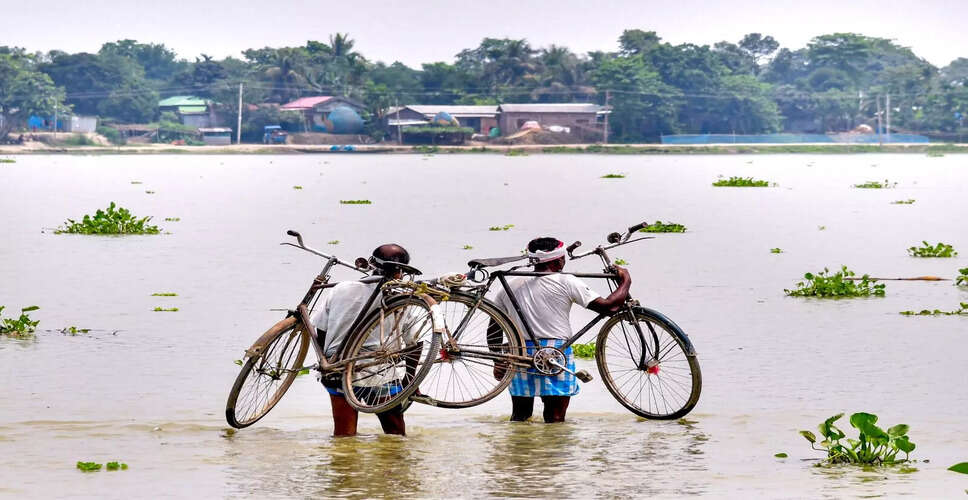
Two cyclists carry their bicycles on their shoulders as they look across a flooded paddy field. (Photo: PTI)
Agartala/Guwahati, Aug 2: Despite enduring severe flooding throughout July, Assam has recorded a monsoon rainfall deficit of 28% this season, as reported by the India Meteorological Department (IMD).
This rainfall shortfall is particularly concerning given that Assam has experienced one of its most significant flood events this year, highlighting the uneven distribution of monsoon precipitation across the state.
According to the latest data from the IMD, five out of the eight Northeastern states have reported below-normal rainfall during June and July, despite facing weather-related calamities.
Officials have linked the irregular rainfall patterns to weak rain-producing systems over the Bay of Bengal, the lack of active monsoon troughs, and the effects of El Niño.
Among the states with insufficient rainfall, Meghalaya faced the largest deficit at 58% during June and July, followed by Arunachal Pradesh (41%), Manipur (40%), Assam (28%), and Mizoram (24%). In contrast, Sikkim, Tripura, and Nagaland experienced normal rainfall during this period.
The rainfall deficit was particularly severe in June, with Assam experiencing a 37% shortfall. Nagaland reported a 56% deficiency, followed by Arunachal Pradesh (44%), Mizoram (37%), and Tripura (36%).
Meghalaya and Manipur were classified under the IMD's "Large Deficient" category, with deficits of 74% and 71%, respectively.
The broader East and Northeast Meteorological Sub-Division, which includes the eight Northeastern states along with West Bengal, Bihar, and Jharkhand, saw an overall rainfall deficiency exceeding 30% during June and July, marking the first half of the four-month southwest monsoon season.
The southwest monsoon reached significant areas of the Northeast on June 7, two days later than usual, and covered the entire region by June 10, according to IMD officials in Guwahati and Agartala.
Looking forward, the IMD has predicted below-normal rainfall across the country for the latter half of the southwest monsoon season (August-September).
However, it has indicated that East and Northeast India may experience normal to above-normal rainfall in several areas during this time, potentially providing some relief to the region.
Meteorologists have noted that the erratic rainfall patterns are influenced by El Niño conditions, weak weather systems in the Bay of Bengal, and the absence of active monsoon troughs.
A stronger El Niño is anticipated to develop in the latter half of 2026, which could lead to hotter and drier conditions across much of Asia, although experts remain hopeful that the Northeast will receive sufficient rainfall during the remaining peak monsoon months.
The southwest monsoon, which contributes nearly 70% of India's annual rainfall, is vital for the agrarian economy of the Northeast, where a significant portion of the population relies on rain-fed agriculture.
Ensuring adequate rainfall in the upcoming months is crucial for Kharif cultivation and for replenishing rivers, reservoirs, and groundwater resources throughout the region.