
Assam Faces Increasing Flood Risks Due to Climate Change

Rising Flood Threats in Assam
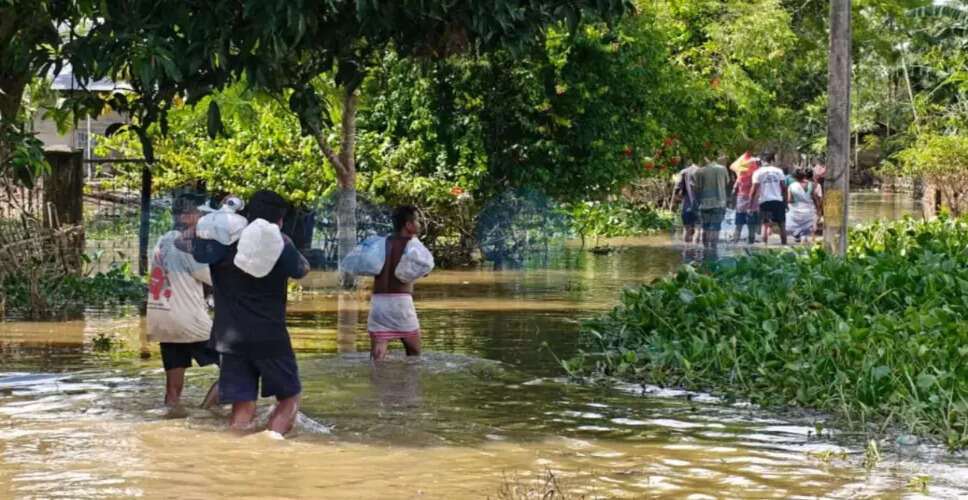
Flood affected families in Sivasagar
GUWAHATI, Aug 10: Recent climate models have issued a serious alert for Assam, predicting that a shorter wet season combined with more intense rainfall will lead to higher flood peaks, reduced drainage times, and a significant increase in the frequency of extreme flooding events in the future.
A report from the climate think tank Climate Trends highlights that the flood situation in Assam is evolving beyond a mere monsoon issue. It is now influenced by global warming, changing river dynamics, and increased human vulnerability, resulting in floods that are more frequent, complex, and destructive.
The report emphasizes that the flood crisis in the state is becoming increasingly severe, driven by the interplay of global warming, shifting river dynamics, and rising human exposure, which collectively make floods more frequent and costly.
According to a recent study titled ‘Causes and Mitigation of Flooding in the Brahmaputra River Basin: A Systematic Review’, there is a notable shift in rainfall patterns within the basin. The peak rainfall period of the monsoon is gradually transitioning from July to August, while post-monsoon rainfall is on the rise and pre-monsoon rainfall is decreasing.
The study indicates that the combination of a shorter wet season and intense rainfall is likely to produce higher flood peaks while allowing less time for drainage. It also forecasts a significant increase in extreme rainfall events, with daily precipitation exceeding 100 mm expected to become more common in the lower Brahmaputra sub-basins.
Hydrological models predict that average streamflow in the basin could rise by 13-15% by mid-century. Alarmingly, the frequency of extreme flooding is anticipated to increase dramatically by 2080. Under a high-emissions scenario, a flood event that currently occurs once every decade could happen as often as every two years.
The report also points out the growing impact of glacial changes on river flows. Currently, glacier and snowmelt account for nearly 27% of the Brahmaputra’s upstream discharge. In the short term, rising temperatures are expected to accelerate glacier and snowmelt, leading to increased early-season runoff.
However, the long-term retreat of glaciers is likely to decrease meltwater contributions, affecting flood timing and creating a mismatch between heavier rainfall and reduced snow storage. Climate Trends notes that while there is a general scientific agreement on these trends, uncertainties about their extent remain.
The Assam State Action Plan on Climate Change (SAPCC) for 2021-2030 anticipates a 5-38% increase in extreme rainfall events and over a 25% rise in flood occurrences under future climate scenarios.
Climate forecasts suggest that rising temperatures and precipitation could elevate the Brahmaputra’s annual streamflow by approximately 13%, while sediment loads may increase by nearly 40% by the century's end. These changes are expected to exacerbate riverbank erosion and elevate flood risks throughout the state.
The report further indicates that human activities, such as deforestation, rapid urbanization, and unplanned land-use changes, are worsening the situation by increasing surface runoff and diminishing the landscape's natural ability to absorb and retain water.
Dr. Akshay Deoras, a research scientist at the National Centre for Atmospheric Science, University of Reading, UK, stated, “We have been observing sharp variations in rainfall patterns. Rainfall is either extremely intense or break-monsoon periods are unusually prolonged, leading to extreme weather events. This is a direct consequence of global warming.”
“While many regions in East and Northeast India, including Assam, have recorded below-normal monsoon rainfall, Assam has still faced some of the worst flooding in a decade. It is crucial to prepare for the changing nature of the monsoon by focusing not only on rainfall amounts but also on its evolving patterns and intensity,” he added.