
Assam Faces Environmental Concerns as Over 1 Lakh Trees Cut for Development
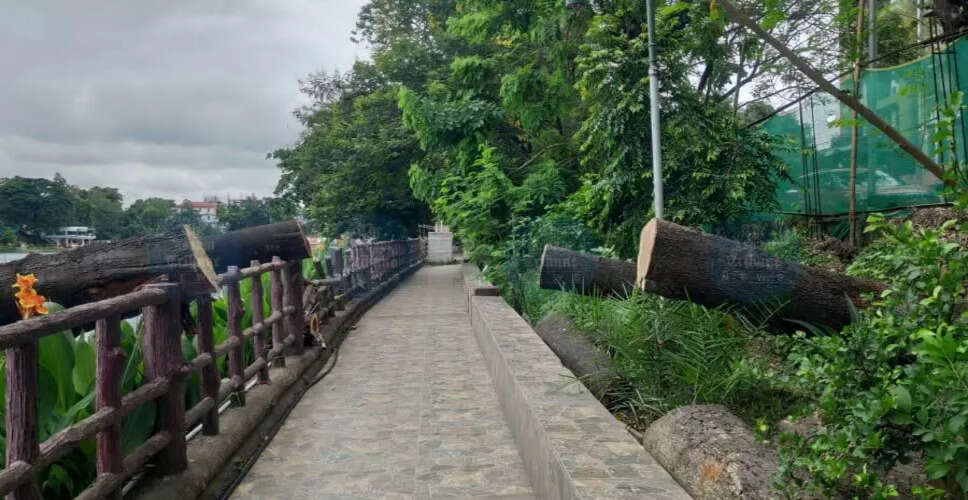
Significant Tree Loss in Assam
Guwahati, March 8: Official data obtained through a Right to Information (RTI) request reveals that Assam has witnessed the felling of more than 100,000 mature trees over the last decade for various development initiatives. This information was sourced from the Office of the Principal Chief Conservator of Forests (PCCF) and the Head of Forest Force under the Assam Environment, Forest and Climate Change Department.
Since May 2016, when the BJP took office in Assam, a total of 106,896 full-grown trees have been cut down. The data was gathered from 15 out of 44 wildlife and territorial forest divisions, with 12 divisions responding without specific details, while 16 divisions have yet to reply to the RTI queries.
Notably, none of the 27 divisions that provided information indicated that they conducted any ecological impact assessments before or after the extensive tree felling.
According to the figures, over 26,000 trees were removed from designated forest areas, while the remainder was cut down in non-forest regions throughout the state.
Of the total, nearly 84,000 trees were cleared for government projects, which included the construction of roads, bridges, flyovers, factories, medical colleges, police battalions, and other infrastructure developments. Additionally, more than 10,000 trees were felled for private projects.
The RTI findings also indicate a surge in tree cutting in recent years, with approximately 65,000 trees cut down between 2021 and 2025 during Chief Minister Himanta Biswa Sarma's administration, compared to over 18,000 trees during the previous government led by Sarbananda Sonowal.
Chandra Mohan Patowary, the Assam Environment, Forest and Climate Change Minister, defended the tree removal, asserting that it was necessary for development projects.
"These trees have been cut across the state for various development projects. It was necessary for infrastructure development," Patowary stated.
He highlighted that several large-scale infrastructure and industrial projects necessitated tree clearing, including the four-laning of National Highway-17 from Guwahati to Goalpara, the construction of Darrang Medical College and Hospital (DMCH), and exploration activities by oil companies like ONGC and Oil India.
Patowary noted that the DMCH site previously housed a silk plantation that had to be entirely cleared for construction.
In response to concerns regarding the loss of green cover, the Assam government emphasized its large-scale plantation initiatives aimed at offsetting the loss.
Patowary mentioned that over 3.5 crore saplings have been planted in the last two years through various afforestation programs. One notable initiative, the "Amrit Briksha Andolan," saw the planting of one crore saplings in a single day.
Official reports from forest divisions indicate that more than 70% of the planted saplings have survived due to adequate care and monitoring.
However, environmental experts argue that equating the removal of mature trees with the planting of saplings is misleading and scientifically flawed.
Narayan Sharma, an Assistant Professor of Environmental Biology and Wildlife Sciences at Cotton University, emphasized that mature trees offer ecological benefits that saplings cannot replicate for decades.
"A full-grown mature tree represents decades of ecological value that cannot be quickly or easily replaced," Sharma stated.
"In most cases, sapling plantations hardly compensate for the loss of mature trees immediately, as it takes decades for them to provide comparable ecosystem services," he added.
Sharma also highlighted the necessity for proper ecological impact assessments whenever significant tree felling occurs.
"When large numbers of trees are felled at a particular location, a proper ecological impact assessment must be conducted. Such studies help determine the impact on local microclimate, biodiversity, and ecosystem stability," he said.
Environmental experts have raised concerns that no systematic study has been conducted to evaluate the cumulative ecological damage resulting from the felling of over 100,000 trees.
Minakshi Bora, an Assistant Professor of Environmental Science at Gauhati University and an expert in GIS and ecohydrology, cautioned that the figures should be interpreted carefully.
"The numbers appear impressive, but they are not directly comparable. Felling over 100,000 mature trees and planting saplings are ecologically unequal actions," Bora remarked.
She explained that mature trees store significant amounts of carbon, provide habitats for wildlife, and play a crucial role in maintaining local ecosystems.
"A mature tree represents decades of biomass, carbon storage, habitat value, and ecosystem services that a sapling cannot immediately replace," she added.
Bora also described the lack of ecological impact assessments as "scientifically concerning."
"Without systematic studies, cumulative ecological degradation may go unnoticed until impacts become severe and irreversible," she warned.