
Assam Assembly Discusses Conservation Efforts for Manas National Park

Concerns Raised Over Manas National Park's Ecological Decline
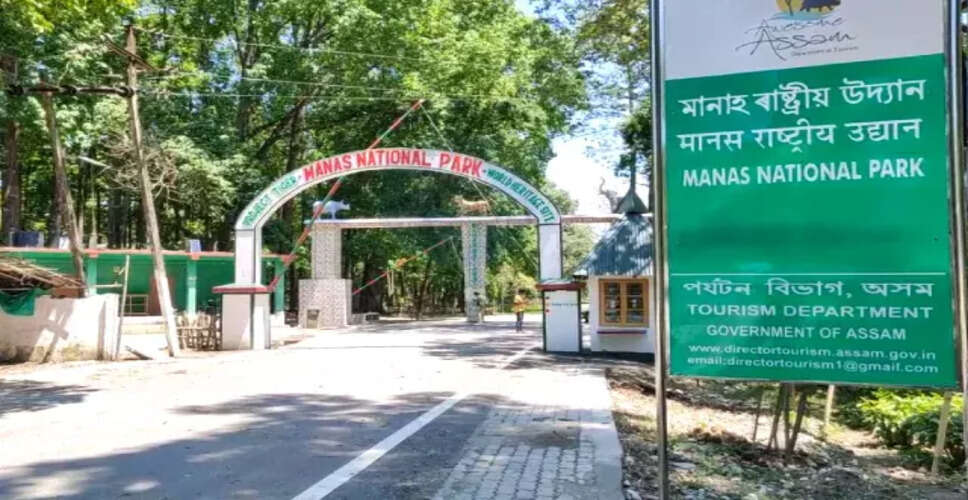
A file image of Manas National Park (Photo: X)
Guwahati, July 6: During the recent Budget Session of the Assam Legislative Assembly, significant concerns regarding the diminishing grasslands and the overall ecological health of Manas National Park were voiced. The state government presented various conservation and tourism development plans for this UNESCO World Heritage Site.
Khumtai MLA Mrinal Saikia initiated the discussion, highlighting a drastic reduction in the park's grassland coverage over the last thirty years.
“In 1990, grasslands constituted 53.61% of Manas National Park. However, a 2019 assessment revealed this figure has plummeted to 30.24%. This indicates a loss of approximately 23% in grassland over nearly three decades,” Saikia informed the assembly.
He pointed out that the primary cause of this decline is the proliferation of invasive weed species and criticized the inadequate tourism facilities within the park.
“We have reached out to UNESCO but have yet to receive any feedback. Manas draws numerous tourists both domestically and internationally. Although two tourism facilities have been constructed, they remain unused. I urge the government to activate these resources,” he stated.
In response, Forest Minister Jayanta Mallabaruah emphasized that restoring the ecological integrity of Manas is a top priority for the Forest Department.
“An ideal ecological balance consists of equal parts woodland and grassland. In 1970, woodland covered approximately 370 sq km, while grassland spanned 440 sq km. Over the years, woodland has increased, and grassland has significantly decreased, now falling below 30%,” the minister explained.
He attributed this ecological degradation to various factors, including infrastructure projects in Bhutan, embankment constructions, historical civil unrest, and the invasion of species like ximolugos.
Mallabaruah noted that the department has initiated several restoration projects in recent years.
“From 2022 to 2025, we have restored about 609 hectares of degraded grassland through the APFPC French-funded initiative. Similar restoration efforts are also being carried out via the Pygmy Hog Conservation Programme and other projects,” he added.
However, he admitted that the results have not met expectations due to evolving ecological conditions.
“We take Mrinal Saikia's concerns very seriously and are committed to improving the situation in the near future,” he assured.
Furthermore, Mallabaruah outlined the government's broader tourism strategy, which aims to alleviate the pressure on Kaziranga National Park by promoting Manas and other protected areas as key wildlife tourism hubs.
Speaker Ranjeet Kumar Dass also called on the Forest Department to ensure that efforts to eliminate invasive species do not harm native flora.
In conclusion, Mallabaruah assured the assembly that the department would persist in its efforts to restore the ecological balance of Manas, enhance tourism infrastructure, and keep the assembly updated on progress.