
Arundhati Roy Critiques Modi's Image Amid Student Protests

Arundhati Roy's Bold Statements on Education Protests
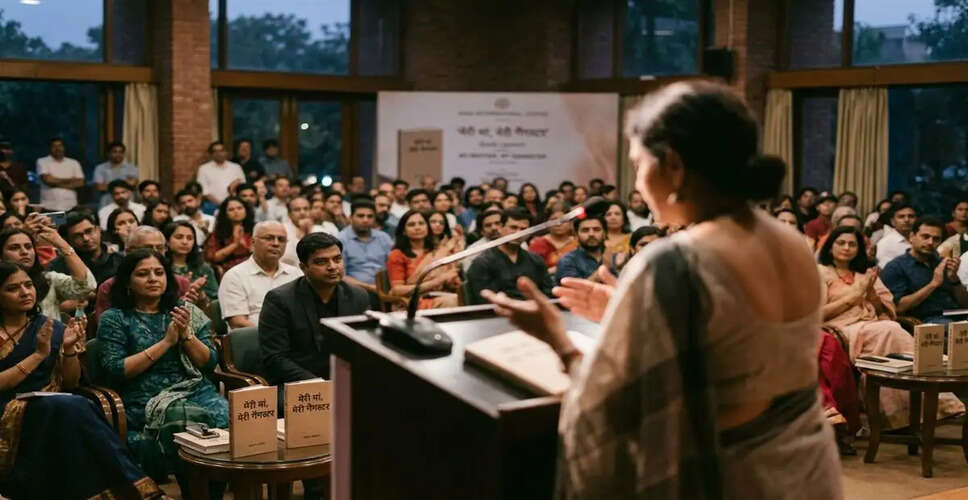
In New Delhi on August 4, renowned author Arundhati Roy expressed that the recent student protests led by the Cockroach People's Party (CAZPA) at Jantar Mantar have significantly undermined Prime Minister Narendra Modi's public image, which took over two decades to build. She stated that this political setback is 'far greater than any electoral defeat' and has occurred within just two weeks. Speaking at the launch of the Hindi translation of her book 'Mother Mary Comes to Me,' titled 'Meri Maa, Meri Gangster,' Roy emphasized that electoral outcomes are merely one aspect of politics, highlighting how recent public movements can swiftly disrupt long-standing narratives. 'The script is still being written, and everyone has a role to play,' she remarked in a packed auditorium at the India International Centre (IIC).
Roy noted that the carefully crafted image of Modi, developed over 24 years and without him addressing a single press conference, was shattered by the protests. 'In a way, this is a victory larger than elections,' she asserted.
However, the Booker Prize-winning author cautioned that if the government maintains control over institutions and key power structures, the challenges will persist. She urged opposition parties and civil society members to collaborate in safeguarding democratic institutions.
Learning from the Youth Protests
Roy also encouraged opposition parties to take cues from the young participants at the Jantar Mantar protests, who displayed remarkable 'intelligence' despite possibly differing views on various issues. 'The protesters played their roles very responsibly,' she stated, likening their coordination to that of a music band, where each member contributes uniquely towards a common goal.
She explained, 'The guitarist cannot be the singer, the singer cannot be the drummer, and the drummer cannot be the guitarist... Each of them has played their roles in different ways. Now, the elders must also show wisdom.'
Over the past two decades, Roy has authored several non-fiction works, including 'The Ministry of Utmost Happiness,' and numerous essays covering topics such as Kashmir, large dams, globalization, and interactions with whistleblower Edward Snowden and Hollywood actor John Cusack.
Controversies Surrounding Roy's Work
The PEN Pinter Prize-winning writer's work is highly respected by her fans, while critics often respond harshly. Roy has faced legal challenges due to her writings, which have sparked intense reactions. 'Meri Maa, Meri Gangster,' translated by Prabhat Singh and published by Rajkamal Prakashan, explores the complex relationship between Roy and her mother, Mary Roy, a prominent educator and women's rights activist who fought a landmark case for Syrian Christian women in Kerala to gain equal inheritance rights.
Roy clarified that the book is neither an autobiography nor a biography of her mother, but rather a narrative about the relationship between two women who happen to be mother and daughter. She explained her choice to refer to her mother as a 'gangster,' stating, 'Some people, perhaps from Hindi-speaking regions, get upset that I called my mother a gangster. But both critics and defenders fail to grasp the essence. Critics say, 'How can you call your mother a gangster?' On the other hand, my defenders say, 'She was very defensive.' Both are wrong. She was indeed a gangster.'
Reflections on Personal Success and Social Justice
Roy shared a childhood incident from the chapter 'Collateral' in her book, recalling how her mother woke her brother in the middle of the night to scold him for bringing home a report card that labeled him an 'average student.' The next morning, he was warmly embraced for achieving good grades. This experience profoundly influenced Roy's understanding of success and privilege. 'Since then, every personal achievement comes with a sense of apprehension,' she noted.
She expressed that whenever she receives praise or applause, she feels as though someone else, a quiet individual, is being beaten in another room. 'This 'other room' has become a central theme in my writing,' she explained. 'People think I am a successful writer, but I am not. They respect me, award me, and give me the Booker Prize... but someone is always being beaten in the 'other room.' My entire writing revolves around this.'
Roy emphasized that everywhere, 'someone is being beaten'—in Gaza, at bus stands, in villages, and at Jantar Mantar—and her work aims to highlight those who remain unseen despite public celebrations of personal success. She urged citizens to resist normalizing injustice, stating, 'Now we must show that we will not be beaten anymore.' Her words resonated with applause from the audience.
Availability of 'Meri Maa, Meri Gangster'
'Meri Maa, Meri Gangster' is priced at ₹577 and is available both online and offline. The English version of the book has already been translated into over 40 languages, including all European languages, Japanese, Chinese, and Mongolian.