
Ancient Inscription Unveils Secrets of the Chindaka Naga Dynasty
A Historic Discovery in Odisha
Bhubaneswar/Jeypore: A remarkable find by epigraphist Bishnu Mohan Adhikari is poised to reshape our understanding of the Chindaka Naga dynasty, a prominent ruling family from the 11th century.
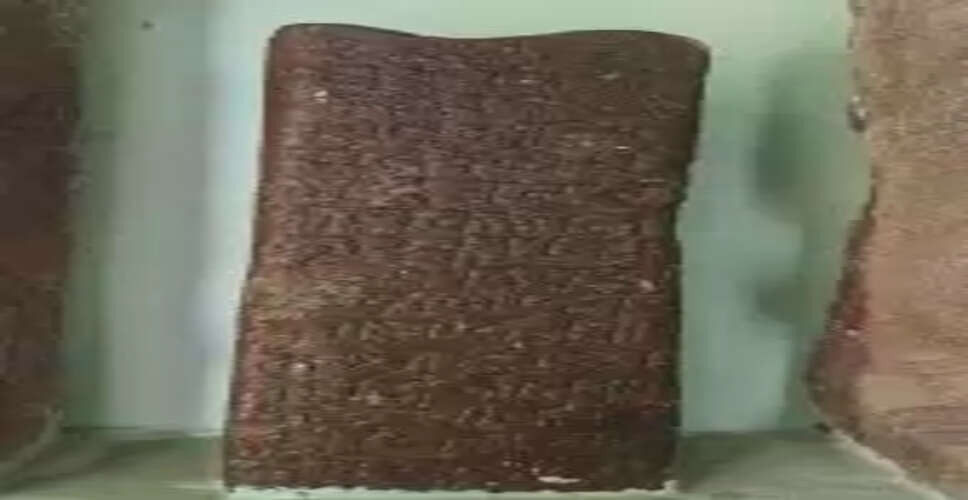
While visiting the Jeypore Museum, Adhikari, along with colleagues Sarat Routray and Himansu Sekhar Sadangi, uncovered an inscription on a stone pillar that had previously gone unnoticed. This discovery provides new perspectives on the history of southwestern Odisha and the Chakrakota region, now part of Chhattisgarh. Adhikari, who has deciphered 124 inscriptions, found the pillar in the museum's verandah, which had been overlooked since the museum's establishment in 1976 by IAS officer Jiban Pani. After receiving approval from museum officials, the team created an estampage of the 16-line inscription.
Adhikari described the stone as a fragmented pillar, approximately 7 feet 4 inches at the base and 26 by 7 inches in height, originally sourced from the Bhairabsinghpur-Kumli-Kamta area in the Indravati valley. Notably, it also features an erotic engraving of an ass and a pig on one side, a motif that Adhikari noted appears in other inscriptions and copper plates from the same dynasty. The inscription includes a ‘Raja Prasasti’ (royal eulogy) dedicated to a Chindaka Naga king, referred to by the title ‘Madana Nrpa kula kamala bhaskara tilaka’. Although some lines (5, 9, 10, and 16) are not legible, Adhikari suspects that additional lines may be hidden beneath the concrete base, as the current inscription ends abruptly.
According to Adhikari, this inscription is linked to the Nagavanshi rulers of Chakrakota, who dominated the Indravati river valley, covering parts of Kalahandi and Koraput during the 11th century. He drew comparisons with similar inscriptions from King Someswara Deva (1069-1110), the son of Dharavarsha and Gunda Mahadevi, found in the Kuruspal region of Chhattisgarh.
Adhikari emphasized that the inscription is written in a corrupted form of Sanskrit using Odra Nagari characters, which closely resemble the developing Odia script. He highlighted words such as ‘Bikantha Sri Karana’, ‘Kasa Dasa’, and ‘Damodara’, which reflect distinctive Odishan writing styles. This suggests that the Jeypore inscription may represent one of the earliest examples of the evolving Odia script from the Koraput area. Additionally, the inscription contains names that correlate with other inscriptions of King Someswara, reinforcing the narrative of dynastic connections.
The historical significance of this discovery has resonated within academic circles. Dr. Raj Kumar Rate, a history lecturer at Khariar Autonomous College, praised it as a ‘monumental finding for Odisha’. He noted that this is the first inscription from the Chindaka Naga dynasty found in Odisha, marking it as the oldest inscription from the current Koraput district, predating the Khechela copper plate grant of Raghunath Krushna Deva of the Surya Sankara dynasty. The Naga dynasty rulers are recognized as one of the early ruling clans in India. In Koraput, the Chindaka Nagas gained prominence following the Nala dynasty.
Their establishment in Chakrakota was supported by the Somavanshi rulers Janmejaya and Udyotakeshari. Historically, during conflicts between the Eastern Gangas and the Kalachuris of Ratnapur, the Chindaka Nagas allied with the Eastern Gangas. This newly deciphered inscription is expected to illuminate the history of the tribal regions of Koraput and the Bastar area of Chhattisgarh, providing vital insights into the political and cultural dynamics of 11th-century India.