
Amur Falcons Return to Manipur After Epic Migration Journey
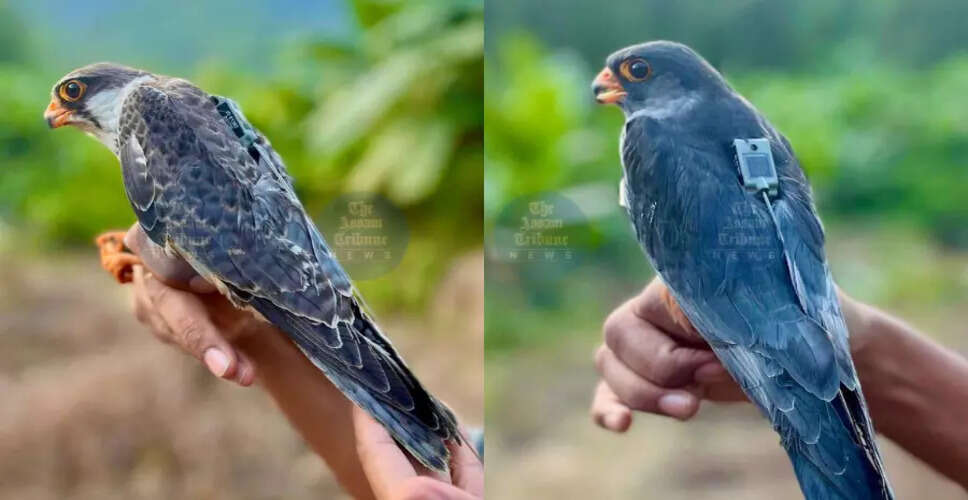

Return of the Amur Falcons
Alang (left), Apanang (right)
Imphal, Oct 23: Two of the three Amur Falcons (Falco amurensis) equipped with satellite tags, named Apapang and Alang, have successfully returned to their roosting area in Manipur after an extensive migratory journey spanning 23 countries across Asia and Africa.
The male falcon, Apapang, and the female, Alang, reached Manipur on Thursday, nearly a year after being fitted with satellite transmitters by researchers from the Wildlife Institute of India (WII) in November 2025.
On Friday, Union Minister for Environment, Forest and Climate Change, Bhupender Yadav, shared the news via a microblogging platform, noting that the falcons had embarked on their journey from northeastern China 11 days prior.
“A journey to India through 23 countries! Having started from their breeding areas in northeastern China 11 days ago, the two Amur Falcons Apapang and Alang arrived in Manipur yesterday,” the minister tweeted.
He highlighted that their return signifies the culmination of nearly a year of tracking and their round-trip journey since being tagged by WII scientists.
Dr. Suresh Kumar from the Wildlife Institute of India, Dehradun, who has been observing the birds' migratory patterns, confirmed their arrival in Tamenglong district.
“Yes, they arrived yesterday,” he stated when reached for comment.
The three satellite-tagged Amur Falcons, Apapang, Ahu, and Alang, were named after a local roosting site and two rivers, Barak and Irang, in Tamenglong district. They were tagged at Chiuluan village on November 11, 2025, as part of a project aimed at studying and conserving these migratory birds.
Unfortunately, contact with Ahu, the female falcon, was lost during its migration in Somalia, Africa.
According to Yadav, Apapang and Alang are anticipated to stay for two to three weeks at selected sites in the mountainous regions of Tamenglong district. Local communities eagerly await the birds' annual return and play a crucial role in their protection.
During their stopover, the falcons feed on termites that emerge around their roosting sites to accumulate fat reserves for the next phase of their migration. They are expected to undertake a non-stop flight lasting six days, covering nearly 6,000 km towards Somalia, which includes a 3,000 km crossing over the Arabian Sea.
In May, Yadav praised Manipur's satellite-tagging initiative for Amur Falcons as one of India's successful community-led conservation efforts.
This radio-tagging program was initiated by the Tamenglong Forest Division in partnership with the Wildlife Institute of India. Launched in November 2018, it has since seen more than a dozen Amur Falcons fitted with radio transmitters.
Known locally as Akhuaipuina or Taomuanpui, Amur Falcons are protected under the Wildlife (Protection) Act of 1972 and are listed in Schedule I.
These birds breed in southeastern Russia and northeastern China before migrating to their winter habitats in southern Africa. They typically begin their return journey around April and May, traversing various parts of Asia.
These pigeon-sized raptors undertake an impressive annual migration of approximately 20,000 km, making them some of the most extraordinary long-distance migratory birds globally.
Every October, Amur Falcons arrive in significant numbers in Manipur and Nagaland, as well as other regions in Northeast India. They generally depart the area in November after building the necessary energy reserves for their long, non-stop flight to Africa, where they spend the winter.