
Amit Shah Defends Women's Reservation Bill in Lok Sabha
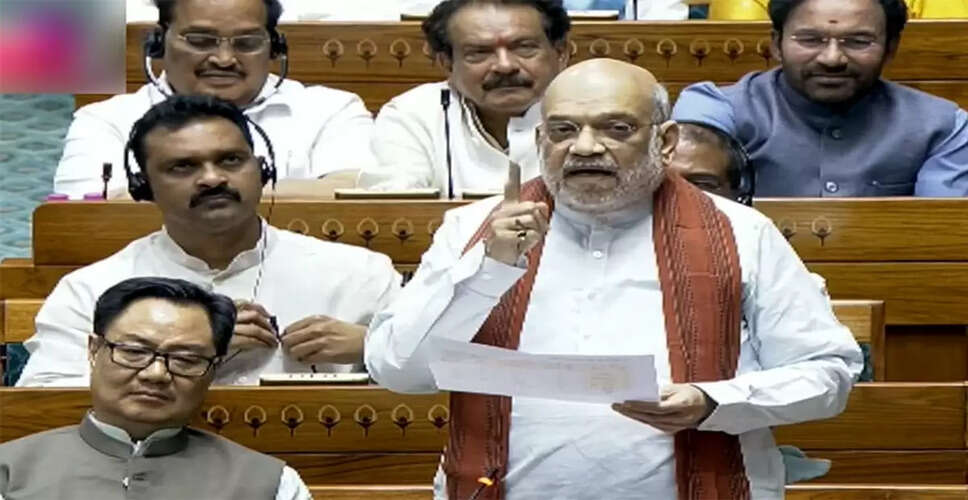

Amit Shah Addresses Opposition Concerns
In a recent session of the Lok Sabha, Union Home Minister Amit Shah criticized members of the 'INDI' alliance for opposing the Women's Reservation Bill using various conditional phrases. He emphasized that the opposition is not against the concept of women's reservation itself, but rather the implementation of the bill. Shah pointed out that those opposing the delimitation process are also against the increase in seats reserved for Scheduled Castes (SC) and Scheduled Tribes (ST). He outlined the objectives of the three bills, stating that the first aims to implement constitutional reforms for women's empowerment in a timely manner, ensuring that the 2029 elections include women's reservation.
Shah addressed concerns raised by several members regarding the timing of the delimitation, clarifying that the recently introduced Nari Shakti Vandan Act specifies that reservations for women will be ensured after the census conducted post-2026. He explained that the mention of this timeline was not arbitrary; it was a requirement stemming from decisions made during Indira Gandhi's government in 1971, which necessitated the inclusion of such provisions.
He further elaborated that the constitution allows for periodic delimitation, which is essential for increasing the number of SC and ST seats. Those opposing delimitation are, in effect, opposing the increase of these reserved seats.
Shah recounted that the first delimitation bill was introduced in 1972, increasing the number of seats from 525 to 545, but was subsequently frozen. He noted that during the Emergency in 1976, the 42nd amendment halted delimitation, a decision made by Indira Gandhi's administration. He criticized the current opposition for attempting to freeze delimitation while in power, stating that the Congress party has historically deprived the public of representation through delimitation.
He also addressed questions regarding the delay in the census, explaining that the 2021 census was postponed due to the COVID-19 pandemic, which was the largest crisis of the century. After the pandemic, it took time for the country to recover, and when the census began in 2024, various parties rightfully demanded a caste-based census. The government engaged in discussions with multiple stakeholders and decided to proceed with the caste census, which is now underway.
Shah reassured the public that the decision made by Prime Minister Narendra Modi's cabinet to conduct a caste census is part of the proposal for the 2026 census. He refuted claims from the opposition that the government is attempting to delay the caste census through constitutional amendments, stating that a timetable for the census was announced three months ago, and the first phase is currently in progress. He also emphasized that the narrative of North versus South should not dominate discussions, asserting that southern states have equal rights in the parliament as northern states.