
Allegations of Misuse of Public Funds in Una District's Pond Restoration Project

Concerns Raised Over Fund Mismanagement
EXCLUSIVE REPORT
Munish Sood
Haroli (Una)
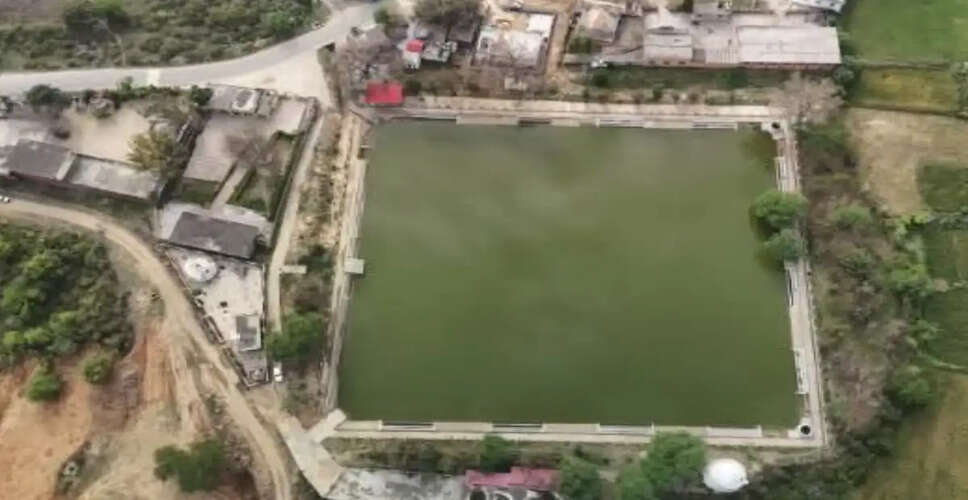
Advocate and social activist Rohit Katwal has filed a comprehensive complaint that questions the proper use of public funds, alleging a potential double drawal of government resources in the restoration of the Gondpur Jaichand pond located in Una district.
In an exclusive interview, Katwal characterized the situation as a clear instance of overlapping approvals and procedural breaches, urging the State Vigilance and Anti-Corruption Bureau to launch a preliminary investigation under the Prevention of Corruption Act, 1988.
According to Katwal, the official documentation reveals that two distinct funding sources have been allocated for the same project, executed by the same agency, without any transparency or separation of project scope.
Funding Overlap on the Same Project
Katwal noted that the project initially received ₹25 lakh in March 2024 through the PMKKKY scheme, facilitated by the District Mineral Foundation Trust (DMFT) in Una, with the Jal Shakti Division, Haroli, as the executing body.
Despite a Utilization Certificate being submitted that claims full expenditure of the sanctioned funds, there is no completion certificate or documented completion date, he pointed out.
Additionally, a second approval was issued in September 2024 under the HP Bulk Drug Park scheme, which allocated ₹31.98 lakh, with a Detailed Project Report (DPR) estimating the total cost at ₹34.31 lakh for the same pond.
“In total, nearly ₹56.98 lakh has been allocated for a single village pond, with both approvals seemingly processed independently, lacking any cross-referencing or acknowledgment of the concurrent funding,” Katwal alleged.
Measurement Book Under Investigation
Katwal stressed that the Measurement Book (MB), essential for certifying work and authorizing payments, appears to have been utilized for both funding streams.
“Identical quantities for excavation, masonry, reinforced concrete work, and pipeline installation are being certified and billed twice. Such duplications raise serious questions about the authenticity of the certifications,” he asserted.
He also highlighted that the DPR marks several components as “existing,” yet billing continues under the second funding source for similar tasks.
Allegations of Procurement Violations
Katwal pointed out potential breaches of procurement regulations, claiming that the project was divided into smaller tenders, each valued below ₹5 lakh.
“This splitting diminishes scrutiny and circumvents standard tendering protocols, contradicting established procurement guidelines,” he stated.
He cited an instance where a contract estimated at ₹4.98 lakh was awarded for ₹7.26 lakh, indicating a significant increase without proper justification.
Doubts About DPR Authenticity
Katwal expressed serious concerns regarding the validity of the Detailed Project Report (DPR), labeling it as “non site-specific and largely copied from external templates.”
“The objectives section of the DPR mentions the rejuvenation of Lake Hancock in Florida, USA, indicating that the document is a mere copy-paste job rather than a tailored report for a local pond in Una,” he alleged.
He also pointed out discrepancies of around ₹33 lakh in the cost abstract, which he claims have been manually altered.
Call for Immediate Action
Katwal has urged the Vigilance Bureau to secure all pertinent records, including sanction files, DPRs, Measurement Books, and contractor bills, and to conduct a thorough reconciliation of entries across both funding sources.
“The evidence is document-based and readily available. Any delay in action could jeopardize the integrity of the records,” he warned.
He has also suggested suspending the officials involved during the investigation and conducting an independent site inspection by external officers.
Political Implications
Given that this issue arises from Haroli, a politically significant area, the allegations are likely to attract broader administrative scrutiny.
“This fundamentally concerns accountability in public fund usage. Proper procedures must be followed, and accountability must be established where necessary,” Katwal stated.
The State Vigilance and Anti-Corruption Bureau has yet to respond officially to the allegations.