
Allegations of Government Negligence in Upper Assam Floods

Concerns Raised Over Flood Management
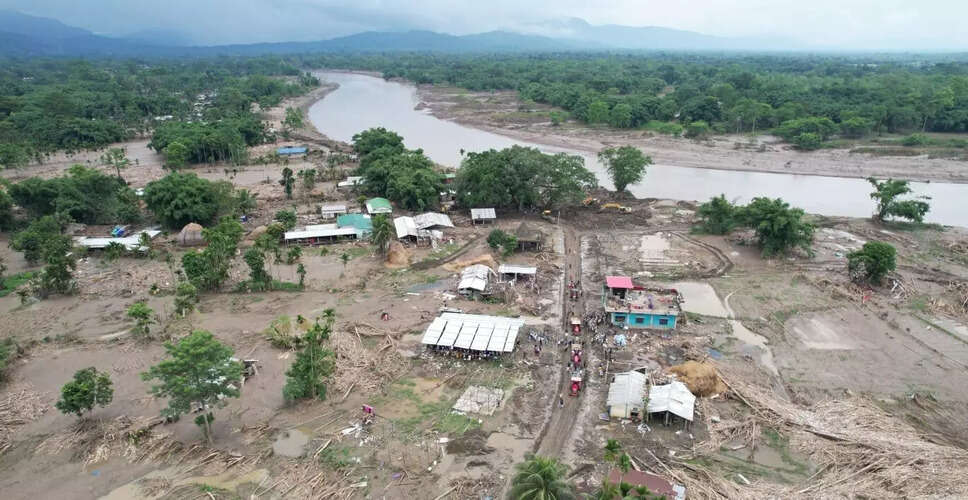
An aerial view of flood devastation in Upper Assam. (Photo:@himantabiswa/X)
Guwahati, Nov 5: Debabrata Saikia, the former Leader of the Opposition in Assam's Legislative Assembly, has claimed that the severe floods that struck Upper Assam in July were not merely a natural disaster but rather a 'man-made catastrophe' resulting from significant government negligence, lack of action, and illegal mining activities in riverbeds.
During a press conference in Guwahati, the senior Congress figure revealed that he had previously submitted a Public Interest Litigation (PIL) to the Gauhati High Court, seeking justice and thorough rehabilitation for those affected by the floods, as well as an inquiry into alleged corruption.
Saikia noted that the High Court had instructed state officials to provide an affidavit by November 3, but the government failed to present essential documents related to emergency relief efforts and requested more time. Consequently, the court has set the next hearing for December 14, according to Saikia.
He emphasized the urgent need to halt all illegal and unscientific mining operations along the Dikhow river and its tributaries. Additionally, he called for the immediate establishment of a specialized Task Force Battalion, as previously ordered by the High Court.
Saikia explained that the unregulated extraction of natural materials has caused the geomorphic phenomenon known as the 'Hungry Water Effect,' which has led to severe erosion of riverbeds and significant damage to embankments.
Challenging the government's rationale for the floods, Saikia pointed out that the India Meteorological Department (IMD) had not issued any warnings regarding cloudbursts. He accused Chief Minister Himanta Biswa Sarma of initially promoting an unfounded narrative of cloudbursts to protect certain associates.
Referencing the Supreme Court's 'Public Trust Doctrine' and 'Absolute Liability' principles, Saikia argued that the state government cannot escape accountability by labeling the disaster as an 'Act of God.'
He called for the formation of an inquiry committee led by a retired High Court judge, including experts from IIT Guwahati and relevant government departments, to investigate the underlying causes of the flooding.
Saikia also questioned the Chief Minister's announcement regarding a CBI investigation, suggesting that a thorough examination of the alleged hydrological and environmental failures necessitates stringent judicial oversight rather than a probe typically associated with homicide or financial fraud cases.
Demanding adequate compensation, the Congress leader proposed financial aid of at least Rs 10 lakh for each affected family, referencing the disaster relief framework utilized in Himachal Pradesh.
He alleged that there were significant irregularities and favoritism in the distribution of flood relief, claiming that the administration had not publicly disclosed the beneficiary list because payments had reportedly been made to multiple bank accounts belonging to families of ruling BJP leaders in unaffected areas.
Furthermore, he stated that many genuine flood victims had yet to receive the promised interim assistance of Rs 15,000 and Rs 10,000.
Highlighting the financial struggles of farmers and small business owners, Saikia remarked that a temporary six-month moratorium on loan repayments provided little relief as interest continued to accrue. He urged for regulatory measures through RBI guidelines and the Banking Ombudsman to facilitate comprehensive debt restructuring for affected borrowers.
Saikia also expressed concerns regarding the proposed 11,200 MW Siang Upper Multipurpose Project (SUMP) in Arunachal Pradesh, labeling it an existential 'water bomb' that poses a threat to Assam.