
Akhil Gogoi Outlines Raijor Dal's Vision for Assam's Development
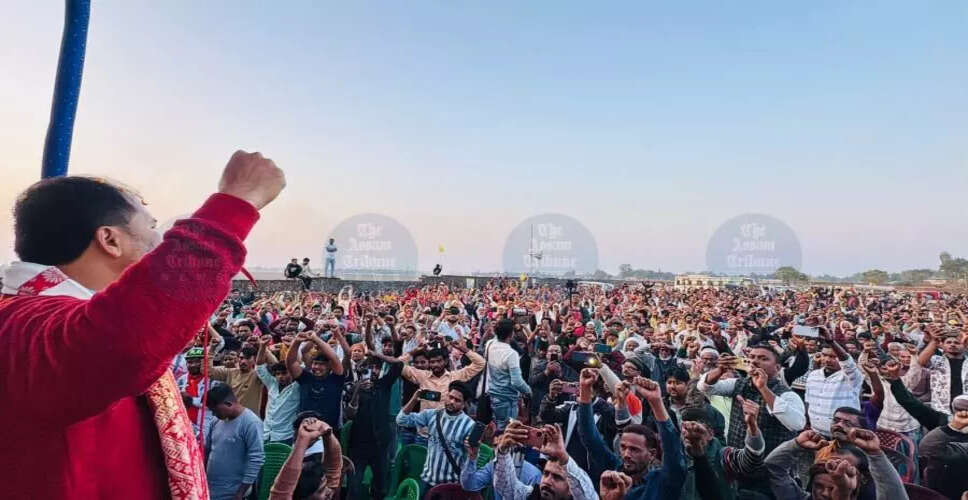
Raijor Dal's Commitment to Assam's Future
GUWAHATI, March 28: On Friday, Akhil Gogoi, the president of Raijor Dal, emphasized the party's dedication to creating a new developmental framework for Assam. This vision includes the introduction of laws aimed at ensuring quality education and healthcare for all residents, alongside initiatives to bolster the agriculture and industrial sectors, should the six-party opposition coalition succeed in the upcoming Assembly elections on April 9.
During a brief conversation amid his busy campaign schedule, Gogoi criticized the BJP-led NDA government in Dispur for allegedly compromising the interests of Assam in favor of large corporations. He asserted that Raijor Dal is committed to achieving social, political, and economic justice for every community.
“The BJP-led government has transferred Assam’s valuable resources and markets to major corporations,” Gogoi stated.
He highlighted that local residents previously controlled the small retail market, which has now been dominated by oligopolies.
“In recent years, the retail sector has been overtaken by large corporations. Local shops are struggling to survive, while big shopping malls and online platforms have taken over. This shift has marginalized local entrepreneurs, leading to significant price increases and rising unemployment,” Gogoi explained.
He accused the BJP-led government of neglecting the fundamental rights of the populace, leaving them vulnerable to market fluctuations.
“Under the current administration, the cost of LPG cylinders has surged nearly threefold, along with other essential goods like salt and eggs. The government has completely capitulated to corporate interests, and the Assam government’s role has been deplorable, merely mimicking central policies,” the Raijor Dal leader remarked.
Gogoi further noted that the state has ceased to play a role in job creation. “Even locals from Sivasagar are unable to secure positions in public sector firms like ONGC. Everything has been privatized or outsourced. If the government can hand over the Lokpriya Gopinath Bordoloi International Airport to a private entity, what more can we expect? For the state government, development seems limited to constructing flyovers, with no attention given to improving basic infrastructure and civic amenities,” he stated.
He reiterated that Raijor Dal is committed to presenting an alternative model if the opposition alliance wins the 2026 Assembly elections.
“Our focus is not merely on election promises but on fulfilling our commitments to the people of Assam,” he asserted.
Among their pledges is the promotion of year-round farming in Assam and establishing small industries in every village and municipal ward.
“Our motto is ‘one village, one industry’. Additionally, we have introduced a concept of ‘finishing schools’ where students completing their education will receive skill training. We aim to cultivate a generation of Assamese with professional skills. Certificates and identity cards will be issued to those who may need to seek employment outside Assam, ensuring they receive fair wages,” Gogoi added.
He also mentioned, “We will legislate to guarantee quality healthcare and education as rights for the people of Assam. Every LP school will have at least one classroom for each grade, with a qualified teacher for every class, trained to international standards. Furthermore, we will ensure free and quality healthcare for all citizens.”
Meanwhile, leaders from Raijor Dal expressed confidence in the six-party opposition alliance achieving a significant majority in the Assembly elections. “We (the alliance) will establish a stable government in Assam,” stated Debanga Sourav Gogoi, the media in-charge of Raijor Dal.
As part of the opposition bloc's seat-sharing strategy, Raijor Dal has nominated candidates for 13 seats, including two constituencies where they are contesting alongside the Congress party. “We aim to win all 13 seats, with a strong expectation of securing at least 10,” Debanga Sourav Gogoi concluded.