
Akhil Gogoi: From Activism to Political Influence in Assam
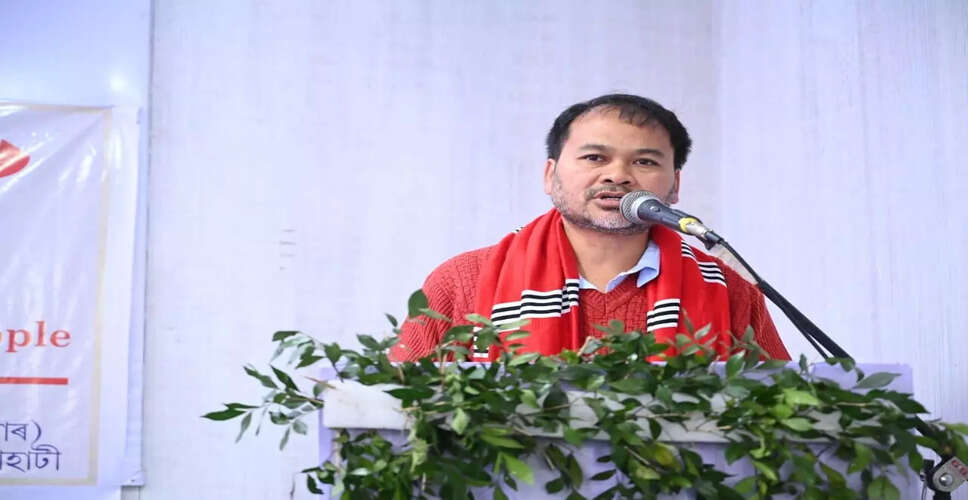
Akhil Gogoi's Political Journey
Guwahati, March 29: Akhil Gogoi's ascent in Assam's political landscape is noteworthy. His party, Raijor Dal, which initially secured just one seat in the 2021 Assembly elections, has now negotiated to obtain 13 seats in collaboration with the Congress, significantly altering the dynamics of the Opposition and complicating the National Democratic Alliance's (NDA) strategies in Sivasagar, where the BJP and AGP are engaged in a so-called 'friendly fight'.
Gogoi has consistently been in the spotlight, transitioning from leading protests for farmers and landless individuals to becoming a key electoral player.
Despite being expelled multiple times from the Assembly for his disruptive antics, he has emerged as a formidable voice for the Opposition on various critical issues. Just ahead of the 2026 elections, the Congress has finally allied with him after extensive negotiations.
Interestingly, he had previously been one of the most vocal critics of the Congress government.
Once recognized as the face of the Krishak Mukti Sangram Samiti, Gogoi gained prominence through anti-corruption initiatives, land rights movements, and sustained opposition to large dam projects. His transformation from activist to political leader was solidified during the anti-CAA protests in 2019, which led to his arrest under the UAPA. His subsequent electoral victory from Sivasagar in 2021, while incarcerated, demonstrated how 'protest politics' can effectively translate into electoral success.
Now, five years later, Gogoi is no longer a mere one-seat player. His influence in alliance negotiations extends beyond the 13 seats his party is contesting. Within the Opposition, he has established himself as both a mobilizer and a disruptor, maintaining an independent stance while being central to anti-BJP narratives.
Dr. Bakul Chandra Patar, an Associate Professor of Political Science at Sivasagar University, notes that the contest for Sivasagar has evolved into a triangular battle with the BJP's involvement. Gogoi appears to have an advantage over AGP's Prodip Hazarika, but the entry of BJP candidate Kushal Dowari has complicated the situation.
Kushal Dowari, also known as Jayanta Hazarika, is a former ULFA member who surrendered in 1991 and has previously represented the Thowra Assembly constituency twice.
Regarding Gogoi's tenure as an MLA, Patar remarked that while his vocal presence in the Assembly resonates with voters, the demand for improved educational and technical institutions in Sivasagar remains unmet.
'The BJP has established a robust organizational presence here, but Gogoi's appeal in minority-dominated areas and his loyal communist voter base make him a strong contender. Additionally, the conscious electorate and younger voters are dissatisfied with Dowari's candidacy, which could influence the election results,' he added.
Notably, CPI candidate Madan Baruah has withdrawn his nomination in support of Gogoi this time. Following delimitation, the constituency now has 2.09 lakh voters, with a majority of female voters.
The upcoming battle for Sivasagar is particularly intriguing as its outcome will serve as a referendum on whether Gogoi's political approach has evolved from grassroots movements into a sustainable electoral force, and whether his opponents, despite their divisions, can effectively counter him.
In the 2021 elections, Gogoi triumphed over BJP's Surabhi Rajkonwar by a margin of 11,875 votes, garnering over 46 percent of the more than 1.5 lakh votes cast. Historically, Sivasagar, once the capital of the powerful Ahoms and a stronghold of Assamese nationalism, has been a Congress bastion, with CPI influence following closely. The BJP and its ally AGP have struggled to gain traction in this prestigious constituency.
Beyond his dramatic presence in the Assembly, Gogoi's empathy towards minority communities has been highlighted by his opponents, who aim to portray him as a supporter of minority women in distress. This narrative has added a new dimension to his political persona. Raijor Dal has also nominated four minority candidates from Gauripur, Goalpara East, Dalgaon, and Dhing.
Additionally, he is attempting to broaden his influence by introducing new candidates, such as Dr. Gyanashree Bora from Mariani and Rahul Chhetri from Margherita.