
AASU Celebrates 60 Years of Constitution with Focus on Education and Indigenous Identity
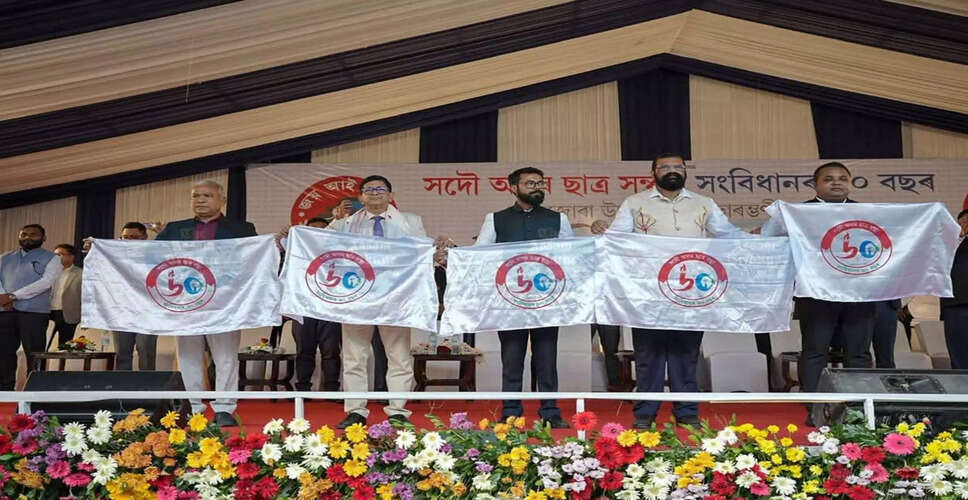

AASU's 60th Constitution Day Celebration
The convention, held for the first time in an open public setting, marked the 60th anniversary of the organisation’s Constitution.
Guwahati, Nov 23: The All Assam Students’ Union (AASU) utilized its Constitution Day event to express concerns regarding the education system in Assam, the diminishing use of the Assamese language, the safeguarding of indigenous identity, and the future direction of the organization, while reaffirming its commitment to regionalism and progress.
Over 1,000 representatives from AASU across Assam gathered at the Central Representatives’ Convention held at Arjun Bhogeswar Baruah Stadium in Sarusajai, Guwahati.
This convention, notable for being the first held in an open public venue, celebrated the 60th anniversary of the organization’s Constitution.
Samujjal Bhattacharya, the chief adviser of AASU, mentioned that the event was initially scheduled for August but had to be postponed due to flooding in Upper Assam.
“We will celebrate throughout the year at both grassroots and state levels. The organization seeks the support of the people as it strives for the future of students and the protection of indigenous communities,” he stated while addressing the attendees.
AASU president Utpal Sarma honored the organization’s martyrs and former members, acknowledging their contributions that have garnered AASU the affection of the public.
“This convention will address the future direction of the organization and the challenges it faces,” he noted, highlighting what he termed as increasing “conspiracies” against AASU.
Sarma reiterated AASU's dedication to a regionalist and progressive ideology, emphasizing that it does not align with any political party.
Regarding the Citizenship Amendment Act, Sarma confirmed that AASU's legal efforts are ongoing in the Supreme Court.
He also advocated for a re-verification of the National Register of Citizens and a Special Intensive Revision of electoral rolls to eliminate illegal Bangladeshi immigrants from voter lists, while discussions on constitutional protections for Assam continue.
The event featured the unveiling of AASU’s new logo by Dr. Jiten Hazarika, vice-chancellor of Dibrugarh University, and Dr. Hitesh Deka, vice-chancellor of Nagaon University. This logo will be prominently displayed on AASU banners and programs throughout the coming year.
Dr. Deka expressed concerns about the state of educational institutions, stating that those built by the community have, over the last decade, started to resemble “cremation grounds.”
He questioned the government's commitment to enhancing these institutions and urged AASU and other regional student organizations to take action to protect them.
Additionally, he called for the establishment of libraries in rural areas and expressed worry over the decreasing interest in education among rural populations.
Dr. Deka also highlighted the declining use of the Assamese language, cautioning that simply designating Assamese as a classical language would not suffice for its preservation.
Dr. Hazarika, a former AASU leader, advocated for research into students' weaknesses and emphasized the need for greater efforts to safeguard Assam’s cultural heritage.
While he regarded the National Education Policy as beneficial, he suggested that modifications might be necessary to better align with Assam’s specific needs. He also proposed workshops to assist Assamese-medium students in learning English and Hindi while maintaining their native language.